

Zoo Mesh Selection Checklist | ZooMesh
A zoo mesh selection checklist for buyers: grade, aperture, coating and supplier questions that prevent costly enclosure mistakes.
8/21/20266 min read
SUMMARY: This guide helps zoo facility managers, architects, and procurement professionals choose the right stainless steel cable mesh by walking through grade selection (304 vs. 316), aperture sizing by species, coating options, and critical supplier questions. You’ll learn how to avoid low-quality imports, specify mesh that lasts 30+ years, and prevent costly enclosure mistakes before they happen.
Introduction: Why You Need a Zoo Mesh Selection Checklist
Choosing stainless steel wire rope netting for a zoo enclosure is not a purchase—it’s an investment in animal safety, visitor experience, and long-term operational efficiency. The wrong specification can mean rust within five years, animal escapes, or a six-figure replacement project that could have been avoided.
Modern zoo enclosures have evolved far beyond iron bars and chain-link fences. Today’s standards demand barriers that are simultaneously invisible to visitors, safe for animals, and structurally secure against the most determined inhabitants—from chewing primates to charging big cats. Stainless steel rope mesh has emerged as the industry gold standard because it delivers exceptional tensile strength, corrosion resistance, and flexibility while maintaining near-total transparency.
But here’s the challenge: not all stainless steel mesh is created equal. The difference between a structure that lasts a decade and one that remains pristine for thirty years lies entirely in material science and engineering precision. This zoo mesh selection checklist breaks down exactly what you need to know—grade by grade, spec by spec, question by question.
For the full standard behind this spec, see the Stainless Steel Rope Mesh Guide core page.


Stainless Steel Grade Selection: 304 vs. 316
The single most consequential decision in specifying zoo mesh is choosing the correct stainless steel grade. Get this wrong, and you’re signing up for premature corrosion, costly maintenance, and potential safety failures.
AISI 304 Stainless Steel is the standard choice for most zoo applications. Composed of 18% chromium and 8% nickel, it offers good corrosion resistance for typical outdoor environments. For zoos in moderate climates away from coastal influence, 304 performs admirably and comes at a lower price point.
AISI 316 Stainless Steel adds 2% molybdenum to the alloy, which dramatically enhances resistance to pitting and chloride corrosion. This makes 316 the superior choice for coastal zoos, facilities near saltwater, or environments with high humidity and chemical exposure from cleaning agents and animal waste. Industry testing using ASTM B117 salt spray standards consistently demonstrates that 316-grade stainless steel lasts 5 to 10 times longer than 304-grade under saline conditions.
How to verify what you’re actually getting: Don’t rely on a supplier’s label alone. Always request Material Test Reports that confirm chromium (Cr) and nickel (Ni) content meets spec. Reputable suppliers will provide mill test certificates with full traceability.
Quick decision rule: If your zoo is within 10 miles of saltwater or uses aggressive chemical disinfectants, choose 316. For inland facilities with standard conditions, 304 will serve you well for decades.
For the related material question, Jaguar Enclosure Mesh Size for a Powerful Cat covers the other side of the spec.
Mesh Aperture: Matching Hole Size to Animal Species
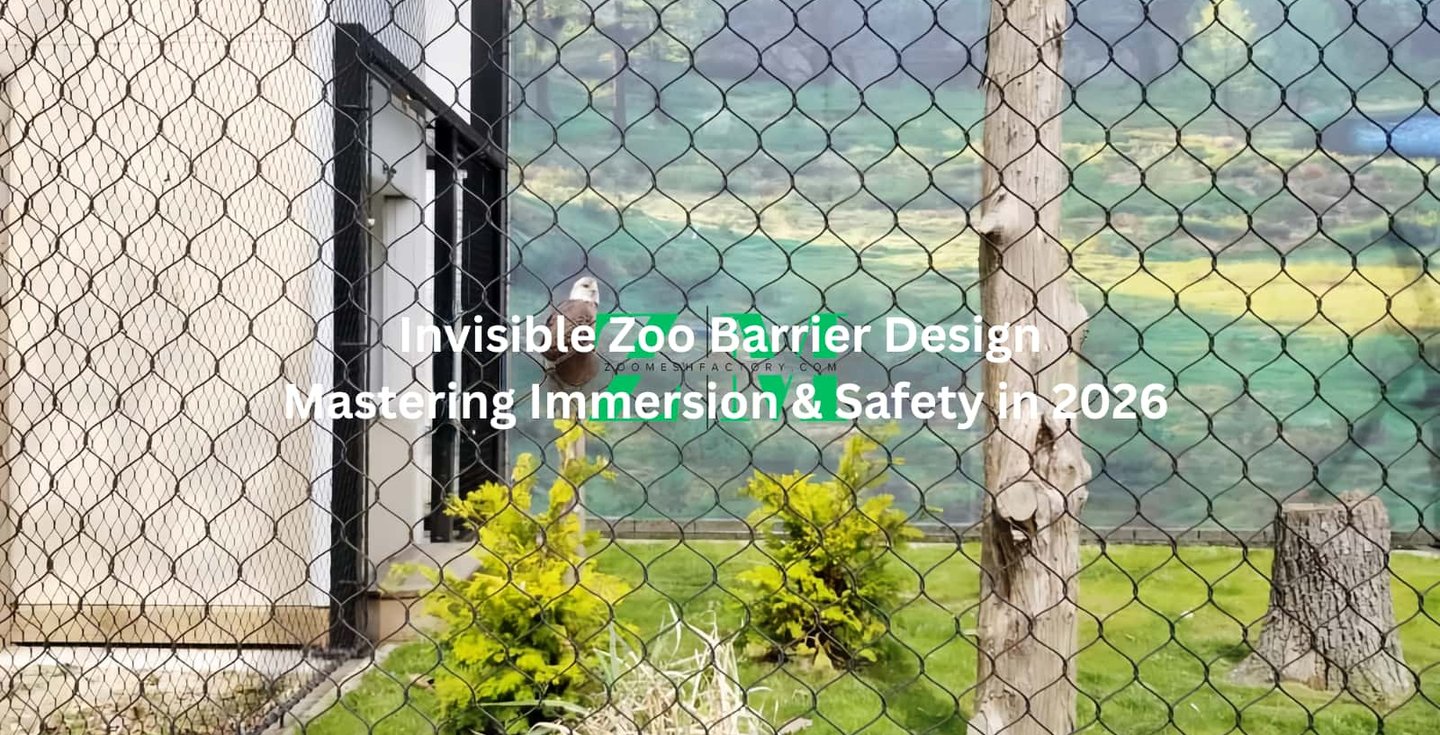
Mesh aperture—the size of the openings in the netting—is where many buyers make expensive mistakes. Choose apertures too small, and you’re overpaying for material you don’t need. Choose them too large, and you’re creating an escape risk.
The principle is simple: match the aperture to the smallest animal in the enclosure. Under the premise of ensuring functionality, select the largest mesh aperture to reduce project cost.
Here’s a practical aperture selection guide based on industry standards:
Why this matters: Aperture is inversely related to price—smaller holes require more processing and higher manufacturing costs. Specifying a 20mm aperture when 51mm would suffice can inflate your budget substantially.
Pro tip: For mixed-species exhibits, always size the aperture to the smallest animal. Predator enclosures like lions and tigers typically use 75mm apertures as an industry standard
Ferrule vs. Knotted: Understanding Connection Types
Two primary connection methods determine how the mesh holds together at intersections:
Ferrule (Swaged) Mesh: Intersections are secured by metal ferrules compressed under extreme hydraulic pressure—a process called swaging. This creates permanent, high-strength connections that resist animal pulling and biting.
Knotted Mesh: Cables are hand-knotted at intersections, offering greater overall flexibility but potentially allowing node slippage under sustained load.
Which to choose: For large carnivore exhibits and high-security applications, ferrule mesh provides superior node strength. For aviaries and exhibits where maximum flexibility is desired, knotted mesh may be appropriate. Always verify that ferrule material matches the cable grade (304 or 316) to prevent galvanic corrosion.
Coating Options: When and Why to Specify
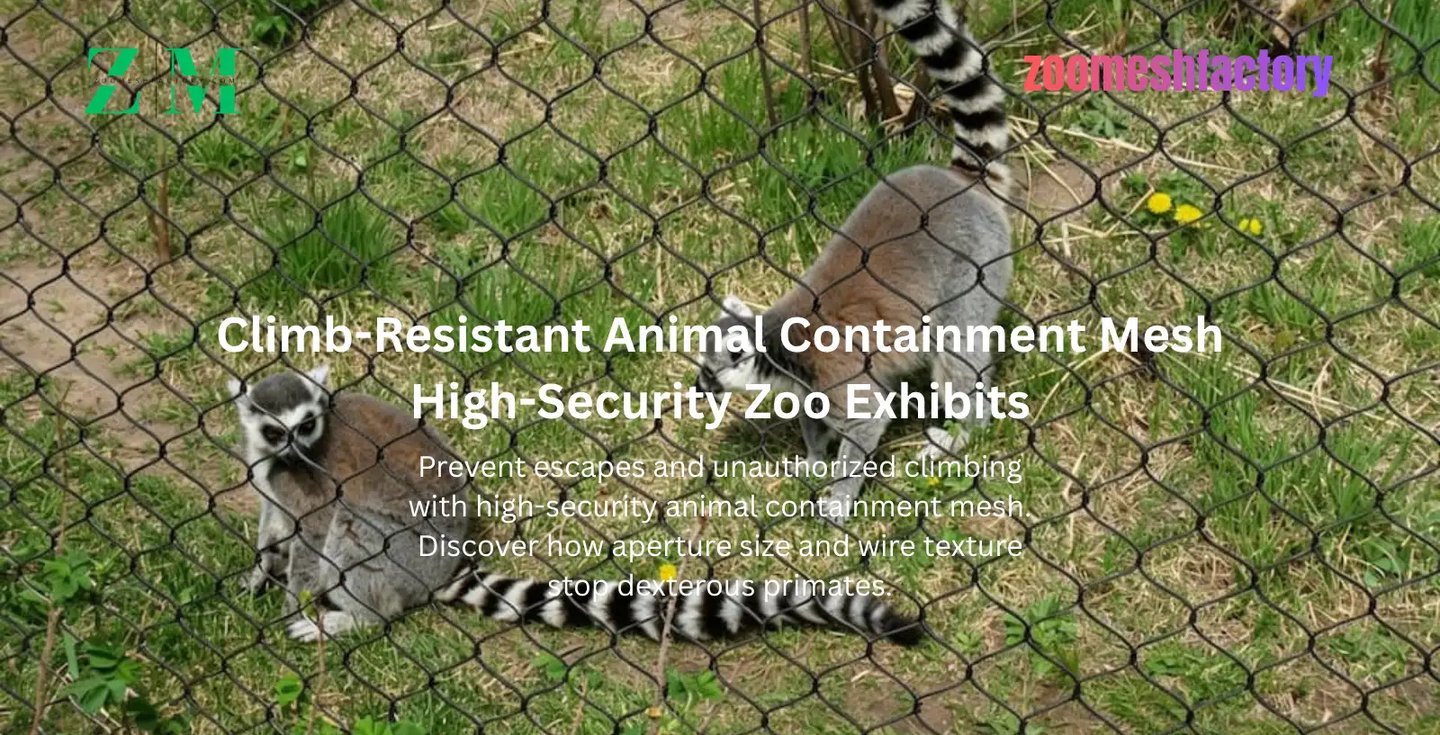
While stainless steel inherently resists corrosion, additional coatings can serve specific purposes:
Mill Finish (Uncoated): The standard option for most zoo applications. Provides natural stainless appearance and maximum corrosion resistance.
Black Oxide: Adds a colored layer (often black) that blends with natural surroundings. Black oxide can also provide extra protection in high-corrosion environments—316 stainless steel with black oxide is recommended for saltwater or waterfowl habitats due to superior chloride resistance.
When to coat: Consider black oxide for exhibits where visual integration with landscape is critical, or for facilities in extreme corrosive environments. Note that coating adds cost and may require periodic inspection for damage.
Supplier Selection: Questions You Must Ask
Not all suppliers deliver the same quality. Here’s your supplier vetting checklist:
“Can you provide material test reports confirming Cr and Ni content?” — Verify grade authenticity.
“What is your production capacity and lead time?” — Ensure the supplier can meet your project timeline.
“Can you provide references from similar zoo projects?” — Past performance in zoo applications is invaluable.
“Do you offer design and installation support?” — Suppliers with integrated design, production, and installation capabilities reduce coordination headaches.
“What quality inspections do you perform before shipping?” — Reputable suppliers conduct stringent inspections to ensure compliance with AISI 304, 316, 316L, and ISO standards.
Red flag: Suppliers who can’t or won’t provide material test reports. If they balk at documentation, walk away.
Cost Considerations: Price Per Square Metre
Zoo mesh pricing varies widely based on grade, aperture, cable diameter, and order volume. Based on current market data:
Volume pricing: Larger orders typically reduce per-square-metre costs. Quotes of $18–$22/m² are common for 1000+ square metre orders.
The real cost equation: While stainless steel mesh has a higher upfront cost than galvanized alternatives, its 30+ year lifespan eliminates the cycle of frequent repairs and costly replacements. Galvanized wire netting typically lasts only 5–10 years in harsh conditions. Over a 30-year horizon, stainless steel is actually the more economical choice.
Installation: What to Expect
Proper installation is as critical as material selection. Even the best mesh fails if installed incorrectly.
Standard installation process:
Unboxing and preparation: Inspect materials, unroll mesh, observe mesh direction and edge markings.
Positioning: Mark width and height of the net on the frame.
Corner fixing: Secure two opposite corners with temporary cable ties, then fix along the top edge.
Perimeter tensioning: Use perimeter ropes to pull mesh taut around the circumference, ensuring even tension.
Ferrule swaging: Thread perimeter rope ends through ferrules, pull taught, and swage with hydraulic tools.
Trimming: Cut excess mesh along edges only after securing—never cut before assembly.
Critical installation rule: Over-tensioning causes cables to snap or ferrules to deform; under-tensioning leads to sagging (“bellying”). Use calibrated ratchets or turnbuckles at each attachment point.


Maintenance: Set It and Forget It (Almost)
One of stainless steel mesh’s greatest advantages is minimal maintenance. Properly specified stainless steel rope mesh delivers a 30+ year service life with zero chemical maintenance, eliminating ongoing sandblasting, painting, or rust repair.
Routine maintenance checklist:
Annual washdown: Rinse with water and mild soap to remove dirt and debris.
Periodic inspections: Check ferrule integrity, cable ends, and tension.
Coastal facilities: Rinse periodically to prevent salt buildup.
Avoid harsh chemicals: Disinfectants that harm animals can also compromise metal.
What you won’t be doing: Sandblasting, painting, rust repair, or frequent replacement.
Zoo Mesh vs. Galvanized: The Comparison
Galvanized mesh is a classic example of “cheap becoming expensive”. The lower initial price tag is deceptive when you factor in the replacement and maintenance costs over decades.
Key Takeaways
Choose 316 stainless steel for coastal zoos or high-corrosion environments; 304 is sufficient for most inland facilities.
Match aperture to the smallest animal in the enclosure—don’t over-specify or under-specify.
7×19 cable construction offers superior flexibility and strength for large predator exhibits.
Ferrule (swaged) connections provide maximum node strength for high-security applications.
Always request material test reports—never rely on supplier labels alone.
PVC coating can enhance corrosion resistance and visual integration in specific settings.
Stainless steel costs more upfront but delivers lower total ownership cost over 30 years compared to galvanized.
Proper installation is as important as material selection—use calibrated tensioning tools.
Maintenance is minimal—annual rinsing and periodic inspections are typically sufficient.
Vet suppliers thoroughly—ask about certifications, references, and quality control processes.
For the full standard behind this spec, see the Stainless Steel Rope Mesh Guide core page.
Frequently Asked Questions
Q: What size zoo mesh do I need for a tiger enclosure?
A: Tiger enclosures typically require 51mm × 51mm to 76mm × 76mm aperture with 4.0–6.0mm cable diameter in 316 stainless steel for maximum corrosion resistance and strength.
Q: How much does stainless steel zoo mesh cost per square metre?
A: Prices range from approximately $8–$26/m² for 304 grade and $40–$55/m² for 316 grade, depending on aperture, cable diameter, and order volume.
Q: Can I install zoo mesh myself, or do I need professional installation?
A: While DIY installation is possible for smaller projects, professional installation is strongly recommended for zoo enclosures. Proper tensioning, ferrule swaging, and edge termination require specialized tools and expertise.
Q: How long does stainless steel zoo mesh last?
A: Properly specified stainless steel rope mesh delivers a 30+ year service life with zero chemical maintenance. 316 grade in coastal environments significantly outperforms 304 under saline conditions.
Q: What’s the difference between zoo mesh and regular wire fencing?
A: Zoo mesh is hand-woven from multi-strand stainless steel cables (7×7 or 7×19 construction) that absorb impact and return to shape, unlike rigid welded wire that deforms permanently. It also offers superior corrosion resistance, transparency, and animal safety.
External Reference
World Association of Zoos and Aquariums — authoritative husbandry and conservation guidance for zoo mesh.
Ready to Start Your Exhibit Design?
Join the hundreds of zoos and sanctuaries worldwide that trust ZooMesh Factory for their containment needs. Our engineers are ready to help you calculate the perfect mesh size for your species.
Contact
Hebei Zoo Mesh Co., Ltd
No. 188 Zhonghua South Street, Shijiazhuang City, Hebei Province, China
info@zoomeshfactory.com
© 2025. All rights reserved.
Quick Link
Product Catalogs
Don't leave without the specs! Save our factory-direct pricing and technical configurations for your next project meeting. Our 2026 Zoo Mesh Factory Direct Catalog is ready for download.