
The Ultimate Guide to Stainless Steel Zoo Mesh: Design, Safety & ROI
Master modern exhibit design with our guide to stainless steel zoo mesh: material science (SS304 vs SS316), invisible black oxide finishes, and long-term ROI
2/27/202613 min read
Introduction – The Evolution of Containment
The history of zoological design is a journey from the "Menagerie" to the "Habitat." In the early 20th century, animal containment was defined by cold iron bars and heavy concrete walls. These structures were designed for one purpose: absolute security. However, they failed both the animals—who suffered from high stress and restricted movement—and the visitors, who viewed the natural world through a heavy, industrial filter.
Today, the global standard has shifted toward Immersion Design. Modern zoos aim to create seamless, naturalistic ecosystems where the boundaries between the human and animal worlds virtually disappear. To achieve this, architects and curators have moved away from rigid fencing in favor of stainless steel zoo mesh.
As a high-tensile, flexible textile, stainless steel wire rope mesh offers a unique "soft-security" solution. It is strong enough to contain a Siberian Tiger yet fine enough to allow a hummingbird to feel the breeze. In this guide, we will explore why this material has become the foundation of modern wildlife conservation and how it balances the complex demands of safety, aesthetics, and long-term financial return.
Key Takeaways (The Quick-Reference Section)
For those in the planning and procurement phases, here is a summary of why stainless steel mesh is the preferred architectural choice for 2026.
Exceptional Longevity: Utilizing AISI 304 or 316 grade steel, our mesh offers a 30-50 year service life, even in harsh coastal or high-humidity tropical environments.
Maximum Transparency: With an open area ratio of up to 90-95%, it provides an "invisible" barrier that enhances visitor engagement and professional photography.
Species-Specific Safety: The flexible, spring-like nature of hand-woven metal fabric absorbs kinetic energy, preventing injury to animals during sudden impacts.
Superior ROI: While the initial investment is higher than galvanized steel, the Total Cost of Ownership (TCO) is significantly lower due to zero maintenance, no rust treatments, and no replacement needs.
Eco-Friendly & Non-Toxic: Stainless steel is 100% recyclable and biologically inert. Unlike PVC-coated wires, it will not peel or leach toxins into the exhibit soil.
Customizable Engineering: Available in wire diameters from $1.2\text{mm}$ to $4.0\text{mm}$ and custom aperture sizes to meet the specific "break-strength" requirements of any species.
Material Science – SS304 vs. SS316
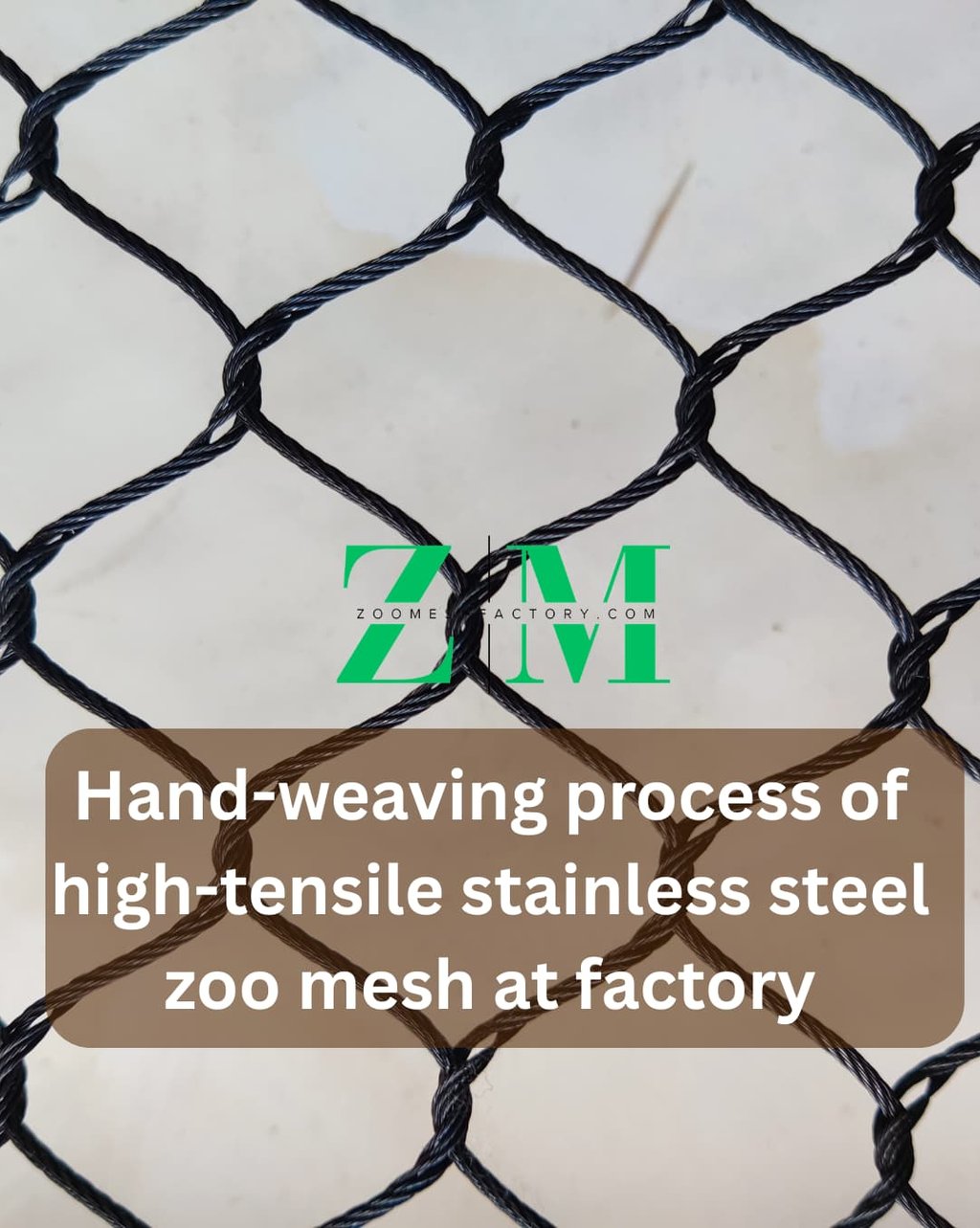
When specifying stainless steel zoo mesh, the most critical decision an architect makes isn't the mesh size—it’s the chemical composition of the steel. While both Grade 304 and Grade 316 appear identical to the naked eye, their performance in the field over a 20-year period is vastly different.
The Chemical Difference: Why Molybdenum Matters
The primary difference between these two grades lies in a single element: Molybdenum.
Grade 304 (The Standard): Contains approximately 18% chromium and 8% nickel. It offers excellent corrosion resistance for most inland environments.
Grade 316 (The Marine Grade): Contains 16%chromium, 10% nickel, and 2% molybdenum. That 2% molybdenum is the "secret weapon" against chloride-induced corrosion (pitting).
Environment Matching: Where to Use Which Grade
Choosing the wrong material can lead to "tea-staining" (surface rust) within months, which ruins the "invisible" aesthetic of a modern exhibit.
Inland & Dry Climates (Use SS304):
For zoos located far from the ocean and in regions with low pollution, SS304 provides more than enough protection. It is the cost-effective choice for indoor aviaries or mountain-region habitats.
Coastal & High-Humidity Zones (Use SS316):
If your facility is within 10km of the coast, SS316 is non-negotiable. The salt air acts as an electrolyte that aggressively attacks 304-grade steel. For more details on protecting coastal exhibits, read our guide on SS304 vs SS316 Mesh Grades.
High-Pollution Urban Areas (Use SS316):
In major cities, smog and traffic exhaust can create acidic rainwater. The added molybdenum in Grade 316 protects the mesh from the sulfurous compounds found in urban rain.
Mechanical Strength and Durability
From a structural standpoint, both grades offer nearly identical tensile strength. However, the long-term integrity of the mesh depends on its resistance to corrosion. Once pitting begins, the individual wire strands (7 x 7 or 7 x 19 construction) can weaken, compromising the safety of the entire enclosure.
A Note on "Black Oxide" and Material Grade
Many clients ask if the Black Oxide finish replaces the need for high-grade steel. The answer is no. Black oxide is a surface conversion, but the core material must still be appropriate for the environment. In fact, applying Black Oxide to SS316 is the "Gold Standard" for modern zoo architecture, providing the ultimate combination of invisibility and permanent rust protection.
Safety Engineering – Protecting the Animals
In the world of wildlife conservation, "security" is often defined by what stays in the enclosure. However, at ZooMesh Factory, we define safety by what happens when the animal makes contact with the barrier. Traditional fencing materials like welded wire or chain link are rigid and unyielding; they act as a "wall." Stainless steel zoo mesh, however, is engineered as a "membrane."
The "Catcher’s Mitt" Effect: Kinetic Energy Absorption
One of the most dangerous moments for a captive animal—particularly high-energy species like leopards or gibbons—is a high-speed impact with a perimeter wall.
The Physics: Because our mesh is composed of flexible 7 x 7 or 7 x 19 wire ropes, it possesses inherent elasticity. When an animal strikes the mesh, the diamonds "give" slightly, absorbing the kinetic energy and distributing the load across the entire panel.
The Result: This significantly reduces the risk of blunt-force trauma, broken bones, or internal injuries compared to a rigid cage wall.
The Elimination of "Beak-Trapping" and Abrasions
For avian species and primates, the fine details of the mesh construction are a matter of life and death.
Hand-Woven vs. Ferruled: In ferruled mesh, the metal sleeves can develop sharp edges over time. Our hand-woven stainless steel mesh is knotted without hardware, ensuring a smooth surface that won't snag feathers or cut sensitive paw pads.
Aperture Precision: We customize the diamond size to ensure it is either too small for a beak to enter or large enough for a limb to move through freely. This prevents "entrapment" injuries, a leading cause of stress in captive raptors and parrots.
Biocompatibility: Non-Toxic and Lead-Free
Animals explore their world with their mouths. Primates climb with their teeth, and birds constantly "beak" their environment.
The Danger of Coatings: Galvanized steel or PVC-coated wires can flake or "off-gas" under intense UV exposure. Ingesting these flakes can lead to heavy metal poisoning.
The Stainless Advantage: Stainless steel is biologically inert. It requires no toxic anti-rust treatments and does not leach chemicals into the habitat. This is why hand-woven mesh is the safest choice for primate exhibits globally.
Psychological Safety: Visual Freedom
Safety isn't just physical; it’s also psychological. An animal that feels "trapped" behind heavy bars displays higher cortisol (stress) levels and stereotypical behaviors (like pacing). The 95%+ transparency of stainless steel mesh provides a "boundary-less" feel. This visual connection to the surrounding environment is a key pillar of modern zoo exhibit design, promoting natural behaviors and longer lifespans for the animals in your care.
Architectural Aesthetics – The Quest for Invisibility
In modern zoological architecture, the highest compliment a visitor can pay to an enclosure is that they "didn't even notice it was there." This is the "Quest for Invisibility." Achieving this effect requires more than just thin wire; it requires a sophisticated understanding of how the human eye perceives light, color, and depth.
The Science of Visual Transparency
Transparency in stainless steel zoo mesh is a result of the "Open Area Ratio." While a glass wall is 100% transparent, it creates a physical barrier to sound and air and produces high-intensity reflections. Woven mesh, conversely, allows for the passage of the elements while maintaining a visual "openness" of over 95%.
By utilizing ultra-thin 1.2mm or 1.6mm cables, architects can create a containment system that the human brain eventually "ignores." When a visitor focuses on a moving animal 5 to 10 meters away, the mesh in the foreground falls out of the eye's focal plane, becoming a soft, blurred texture rather than a solid wall.
The "Vanishing" Power of Black Oxide
The greatest enemy of invisibility is glare. Natural stainless steel, while durable, reflects sunlight. This "shimmer" acts as a visual signal to the brain that a barrier is present. To solve this, leading designers specify a Black Oxide finish.
Light Absorption: Unlike paint, which sits on top of the wire, Black Oxide is a chemical conversion that turns the steel a deep, matte charcoal. This surface absorbs light rather than reflecting it.
Natural Camouflage: In a lush, green exhibit, a black mesh disappears into the shadows of the foliage. This allows the vibrant colors of tropical birds or primates to pop, creating a high-definition viewing experience.
Architectural Whitepaper: For a deeper technical dive into light refraction, read our full report: Designing for Invisibility in Modern Zoos.
Organic Geometry: Breaking the Square
Traditional fencing is limited to flat planes and 90-degree angles. Stainless steel zoo mesh functions as a structural fabric. Because it is hand-woven and flexible, it can be draped over organic shapes like:
Spherical Domes: Creating "open-air" flight paths for raptors.
Flowing Canopy Trails: Allowing primates to travel above visitor paths in a continuous, mesh-wrapped "tunnel."
Tapered Enclosures: Avoiding the "box" look by following the natural topography of the land.
Enhancing the Visitor Experience
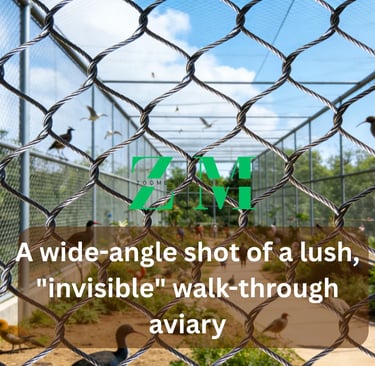
When the barrier is "invisible," the psychological barrier between the human and nature is removed. This immersion is the primary driver of ticket sales and member retention for modern facilities. By choosing a mesh that prioritizes aesthetics without sacrificing strength, zoos can create "Instagrammable" moments where the animals look as if they are standing in the wild, not behind a fence. This design philosophy is at the heart of every modern zoo exhibit project we support.
Installation & Engineering Requirements
A world-class stainless steel zoo mesh enclosure is only as good as its installation. Because this material is a flexible "fabric" rather than a rigid panel, it requires specific engineering protocols to ensure it remains both "invisible" and structurally sound for its 30-year lifespan.
1. The Importance of Professional Tensioning
The "magic" of wire rope mesh—its transparency and strength—depends entirely on tension. A mesh that is installed loosely will sag, vibrate in the wind, and become highly visible to the eye.
Pre-stressing: During installation, the mesh must be pulled to a specific "pre-stress" load. This ensures that the diamond apertures remain consistent and that the panel can handle external forces like animal impact or snow loads without deforming.
The "Drum-Tight" Goal: A correctly tensioned panel should feel as firm as a drum head. For a step-by-step technical breakdown, refer to our Professional Guide on How to Tension Mesh.
2. Boundary Cable Integration
Unlike chain-link, which is often stapled to wooden posts, high-tensile zoo mesh is typically secured to a Boundary Cable.
The Frame: A thick 6mm to 10mm stainless steel cable is run along the perimeter of the enclosure frame.
The Lacing: The mesh is then "stitched" to this boundary cable using a specialized lacing wire. This method allows the loads to be distributed evenly across the structural steel, preventing "stress points" that could lead to wire breakage.
3. Static and Dynamic Load Calculations
When designing for large species, engineers must calculate two types of loads:
Static Loads: The weight of the mesh itself plus environmental factors like ice or wind.
Dynamic Loads: The sudden force of an animal jumping or flying into the mesh.
For apex predators, we recommend a wire diameter of at least 3.2mm. You can see how these heavy-duty specs are applied in our Animal Enclosure Product Gallery.
4. Seaming and Joining Large Panels
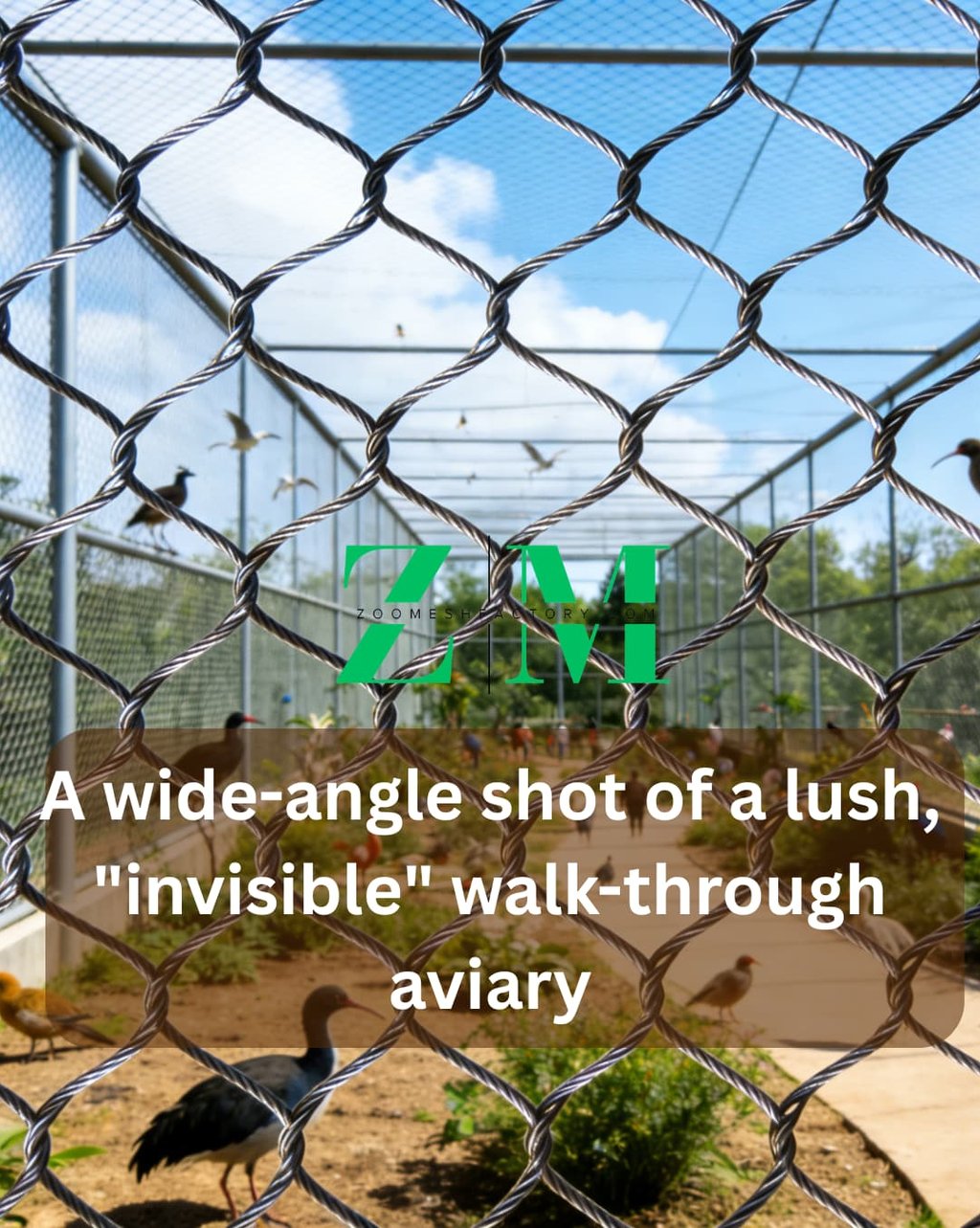
For massive structures like walk-through aviaries, the mesh is often delivered in multiple large sections.
Seamless Joining: Our factory-trained installers use a "diamond-to-diamond" weaving technique to join these panels. When done correctly, the seam is completely invisible to the visitor, maintaining the "immersion" effect of the habitat.
5. Hardware Compatibility
To prevent Galvanic Corrosion, every nut, bolt, and lacing wire used in the installation must match the grade of the mesh. If you are using SS316 mesh, you must use SS316 hardware. Mixing metals can lead to rapid rusting at the connection points, compromising the security of the exhibit. This is a critical factor we cover in our analysis of SS304 vs. SS316 Mesh Grades.
Cost Analysis – The ROI of Stainless Steel
For procurement officers and zoo boards, the primary hurdle in selecting stainless steel zoo mesh is the initial capital expenditure. It is undeniably more expensive upfront than galvanized chain-link or plastic-coated netting. However, a professional Total Cost of Ownership (TCO) analysis reveals that stainless steel is actually the most economical choice over a 10-year period.
1. Initial Investment vs. Life-Cycle Cost
While galvanized steel may cost 30%-50% less on day one, its "economic life" is significantly shorter. In a typical zoo environment, galvanized materials begin to show structural rust within 5 to 7 years.
The "Hidden" Cost of Replacement: Replacing an enclosure involves more than just the cost of new wire. It includes the cost of animal relocation, specialized labor, and—most importantly—lost ticket revenue from a closed exhibit.
The Stainless Advantage: A single installation of SS316 marine-grade mesh can last upwards of 40 years, effectively eliminating the need for a "re-build" budget for a generation.
2. Zero-Maintenance Savings
Maintenance labor is one of the highest recurring costs for any modern zoo.
No Coatings: Traditional fences often require periodic painting or anti-rust treatments. These treatments are not only expensive but can be toxic to the animals.
Cleaning: Because stainless steel is chemically inert, it does not "trap" grime or oxidation. A simple pressure wash is usually all that is required to maintain the "invisible" look discussed in our Architectural Design Guide.
3. The "Visitor Value" Multiplier
Aesthetics have a direct impact on a zoo’s bottom line.
Social Media & Marketing: In the age of Instagram and TikTok, visitors want high-clarity photos. Exhibits using "invisible" black oxide mesh produce better photos, leading to more organic social media promotion and higher visitor footfall.
Higher Membership Retention: Surveys consistently show that visitors stay longer and renew memberships more frequently at zoos that prioritize "immersion" over traditional "caging."
4. Reducing Veterinary Liabilities
An often-overlooked ROI factor is the reduction in medical costs. As explored in our section on Safety Engineering for Primates, the elastic nature of hand-woven mesh prevents the "wire-bite" and impact injuries common with rigid fencing. Reducing the frequency of specialized veterinary interventions for a single high-value animal can save the zoo thousands of dollars in a single year.
5. ROI Comparison Table
Conclusion: Making the Sustainable Choice
By choosing stainless steel zoo mesh, you are choosing a permanent solution. You are investing in the safety of your animals, the satisfaction of your visitors, and the long-term financial health of your institution. At ZooMesh Factory, we provide the engineering data and material certifications needed to help your board make this profitable decision with confidence.
Species-Specific Recommendations
Selecting the right stainless steel zoo mesh is not a "one-size-fits-all" process. The requirements for a $50\text{g}$ finch are fundamentally different from those of a 250kg Bengal Tiger. To maximize both visibility and security, architects must match the wire diameter and aperture size to the specific biology and behavior of the species.
1. The Aviary: Precision for Flight and Beaks
For birds, the primary concerns are weight and "beak-trapping."
Recommended Spec: 1.2mm to 1.6mm wire diameter.
Aperture: 20mm x 20mm to 50mm x 50mm
The Logic: Light-gauge wire is essential for large-span structures like walk-through aviaries. For smaller psittacines (parrots), a smaller aperture is required to prevent them from wedging their beaks into the mesh, while raptors require high-tensile strength to withstand high-speed flight impacts.
Case Study: See how we achieved 98% transparency in our Alpine Aviary Project.
2. Primates: Dexterity and Climbing Strength
Primates are the most "interactive" species; they climb, pull, and examine every knot of the mesh with their fingers and teeth.
Recommended Spec: 1.5mm to 2.4mm wire diameter.
Aperture: 38mm x 38mm to 76mm x 76mm
The Logic: Hand-woven mesh is vital here because it lacks the sharp ferrules that can cut sensitive finger pads. The 7 x 7 cable construction provides a "grip" that feels natural for climbing species.
Safety Link: Read more on why hand-woven mesh is the safest choice for primates.
3. Large Carnivores: High-Security Containment
For apex predators, the mesh is the only thing standing between a powerful hunter and the public. Strength is the only metric that matters.
Recommended Spec: 3.2mm wire diameter.
Aperture: 50mm x 50mm to 100mm x 100mm
The Logic: We utilize 7 x 19 cable construction for predators, which offers a higher breaking load than standard cables. Despite the thickness, the high-tensile steel allows us to keep the aperture large, maintaining excellent visibility for visitors.
Products: View our heavy-duty predator enclosure specifications.
4. Small Mammals and Reptiles: Fine Detail
For species like lemurs, red pandas, or even large reptiles, the mesh must act as a barrier to smaller pests (like rats) while keeping the inhabitants secure.
Recommended Spec:1.2mm to 1.6mm wire diameter.
Aperture: 25mm x 25mm
The Logic: A smaller diamond size ensures that no "unwanted guests" enter the exhibit to steal food or spread disease, while the fine wire maintains the "invisible" look essential for these often-photographed smaller animals.
Summary Table: Species-to-Mesh Mapping
Conclusion – Partnering with a Factory-Direct Manufacturer
The transition from traditional, heavy-iron containment to the "invisible" world of stainless steel zoo mesh represents a significant leap forward in animal welfare and architectural beauty. As we have explored in this guide, achieving the perfect balance of safety, aesthetics, and long-term ROI requires more than just buying wire—it requires a partner who understands the material science, the engineering loads, and the biological needs of the animals.
The ZooMesh Factory Advantage
By working directly with a specialized zoo mesh manufacturer, architects and zoo directors gain three critical advantages:
Direct Quality Control: From the selection of AISI 316 wire rope to the final hand-weaving of the knots, every square meter of mesh is inspected to meet international safety standards.
Customization at Scale: Whether you need a unique 1.2mm black oxide mesh for a walk-through aviary or 3.2mm high-security panels for a tiger habitat, factory-direct sourcing allows for bespoke aperture sizes and dimensions that third-party retailers cannot offer.
Engineering Support: We don't just ship rolls of mesh; we provide the technical data sheets, load-bearing calculations, and tensioning protocols necessary for a successful installation.
Designing for the Next Generation
The enclosures built today will be the legacy of your facility for the next 30 to 50 years. Choosing a sustainable, non-toxic, and virtually indestructible material like stainless steel ensures that your investment remains as safe and beautiful in 2070 as it is on opening day.
As the world’s leading zoos continue to push the boundaries of immersive exhibit design, ZooMesh Factory remains committed to providing the "invisible" foundations that make these experiences possible.
Ready to Begin Your Project?
The engineering team at ZooMesh Factory is ready to assist you with material selection and technical specifications. Whether you are in the initial concept phase or ready for a construction quote, we are here to help.
Request a Technical Quote: [Contact Our Engineering Team]
Download Our Catalog: [View Full Product Specs]
View Recent Work: Explore Our Global Project Gallery
List of Resources
If you want professional optical solutions for glare-free invisible zoo barriers, read our invisible zoo barrier design guide.
New buyers can start with our beginner-friendly zoo fencing guide to grasp basic enclosure selection logic.
Avoid low-quality mesh procurement traps by reading our guide on choosing high-quality zoo netting.
For eco-friendly, recyclable enclosure material analysis, view our sustainable zoo enclosure materials guide.
Check transparent factory rates via our wholesale zoo netting price per square meter breakdown.
For salt-air resistant marine mesh solutions, read our coastal grade SS316 zoo netting guide.
Cut middleman markup with our cost-effective zoo netting factory direct buying guide.
Learn optical physics for immersive exhibits in designing for invisibility modern zoo exhibits.
View deep metallurgy and tensile data in our SS316 marine grade zoo mesh technical guide.
Match diamond openings to animal species with our custom aperture rope netting guide.
Learn non-toxic, animal-safe mesh standards from our bio-neutral wildlife mesh guide.
For curved, domed and irregular habitat frames, read our custom hand-woven cable mesh guide.
Calculate 20-year total ownership cost via stainless steel vs galvanized zoo netting analysis.
Ready to Start Your Exhibit Design?
Join the hundreds of zoos and sanctuaries worldwide that trust ZooMesh Factory for their containment needs. Our engineers are ready to help you calculate the perfect mesh size for your species.
Contact
Hebei Zoo Mesh Co., Ltd
No. 188 Zhonghua South Street, Shijiazhuang City, Hebei Province, China
info@zoomeshfactory.com
© 2025. All rights reserved.
Quick Link
Product Catalogs
Don't leave without the specs! Save our factory-direct pricing and technical configurations for your next project meeting. Our 2026 Zoo Mesh Factory Direct Catalog is ready for download.