
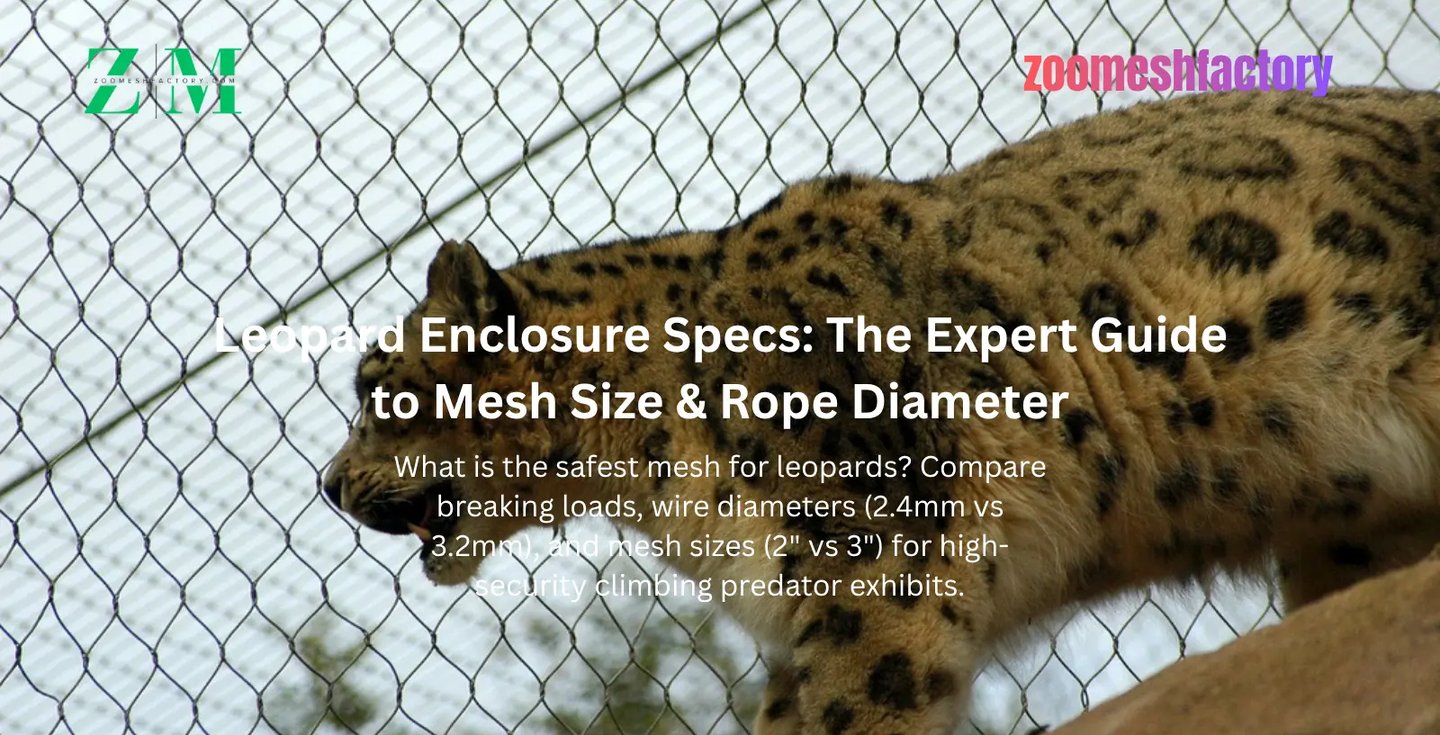
Leopard Enclosure Specs: The Expert Guide to Mesh Size & Rope Diameter
What is the safest mesh for leopards? Compare breaking loads, wire diameters (2.4mm vs 3.2mm), and mesh sizes (2" vs 3") for high-security climbing predator exhibits.
Hebei Zoo Mesh Co., Ltd
5/25/20269 min read
For leopard enclosure safety, the 2026 industry standard for primary containment is 3.2mm (1/8") diameter stainless steel cable mesh with a 51mm to 76mm (2" to 3") aperture. Because leopards are elite climbers and exert high-impact forces during lunges, the mesh must have a minimum breaking load of 1,600 lbs (7.12 kN). Handwoven mesh is preferred over rigid alternatives as it provides "give" to prevent animal injury while resisting the sharp claws and high bite force (approx. 310 psi) of large felids.
Key Takeaways
Standard Spec: 3.2mm wire / 3" mesh is the "sweet spot" for strength and visitor visibility.
Climbing Prevention: Use 45° inward overhangs with handwoven mesh to negate the leopard’s climbing advantage.
Material Choice: SS316 is mandatory for coastal zoos; SS304 is sufficient for inland habitats.
Safety First: Hand-knotted mesh eliminates the sharp burrs found in machine-cut welded wire, protecting expensive animal coats.
I. The Physics of Leopard Containment: Beyond the Strength of Lions
When designing a "zoo fence," many people mistakenly believe that if it can hold a lion, it can hold a leopard. From a physics and behavioral standpoint, this is a dangerous assumption. Leopards present a unique set of variables that demand a much more sophisticated mesh solution.
Why Leopards are the Ultimate Escape Artists
Unlike lions, who are primarily terrestrial, leopards are arboreal masters. Their climbing ability is unparalleled among large felids.
Vertical Agility: A leopard can carry a carcass twice its own weight up a vertical tree trunk. In a captive environment, they treat traditional fencing like a ladder.
Explosive Agility: Leopards possess a higher power-to-weight ratio than lions. Their ability to twist, turn, and lunge from a stationary position means they apply force in unpredictable directions—upward, downward, and laterally—putting immense stress on mesh joins.
Understanding "Impact Energy"
Let's talk numbers. When a 150lb (68kg) leopard hits a mesh barrier at a sprinting speed of 30mph (48km/h), the fence must absorb a massive burst of kinetic energy.
If the fence is rigid (like welded wire), that energy has nowhere to go. It snaps the welds or creates a "permanent set" (a dent). However, Zoo Mesh Factory’s handwoven cable mesh is designed to be elastic. When the cat hits the mesh, the interwoven diamond structure deflects, converting the impact into potential energy and spreading the force across dozens of neighboring cables. This "soft catch" protects the leopard from skeletal injury while ensuring the barrier remains intact.
To learn anti-escape mesh geometry designed for agile big cats and intelligent primates, check our climb-resistant high security containment mesh resource.
II. Breaking Down the Specs: Wire Diameter (d)
In the world of stainless steel rope mesh, the wire diameter (d) is the most critical factor in determining the Minimum Breaking Load (MBL). Choosing the right thickness is a balance between absolute security and visual transparency.
2.4mm (3/32"): Precision for Smaller Predators
The 2.4mm cable is the "surgical tool" of zoo fencing. It offers incredible visibility—virtually disappearing from 10 meters away—while maintaining significant strength.
Best Use Cases: Secondary containment barriers, roof netting for large habitats, or primary containment for medium-sized cats like Lynx, Serval, or Caracals.
The Benefit: It’s lighter and easier to install on high-tension frames where weight is a concern.
3.2mm (1/8"): The "Gold Standard" for Big Cats
For Leopards, Jaguars, and Snow Leopards, 3.2mm is the non-negotiable industry standard for 2026.
Tensile Dominance: Our 3.2mm 7x19 construction cable provides the heavy-duty resistance required to stop a full-grown Jaguar’s lunge. It is thick enough to resist the persistent "picking" and biting behaviors common in highly intelligent predators.
Durability: The extra mass of the 3.2mm wire provides a higher "wear life," ensuring that even after years of environmental exposure and animal interaction, the structural integrity remains well above safety margins.
Expert Insight: Never compromise on the diameter for a primary perimeter. A 2.4mm wire might look better, but for a 150lb cat with a 310 psi bite force, 3.2mm is the only choice that offers true peace of mind.
Technical Resource: Don't leave your safety to chance. View our spec sheets for animal enclosure mesh to compare the breaking loads and weights for every cable diameter we manufacture. While 3.2mm is our gold standard for leopards, smaller bird species thrive in our lighter 1.2mm to 2.0mm ranges.
III. Selecting the Mesh Aperture: The Geometry of Safety
In leopard containment, the "aperture" or opening size is just as vital as the wire thickness. The goal is to create a mesh that is too small for a paw to penetrate but large enough to provide an immersive viewing experience.
2" x 2" (51mm): The Nursery and High-Security Standard
For enclosures housing leopard cubs, or for specific "hot zones" where the cats are in close proximity to keepers or visitors, the 51mm aperture is the industry benchmark.
Entrapment Prevention: A 2-inch opening ensures that even a small cub cannot get its head or limbs stuck in the mesh.
Claw Resistance: It limits the animal's ability to get a full "grip" on the wire, which reduces the leverage they can use to pull or shake the barrier.
3" x 3" (76mm): The Adult Exhibit Sweet Spot
For main display areas, the 76mm aperture is the favorite among zoo designers.
Optimal Transparency: It offers a significant increase in visibility compared to the 2" mesh, allowing the cat’s coat patterns to be seen clearly without visual distortion.
Tensile Efficiency: Despite the larger opening, the 3.2mm cable maintains a massive breaking load, making it more than sufficient for adult leopards and jaguars.
Why "Handwoven" Beats "Ferruled" for Climbing Predators
Many suppliers offer ferruled mesh (where cables are joined by metal sleeves). However, for climbing predators, Handwoven Mesh is the superior choice for two reasons:
Flexibility vs. Rigidity: Ferruled mesh is rigid. When a leopard climbs it, the stress is concentrated on the ferrules, which can eventually crack or slide. Handwoven mesh is supple; it moves with the animal, dissipating the stress.
Paw Safety: Ferrules have edges. A fast-moving cat can scrape its pads on these metal sleeves. Handwoven mesh is a continuous "knotless" weave, providing a smooth surface that protects the animal’s paws.
For tiger exhibits, the dynamic forces of a charging predator demand a heavier gauge than standard leopard enclosures – that’s why we’ve dedicated an entire resource to the 3.2mm heavy cable mesh for tiger impact resistance, covering tensile ratings, installation, and long-term cost analysis.
If you want a full cost & lifespan comparison between stainless cable mesh and traditional chain link for tiger habitats, read our tiger enclosure guide.
IV. Engineering for the "Climb": Outsmarting Agility
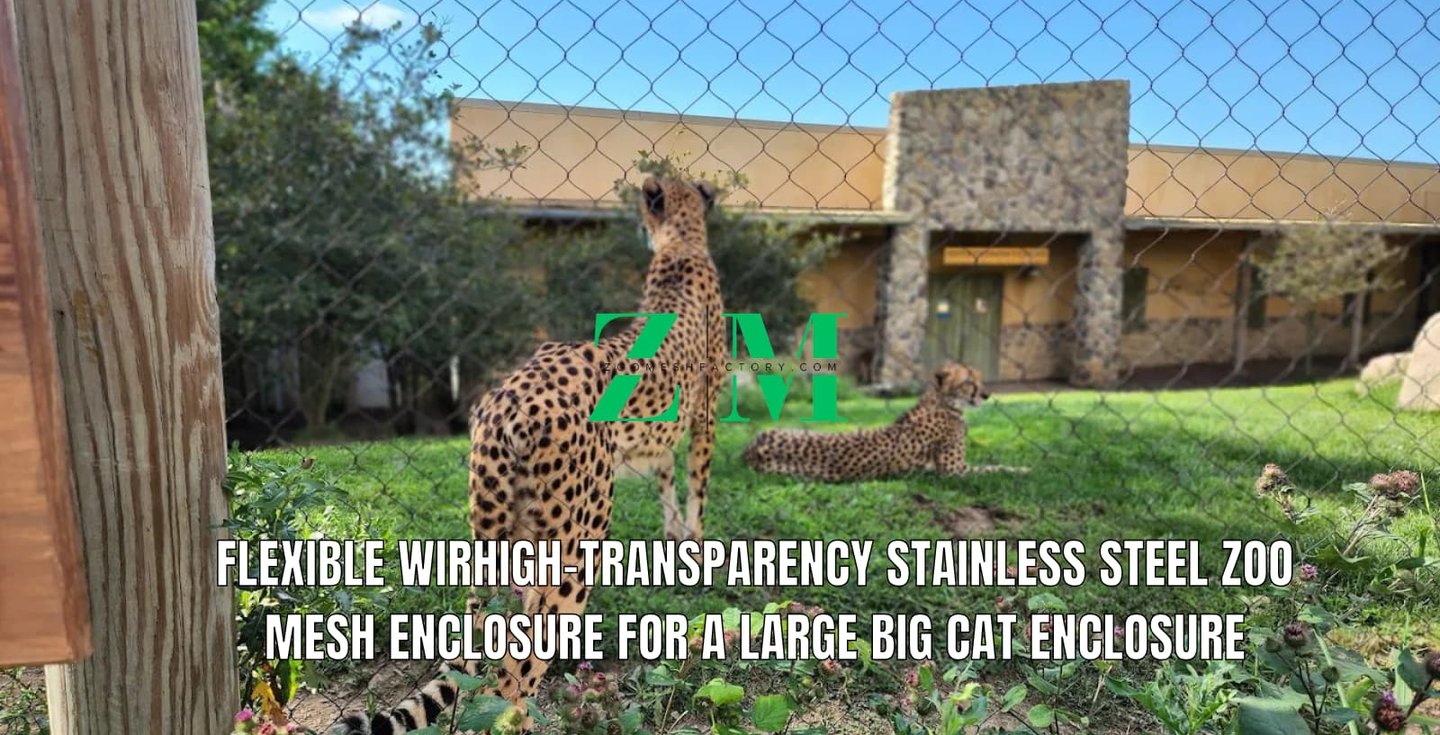
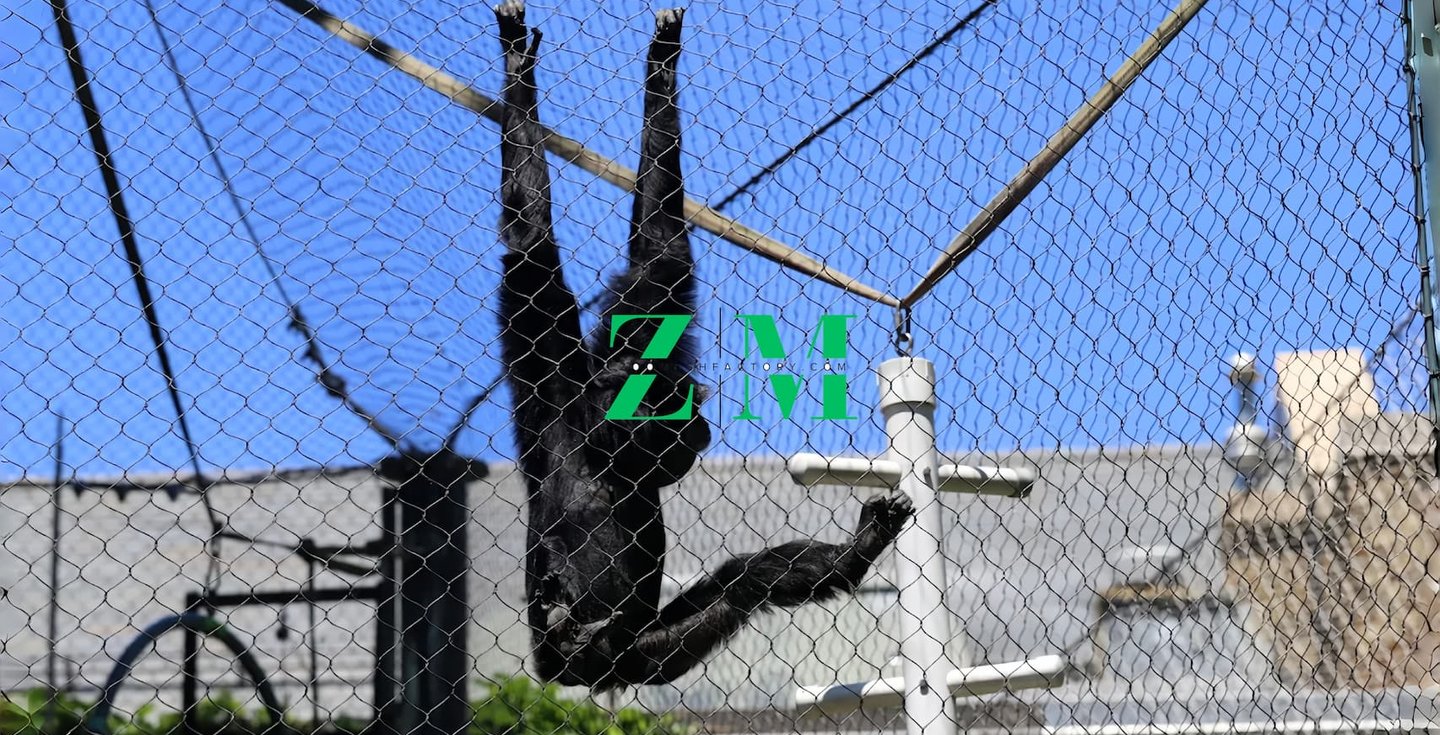
Because leopards are elite climbers, a vertical fence is often just a suggestion to them. True containment requires engineering that utilizes the mesh's physical properties to negate the cat's natural advantages. Jaguars are powerful climbers and biters, and their enclosures demand a mesh that is both impact-resistant and visually unobtrusive—which is why many zoos choose our black oxide invisible mesh specifically engineered for jaguar habitats.
Designing Anti-Climb Overhangs and Ceilings
The flexibility of stainless steel cable mesh allows it to be shaped into complex "anti-climb" structures that rigid fencing simply cannot achieve.
The 45-Degree Inward Cant: By installing an overhang of flexible mesh at the top of the perimeter, you create an unstable climbing surface. When the leopard reaches the overhang, the mesh’s natural "give" makes the cat feel insecure, causing it to retreat.
Full Overhead Containment: For smaller, high-intensity exhibits, a full mesh ceiling is often used. Because the mesh is lightweight, it can be draped over long spans without requiring heavy, expensive support beams.
The Importance of Uniform Tensioning
A mesh fence is only as strong as its tension. If the mesh is too loose, it sags and becomes easier to climb; if it's too tight, it loses its ability to absorb impact.
Dynamic Loading: Uniform tension ensures that when a cat strikes the mesh, the energy travels evenly through the cables to the anchor points.
Aesthetic Uniformity: Correct tensioning ensures the diamond shapes remain perfect, which is essential for that "invisible" look.
Expert Tip: Engineering a leopard exhibit requires a holistic approach. See how we adapt these high-tension principles for aviary netting and overhead containment to create 360-degree security that looks beautiful from every angle.
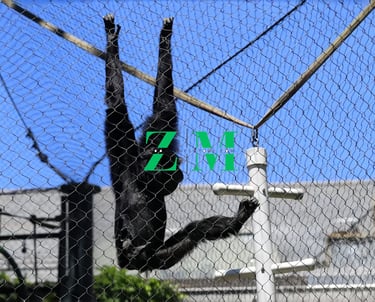
V. Corrosion & Hygiene: The SS316 Advantage
In a leopard or jaguar habitat, the "zoo fence" is under constant chemical assault. It’s not just the rain or humidity; it’s the biology of the animals themselves.
Why Acid-Resistance is Non-Negotiable
Large felids are territorial markers. Leopard urine is highly concentrated and acidic. When sprayed repeatedly on traditional galvanized steel or low-grade alloys, it triggers a rapid chemical reaction called "pitting corrosion." This weakens the wire at the molecular level, specifically at the base of the enclosure where security is most vital.
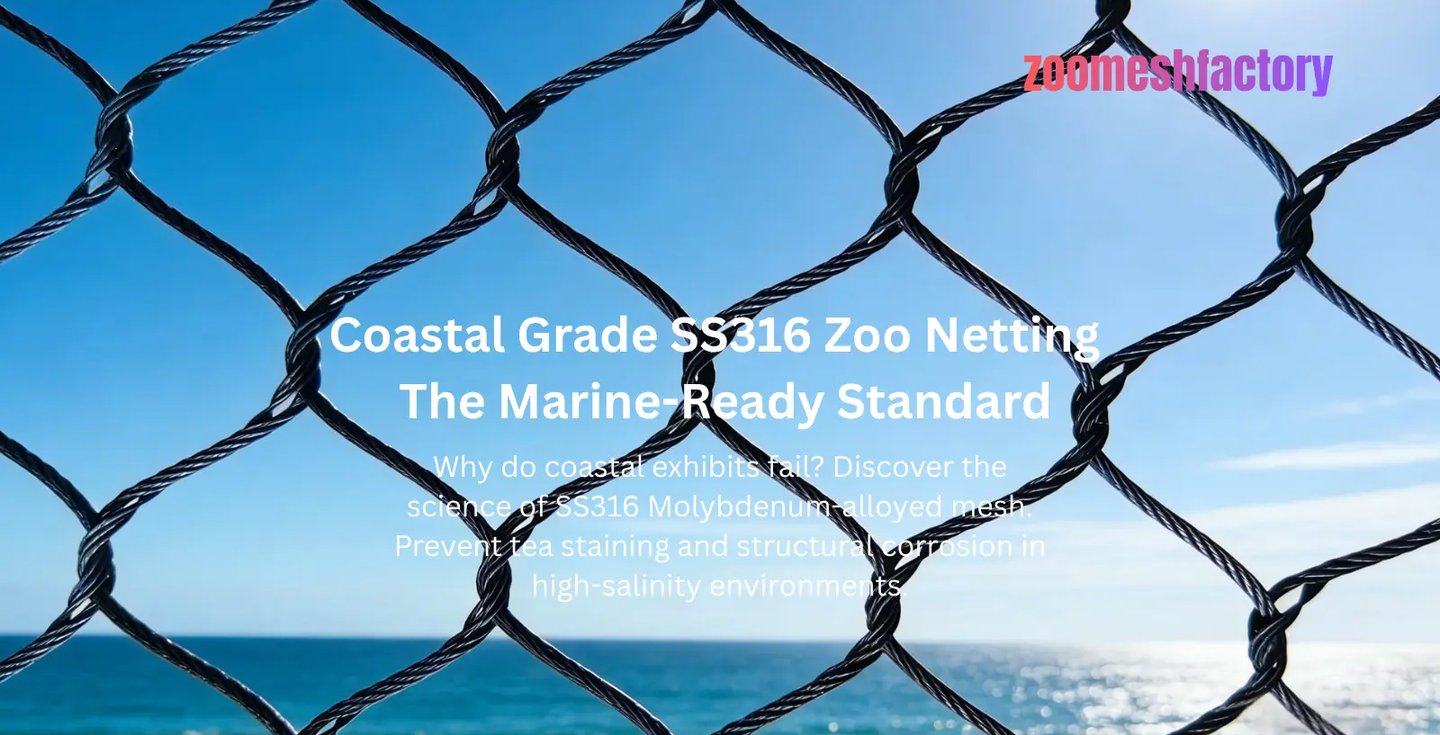
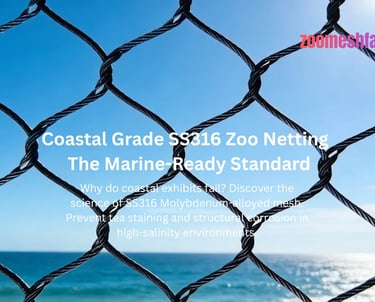
By using SS316 Stainless Steel, you are utilizing a marine-grade alloy containing Molybdenum. This element creates a passive protective layer that is nearly impervious to the high-ammonia and acidic content of predator waste. It allows keepers to use pressurized water or mild acidic cleaners to maintain hygiene without worrying about compromising the structural integrity of the mesh.
The "Black Oxide" Finish: Invisible Protection
We often talk about the aesthetic benefits of our black finish, but from a technical standpoint, it is a functional powerhouse.
Enhanced Durability: Unlike paint or powder coating, which can be scratched off by sharp claws, the Black Oxide finish is a chemical conversion. It becomes part of the steel's surface, adding an extra layer of oxidation resistance.
Optical Absorption: By absorbing light rather than reflecting it, the black finish prevents the "fence glare" that can cause eye fatigue for the animals and ruin photography for the guests. It allows the leopard’s natural camouflage to stand out, rather than the steel barrier.
VI. Sourcing & Installation Logic: The Power of the Single Panel
When you are dealing with a predator that can exert hundreds of pounds of pressure in a single bound, every seam in your fencing is a potential liability. This is where the "Factory-Direct" model shifts from a financial benefit to a safety imperative.
Reducing the "Weakest Link"
In a typical retail purchase, you receive standard-sized rolls (e.g., 2m x 10m). To cover a large leopard habitat, you might need to join 20 or 30 panels. Every one of those joins—whether done with ferrules or lacing wire—is a "weak link."
Custom Loom Sizing: At Zoo Mesh Factory, we manufacture panels to your exact architectural specifications. We can produce single, continuous sheets of handwoven mesh that are massive in scale.
Structural Uniformity: One continuous panel means uniform tension across the entire wall. There are no seams for a leopard to hook a claw into, and no joins that can loosen over time due to vibration or animal impact.
Streamlining the Installation
Buying direct doesn't just save money; it saves time. Custom rolls arrive ready to be hoisted and tensioned. Because the mesh is lightweight and flexible, a small crew can cover a large area in a fraction of the time it would take to install heavy, rigid welded panels.
Expert Procurement Tip: When ordering, always provide your "net opening" measurements. We calculate the stretch and tensioning margins at the factory to ensure your mesh fits perfectly the first time.
Take Action: Ready to spec your project? Browse our full range of products for custom project rolls and see how factory-direct customization can simplify your next build.
Ready to talk budget? See our Breakdown of Factory-Direct Savings to see how much your project can save."
While we design heavy-duty mesh for large predators, we also produce chew-proof stainless cable mesh for macaw & parrot aviaries; check our core aviary mesh specifications.
VII. Frequently Asked Questions (FAQ)
1. What is the breaking load of a 3.2mm stainless steel cable mesh?
Our 3.2mm (1/8") stainless steel wire rope mesh, featuring a 7x19 strand construction, has a minimum breaking load (MBL) of approximately 1,600 lbs (7.12 kN). This high tensile strength, combined with the energy-absorbing "give" of the handwoven diamond pattern, makes it the safest choice for high-impact predators like leopards and jaguars.
2. Can a leopard’s claws damage the handwoven mesh over time?
No. Unlike plastic-coated fencing or soft alloys, our AISI 316 stainless steel is significantly harder than a leopard's claws. While the cats may attempt to climb or "scratch" the mesh, the steel's surface remains intact. Furthermore, because it is handwoven without sharp ferrules, there is nothing for the claws to snag or break.
3. Why is SS316 recommended over SS304 for jaguar enclosures?
Jaguars and leopards often inhabit humid, tropical-style exhibits. SS316 contains Molybdenum, which provides critical resistance to "pitting corrosion" caused by humidity and acidic animal waste. While SS304 is strong, SS316 ensures a 30-year lifespan in the corrosive environments typical of large predator habitats.
4. Does the Black Oxide finish affect the strength of the cable?
Not at all. The Black Oxide finish is a chemical conversion process, not a mechanical heat treatment. It changes the surface color and adds an extra layer of oxidation resistance without altering the core tensile strength or flexibility of the stainless steel wire. It is purely an aesthetic and protective enhancement.
5. What is the maximum panel size you can produce at the factory?
As a direct manufacturer, Zoo Mesh Factory can produce exceptionally large custom panels—often up to 10 meters in height and 20+ meters in length in a single continuous weave. Sourcing these massive rolls direct from the factory eliminates the need for dangerous mid-panel joins, which are the most common failure points in predator fencing.
Ready to Start Your Exhibit Design?
Join the hundreds of zoos and sanctuaries worldwide that trust ZooMesh Factory for their containment needs. Our engineers are ready to help you calculate the perfect mesh size for your species.
Contact
Hebei Zoo Mesh Co., Ltd
No. 188 Zhonghua South Street, Shijiazhuang City, Hebei Province, China
info@zoomeshfactory.com
© 2025. All rights reserved.
Quick Link
Product Catalogs
Don't leave without the specs! Save our factory-direct pricing and technical configurations for your next project meeting. Our 2026 Zoo Mesh Factory Direct Catalog is ready for download.