
Stainless Steel Wire Rope Mesh for Great Ape Enclosures | 10kN Security
How do you contain a 200kg Gorilla? Discover the engineering behind high-tensile SS316 wire rope mesh for Great Ape habitats. Impact resistance, primate safety, and 30-year durability.
Hebei Zoo Mesh Co., Ltd
4/6/202610 min read
Key Takeaways: Why Great Apes Require "Active" Mesh
Dynamic Strength: A leaping ape creates "Impact Load" 5x-10x their body weight; flexible mesh absorbs this energy like a spring.
Anti-Tamper Design: Seamless ferrules and hand-woven knots prevent intelligent primates from "unpicking" the mesh.
Zero Visual Distortion: 95% transparency allows for high-quality guest photography and clear behavioral monitoring.
Dermatological Safety: Burr-free, smooth-polished 316 stainless steel prevents palm abrasions during high-speed climbing.
I. Introduction: The Unique Challenge of the Great Ape
In the world of zoological containment, the Great Ape represents the ultimate engineering "Stress Test." Whether it is the sheer mass of a Silverback Gorilla or the mechanical curiosity of a Chimpanzee, these species require a barrier that can think as fast as it can hold.
The "Ape IQ" Factor: Strength is Only Half the Battle
Unlike hoofstock or large felids, Great Apes are active investigators of their environment. They do not just encounter a barrier; they test it for weaknesses.
Tool Use & Manipulation: A Great Ape will use its fingers—and occasionally sticks or stones—to probe ferrules, look for loose wire ends, or attempt to "unweave" the mesh at its anchor points.
Persistent Testing: If an ape finds a single millimeter of "play" in a cable or a slightly loose bolt, they will focus their immense dexterity on that specific point until it fails. This is why Stainless Steel Wire Rope Mesh for Great Ape Enclosures must be structurally "seamless."
Beyond Static Weight: The Physics of a 200kg Gorilla Strike
A common mistake in enclosure design is calculating for Static Load (the weight of the animal at rest). However, a 200kg Gorilla in a territorial display or a 60kg Chimpanzee leaping from a 5-meter platform generates Dynamic Impact Loads.
The Hammer Effect: Kinetic energy is calculated as E_k = 1/2mv2. Because velocity is squared, a fast-moving ape can strike the mesh with a force exceeding 1,000kg (10 kN).
The Failure of Rigid Barriers: Rigid steel bars or welded wire cannot deform to absorb this energy. The force is transferred directly to the welds or the mounting hardware, leading to "metal fatigue" and eventual structural snapping.
For heavy-duty flexible mesh engineered to absorb massive impact from gorillas and chimpanzees, check our impact-resistant primate mesh guide.
II. The Anatomy of High-Tensile Wire Rope
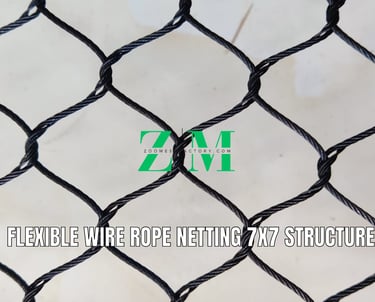
To counteract these forces, we utilize a specialized 3D-woven cable system. The performance of the mesh depends entirely on the internal "architecture" of the wire rope itself.
7x7 vs. 7x19 Construction: Flexibility vs. "Bite-Resistance"
We primarily offer two cable constructions for Great Ape habitats, each serving a specific behavioral need:
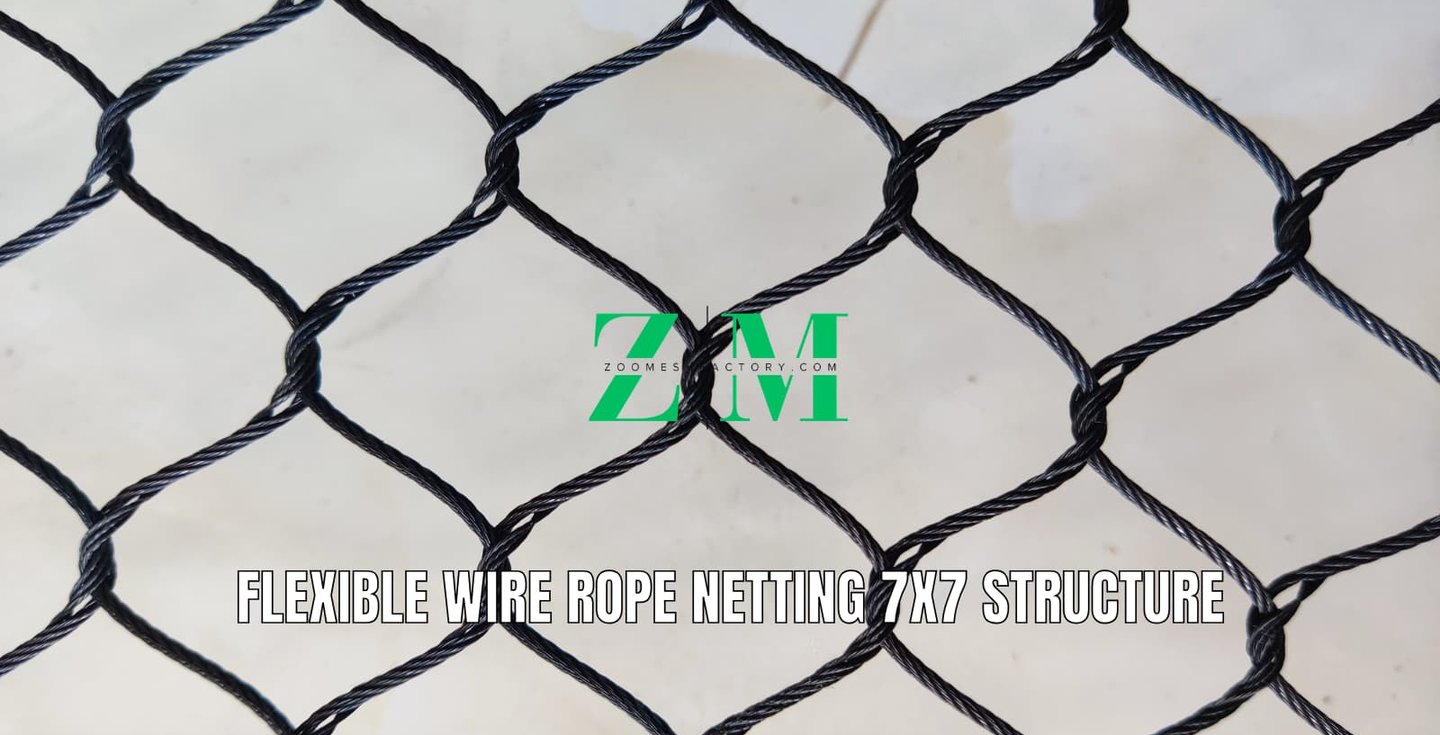
7x7 Construction (The Industry Standard): This consists of 7 strands, each made of 7 individual wires. It is stiffer and offers high "Bite-Resistance." If an ape attempts to chew the mesh, the thicker individual wires in a 7x7 cable are harder to deform or fray.
7x19 Construction (High-Flexibility): This uses 133 individual wires (7 strands of 19 wires). It is significantly softer and more flexible. We recommend 7x19 for overhead "chutes" or "sky-walks" where the mesh needs to contour around complex 3D curves without creating structural stress points.
The Metallurgy of SS316: Why Anything Less is a Liability
Great Ape habitats are often high-humidity environments—either due to tropical climate simulations or frequent high-pressure washdowns by keepers.
The Acid Factor: Primate waste is naturally acidic. Over time, this acidity causes "Stress Corrosion Cracking" in standard SS304 steel.
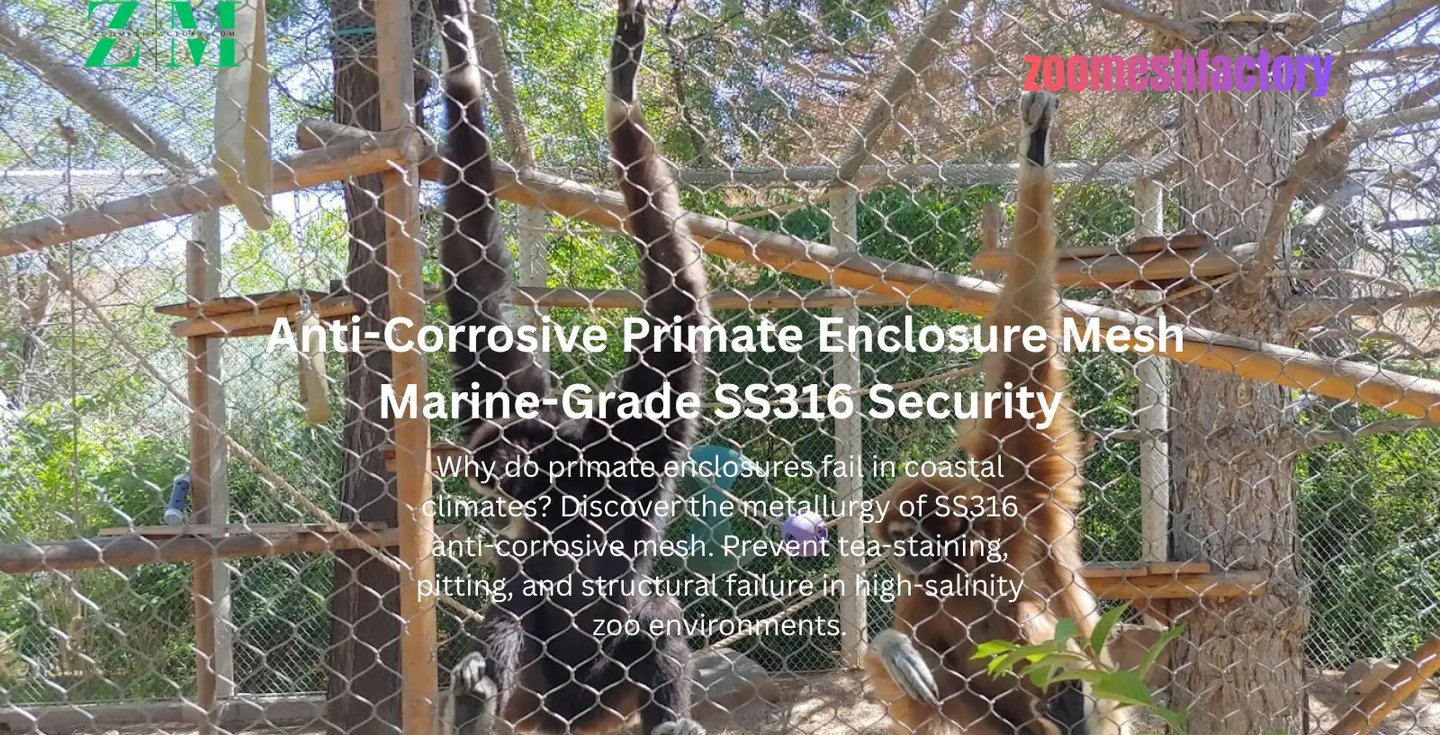
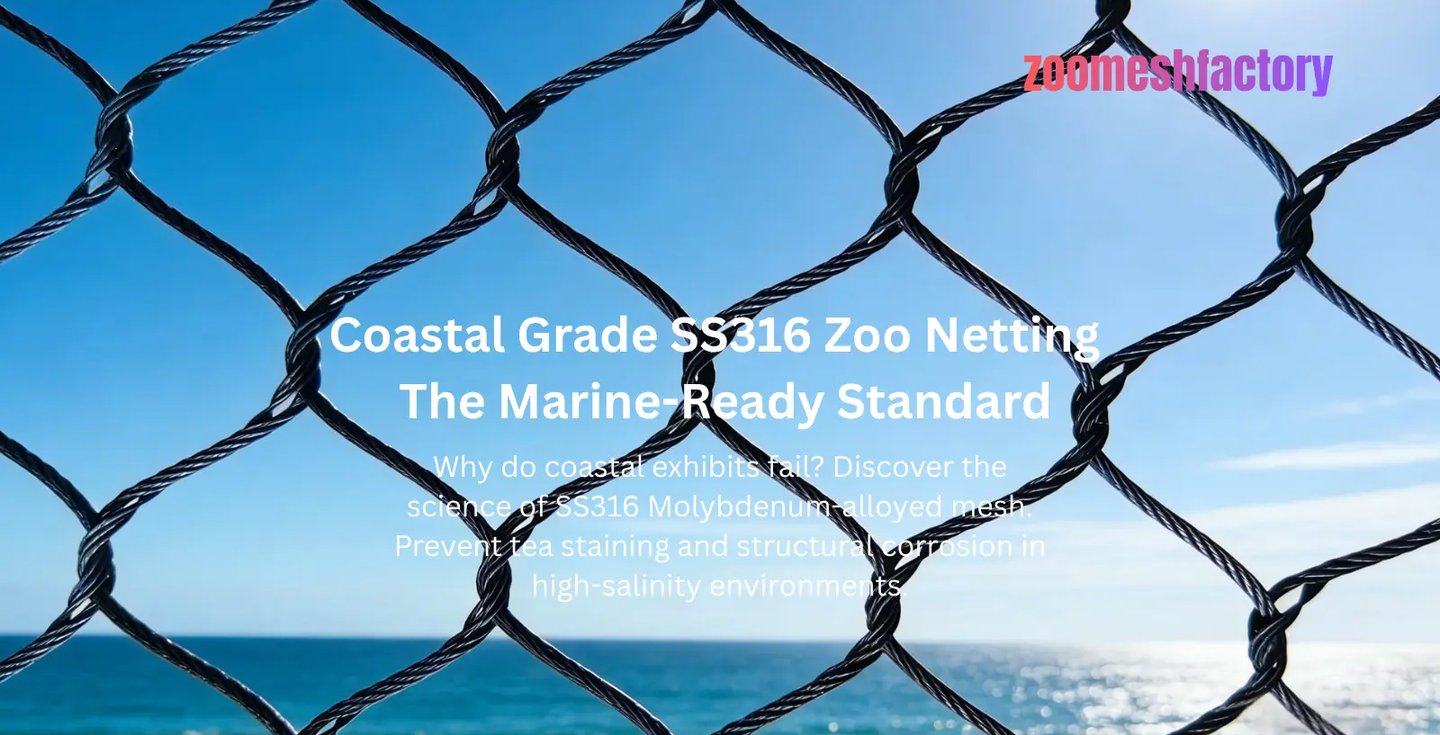
The SS316 Shield: By utilizing SS316 Marine-Grade Stainless Steel, we incorporate Molybdenum into the alloy. This creates a barrier that is immune to chloride pitting and acid-induced degradation. In a high-security ape exhibit, a "rusty" mesh isn't just an eyesore; it’s a weakened cable that compromises public safety.
More: [Anti-Corrosive Primate Enclosure Mesh: The Marine-Grade Standard]
III. Impact Resistance: The Science of Kinetic Dissipation
When engineering for Great Apes, the greatest threat isn't a single "hit," but rather the relentless, repetitive force of Rhythmic Rocking. This behavior—where an ape grabs a barrier and shakes it with their full body weight—is the primary cause of failure in traditional fencing.
Why Rigid Welded Wire Fails
Rigid systems, such as welded wire panels or heavy-duty bars, are designed to be "unmovable." However, in physics, unmovable objects must absorb 100% of the energy they receive.
The Fatigue Point: Every shake of the cage creates a micro-flex at the weld joints. Over time, this leads to Work Hardening, making the metal brittle until it eventually snaps under a fraction of its original rated load.
The "Anchor Strain": Because rigid mesh cannot stretch, the energy from a 200kg strike travels instantly to the mounting bolts. This frequently leads to "pull-out" failures where the entire panel detaches from the concrete or steel frame.
How "Diamond Deformity" Saves the Habitat
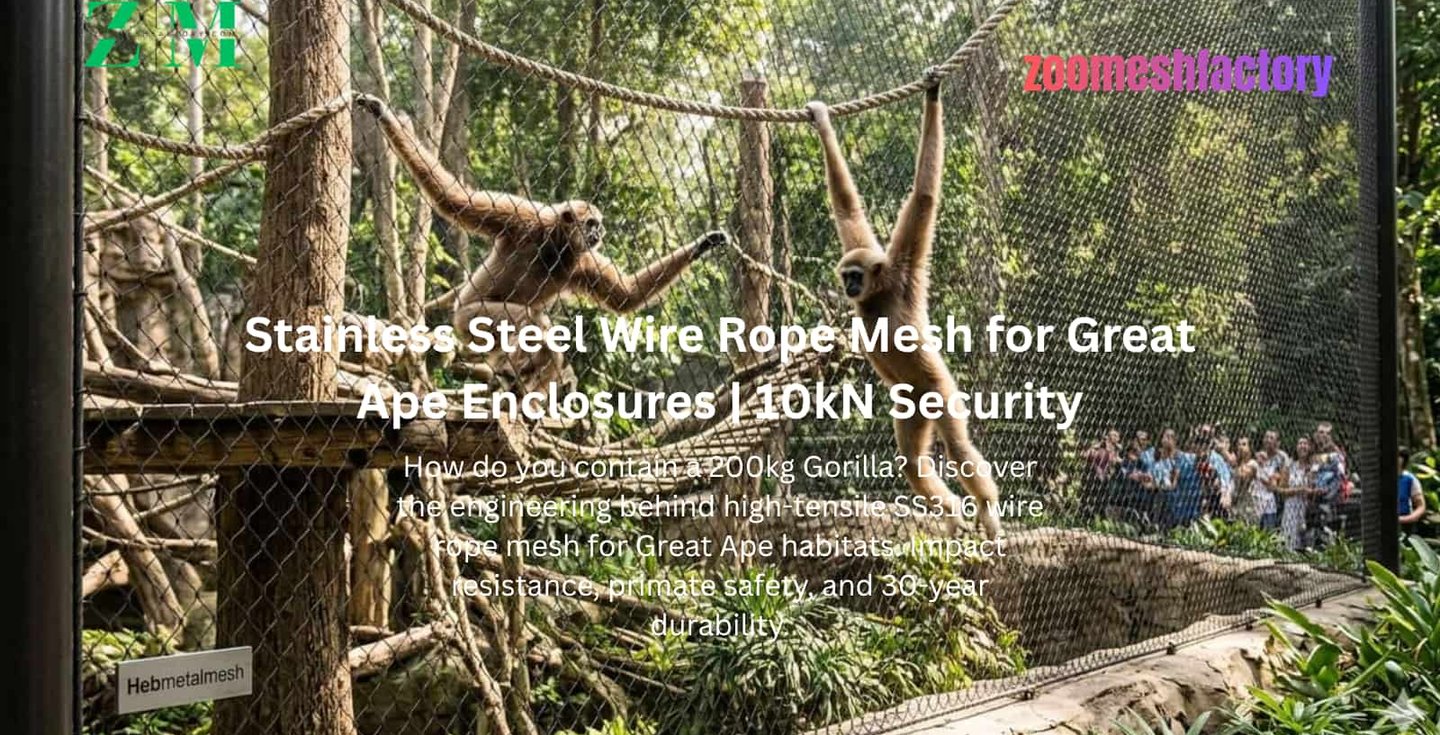
Our Stainless Steel Wire Rope Mesh is a "living" structure. It utilizes a flexible diamond weave that acts as a giant mechanical spring.
Energy Spreading: When a primate strikes the mesh, the diamond apertures temporarily deform, spreading the kinetic energy across the entire panel rather than a single wire.
Safety for the Animal: This elasticity also protects the ape. Instead of hitting a "brick wall" and risking broken bones or blunt force trauma, the mesh provides a soft deceleration—crucial for high-energy species like Orangutans that frequently leap between vertical surfaces.
IV. Security Specs: Breaking Loads and Apertures
Selecting the correct gauge and spacing is the difference between a secure habitat and a liability. For Great Apes, there is no room for "entry-level" specifications.
The 3.2mm (d) Standard: The Global Benchmark
In the zoological industry, a wire diameter of 3.2mm (1/8") is the non-negotiable standard for Great Ape primary barriers.
Tensile Prowess: A 3.2mm SS316 cable in a 7x7 construction has a typical breaking load of approximately 10.20 kN (1,040 kg). This provides a safety factor of 5:1 for even the largest male Gorillas.
Bite-Proof Density: This diameter is thick enough to resist the shearing force of primate canine teeth, which can exert incredible localized pressure.
Climb-Ability vs. Security: Selecting the Aperture (L)
The diamond size (L) determines how the ape interacts with the wall.
For Enrichment (Climbing): Large apertures (76mm to 102mm) allow Apes to use the mesh as a climbing wall, providing vital physical exercise.
For Public Safety (Reach-Through): In areas where the public is close to the mesh, apertures must be reduced to 51mm or smaller to prevent "finger-traps" or the primate reaching through to grab clothing or equipment.
Match perfect diamond openings to your primate species with our monkey enclosure mesh aperture size guide.
Technical Table: Breaking Load Capacity by Primate Species
V. Managing Primate Intelligence: Tamper-Proof Ferrules
If a Silverback Gorilla is the "brute force" of the primate world, the Chimpanzee is the "locksmith." Chimpanzees and Orangutans possess a level of mechanical curiosity that can dismantle standard fencing over time. To ensure a 30-year lifespan, Stainless Steel Wire Rope Mesh for Great Ape Enclosures must be engineered to resist cognitive probing.
The Vulnerability of "Knotted" Mesh
Traditional knotted netting, while strong, relies on the friction of the rope against itself.
The Intelligence Risk: A bored or determined primate can use their fingers, teeth, or even small tools (sticks) to pick at the knots. Once a knot is loosened, the structural integrity of the diamond weave begins to "slide," creating a gap that the animal can eventually widen for escape.
The Hygiene Risk: Knots create small crevices where organic matter—food, waste, and bacteria—can accumulate, making the enclosure difficult to sanitize.
Sleeve-Press Technology: The "Cold-Weld" Standard
Our mesh eliminates the human-error risk of knots by utilizing Seamless Ferrules (Sleeves).
The Permanent Bond: During the weaving process, every intersection of the wire rope is enclosed in an SS316 sleeve and subjected to a high-pressure mechanical press. This creates a "cold-weld" effect.
Tamper-Proof Design: The resulting ferrule is smooth, rounded, and physically impossible for primate fingers to pry open. Because the sleeve is made of the same marine-grade alloy as the wire, it offers uniform strength across the entire panel. There are no "weak links" for an ape to manipulate.
Learn smooth knotless weave advantages to prevent primate paw injuries in our hand-woven mesh safety article.
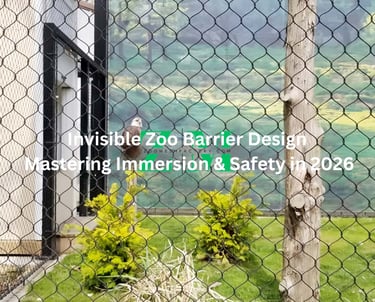
VI. Guest Experience: The "Invisibility" Factor
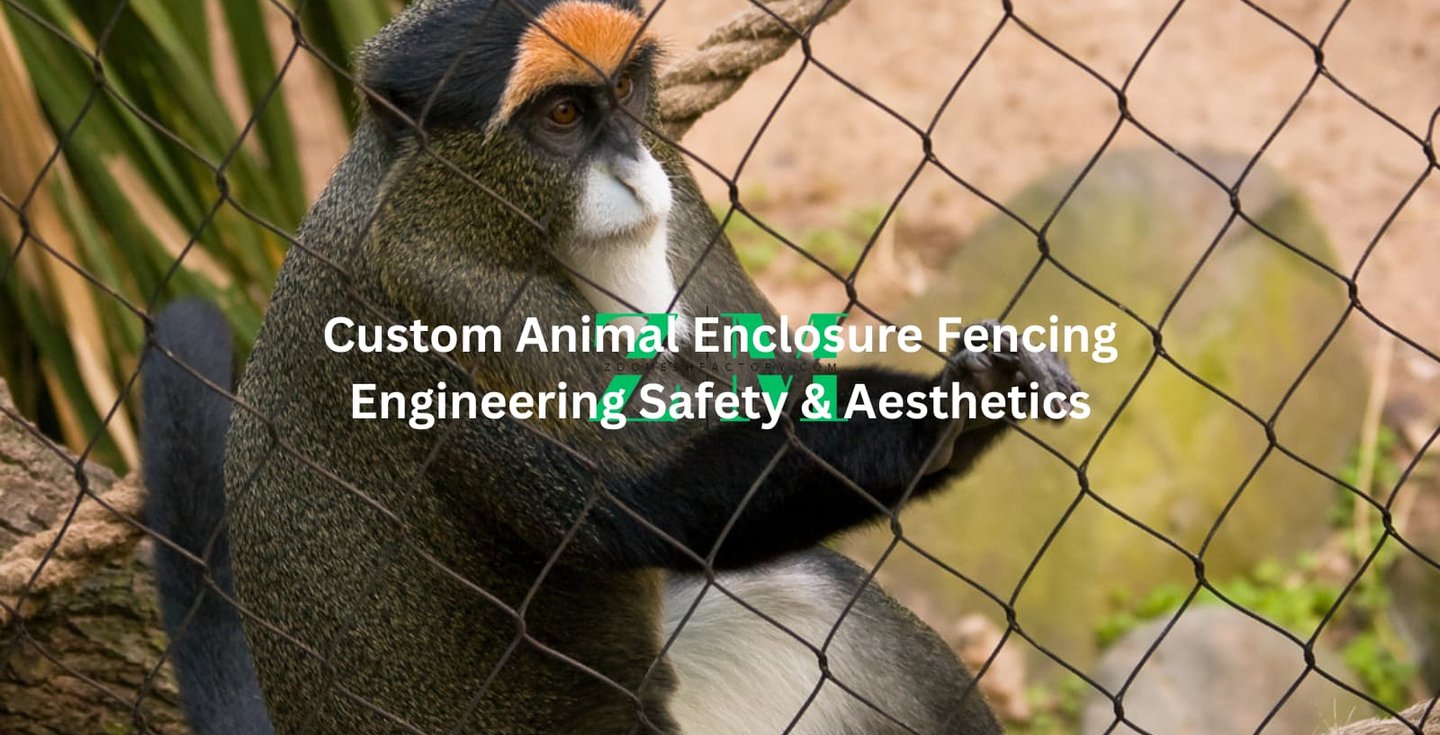
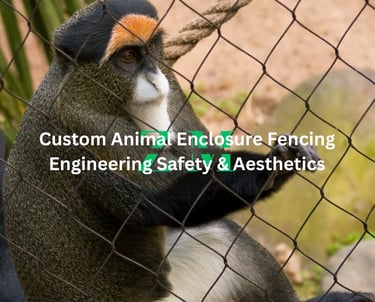
In modern zoo design, the best barrier is the one you can’t see. For Great Ape habitats, which often feature lush, tropical landscaping, a bright silver fence creates a "cage" aesthetic that diminishes the guest's connection to the animal.
Why Black Oxide is the Gold Standard for Immersion
The primary challenge of silver stainless steel is its high reflectivity. Direct sunlight bounces off the wire, creating a visual "wall" that obscures the view.
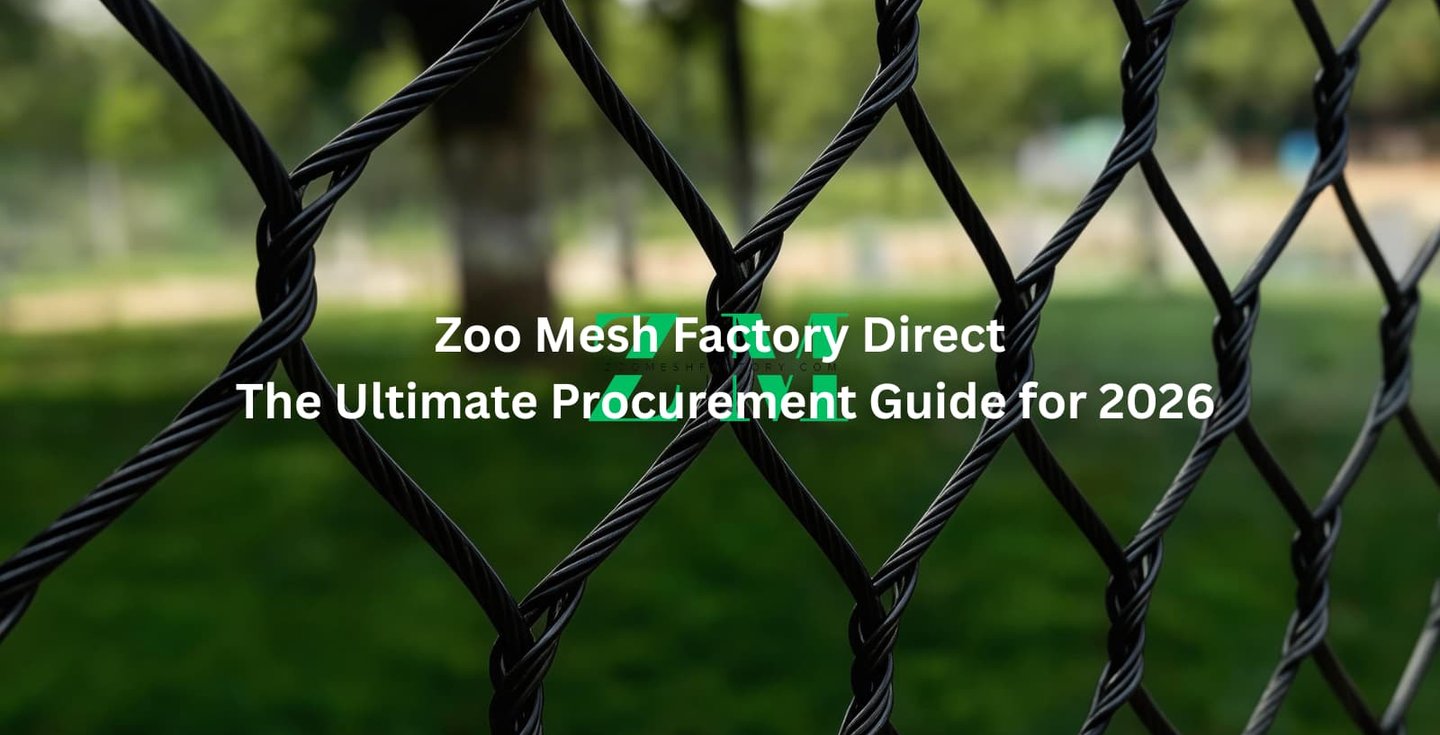
Light Absorption: Our Black Oxide Finish is a chemical conversion coating that turns the surface of the steel into a deep, matte black. Instead of reflecting light into the visitor's eyes, the mesh absorbs it.
The "Vanishing" Effect: Against a backdrop of green foliage or dark rockwork, the 3.2mm wire becomes almost invisible to the human eye. This allows guests to focus on the behavior of the Gorillas rather than the steel between them.
Improving Photography and Monitoring
Glare-Free Photography: Visitors today view the world through their smartphones. Black Oxide mesh allows cameras to focus past the wire rope, eliminating the blurry "fence lines" that ruin guest photos.
Behavioral Monitoring: For keepers and researchers, high-transparency barriers are essential for observing subtle facial expressions and social cues in Great Apes, which can be hidden by thicker, more intrusive fencing materials.
VII. Installation & Maintenance for High-Security Zones
Installing Stainless Steel Wire Rope Mesh for Great Ape Enclosures is a precision task. Because primates exert such high dynamic loads, the way the mesh is tensioned and anchored is just as important as the wire itself.
Tensioning Overhead "Chutes" and "Sky-Walks"
Modern great ape exhibits often feature overhead tunnels or "O-lines" that allow orangutans or chimps to travel above the public.
The Sag Factor: If the mesh is under-tensioned, the weight of a 100kg ape will cause the "floor" of the tunnel to sag, creating a pinch point against the structural frame.
The "Trombone" Effect: Over-tensioning can also be dangerous, as it removes the mesh's ability to dissipate kinetic energy. We utilize a specific boundary cable tensioning system that allows the mesh to remain taut enough for climbing but flexible enough for impact.
Inspecting for "Crow-Footing" and Cable Fatigue
While SS316 is incredibly durable, a rigorous inspection protocol is the hallmark of a world-class zoo.
Identifying Crow-Footing: This is a term for small, frayed wires that "bloom" out from a cable. In a primate habitat, these are usually caused by the animal repeatedly using a specific tool or rock against the mesh.
The 10% Rule: Industry safety standards suggest that if more than 10% of the individual wires in a single strand are broken within one diamond length, the panel should be scheduled for a "patch" or replacement.
Ferrule Integrity: Because we use Sleeve-Press Technology, keepers should simply visually confirm that the sleeves remain centered. Unlike knots, which can "crawl" under pressure, our ferrules are locked in a permanent cold-weld.
Get step-by-step tensioning and framing instructions in our monkey enclosure mesh installation guide.
VIII. Conclusion: The Future of Great Ape Conservation
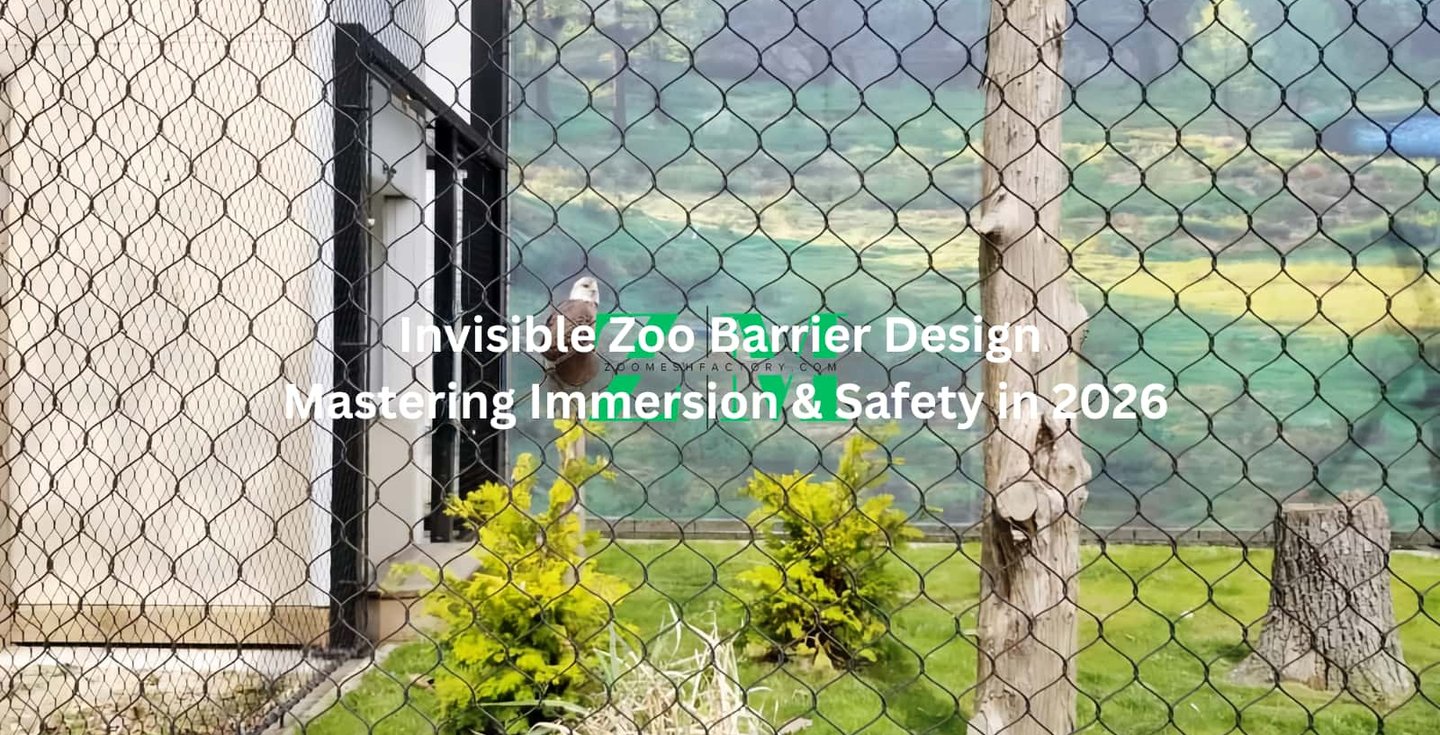
Designing a Great Ape habitat in 2026 is a balancing act between two seemingly opposite goals: Absolute Security and Total Transparency. The days of heavy iron bars and concrete bunkers are over. Today’s conservation-led zoos demand environments that look like the wild but perform like a high-security vault.
By choosing Stainless Steel Wire Rope Mesh, you are investing in a three-dimensional security system that respects the intelligence of the primate while protecting the safety of the public.
For the Animal: A tactile, climbable surface that encourages natural movement.
For the Guest: An "invisible" window into the life of our closest relatives.
For the Facility: A 30+ year asset that eliminates the recurring costs of rust and structural repair.
When you specify 3.2mm SS316 hand-woven mesh, you aren't just buying a fence—you are building a legacy of safety and animal welfare that will last for generations.
Compare long-term TCO and grade options via our monkey enclosure mesh buyers guide.
Many mixed-species zoo habitats house primates alongside large parrots; check our dedicated guide for ideal mesh sizes and anti-chew specs built specifically for macaw & parrot aviaries.
Great Ape Enclosure FAQ
What is the minimum wire diameter required for a Gorilla enclosure?
For Great Apes like Gorillas and Orangutans, a 3.2mm (1/8") wire diameter is the global industry standard. This size provides a typical breaking load of 10.20 kN, which offers the necessary safety factor to withstand the dynamic impact of a 200kg primate leaping or rocking against the mesh."
Can Chimpanzees undo the knots in stainless steel wire mesh?
While intelligent primates can sometimes manipulate hand-knotted mesh, our 'Sleeve-Press' technology uses seamless SS316 ferrules to create a permanent cold-weld bond. These ferrules are tamper-proof and cannot be pried open by fingers or tools, ensuring the mesh structure remains secure.
Does Black Oxide mesh impact the visibility of Great Ape habitats?
Actually, Black Oxide mesh significantly improves visibility. The matte black finish absorbs light rather than reflecting it (unlike silver stainless steel), which eliminates glare and makes the mesh virtually invisible against natural backgrounds, allowing for better animal monitoring and guest photography.
Why is flexible wire rope mesh better than rigid fencing for Great Apes?",
Flexible mesh acts as a kinetic energy dissipator. Unlike rigid bars that can suffer from metal fatigue and weld failure due to 'rhythmic rocking,' flexible diamond weave deforms slightly under impact, spreading the force across the entire panel and reducing stress on the anchor points.
How do you prevent 'finger-trapping' in primate mesh exhibits?
To prevent finger-traps and reach-through hazards, we recommend an aperture (diamond size) of 51mm or smaller in public-facing areas. For internal climbing enrichment where public contact isn't a factor, larger apertures of 76mm to 102mm are ideal for Great Ape hand-holds."
Ready to Start Your Exhibit Design?
Join the hundreds of zoos and sanctuaries worldwide that trust ZooMesh Factory for their containment needs. Our engineers are ready to help you calculate the perfect mesh size for your species.
Contact
Hebei Zoo Mesh Co., Ltd
No. 188 Zhonghua South Street, Shijiazhuang City, Hebei Province, China
info@zoomeshfactory.com
© 2025. All rights reserved.
Quick Link
Product Catalogs
Don't leave without the specs! Save our factory-direct pricing and technical configurations for your next project meeting. Our 2026 Zoo Mesh Factory Direct Catalog is ready for download.