

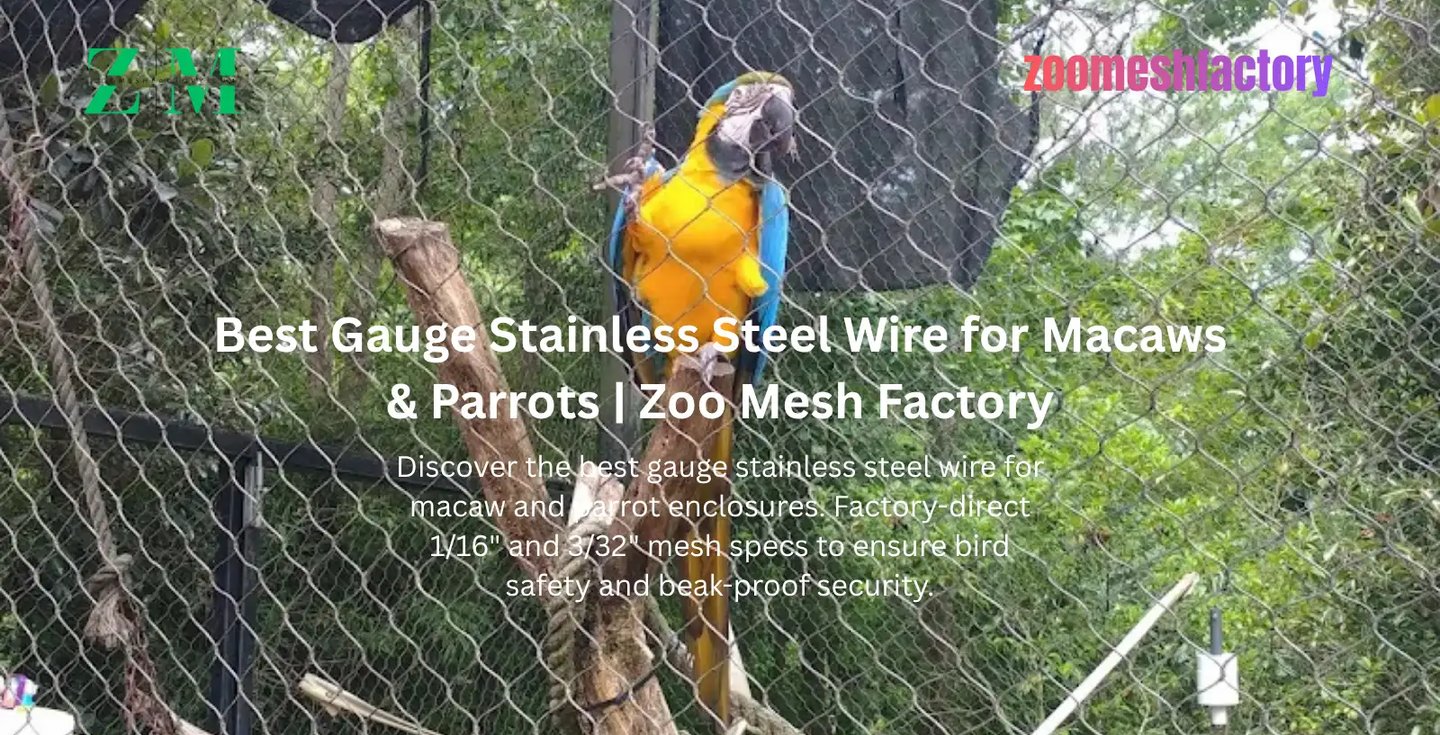
Best Gauge Stainless Steel Wire for Macaws & Parrots | Zoo Mesh Factory
Discover the best gauge stainless steel wire for macaw and parrot enclosures. Factory-direct 1/16" and 3/32" mesh specs to ensure bird safety and beak-proof security.
Hebei Zoo Mesh Co., Ltd
5/3/202614 min read
What is the best gauge stainless steel wire for macaw and parrot enclosures?
For macaws, the industry standard is 3/32" (2.4mm) wire diameter with a 2" x 2" (50mm) mesh opening to withstand extreme beak pressure. For medium parrots (African Greys, Amazons), the best choice is 1/16" (1.6mm) wire diameter with a 1" x 1" (25mm) opening. Using 304/316 hand-woven stainless steel cable mesh ensures the enclosure is non-toxic (zinc-free), rust-proof, and flexible enough to prevent bird impact injuries, outlasting traditional welded wire by decades.
I. Introduction: Why "Standard" Wire is a Death Trap
Let’s be completely honest for a moment. Most people building an aviary walk into their local hardware store, look at a roll of galvanized wire mesh or standard chicken wire, and think: "Yeah, that'll do." It won't. In fact, if you are housing large psittacines like Macaws or Cockatoos, that cheap roll of wire is a ticking time bomb for your investment and a direct hazard to the birds themselves.
The Beak Power Reality
To understand why traditional wire fails, you have to respect the mechanics of a parrot's beak. A large macaw—such as a Hyacinth or a Scarlet Macaw—can exert an astonishing crush force of 500 to 700+ PSI (pounds per square inch). To put that into perspective, a human's bite force sits around 120 to 160 PSI.
When a bird with that kind of power gets bored or curious, standard welded wire isn't a barrier—it’s a snack. They don't just chew on the wire; they leverage their beak to twist, bend, and eventually snap the welded joints. Once a single weld breaks, the structural integrity of the entire panel collapses, leaving sharp, exposed points that can cause severe injury or create an escape route.
The Hidden Killer: Zinc Poisoning
Even if your birds don't manage to snap the wire immediately, standard galvanized hardware cloth poses a much more insidious threat: Zinc poisoning, often referred to in avian medicine as New Bird Disease.
To prevent rust, traditional steel wire is hot-dipped or electro-galvanized with a heavy layer of zinc. Because parrots use their beaks as a "third foot" to climb the walls of their enclosure, they constantly scrape and ingest microscopic flakes of this coating. Over time, this heavy metal accumulates in their system, leading to:
Severe gastrointestinal distress
Neurological damage
Feather plucking and self-mutilation
Fatal organ failure
As a professional or dedicated enthusiast, your goal is to build a safe sanctuary, not a gilded cage that slowly poisons its inhabitants.
While wire gauge is critical for macaw safety, coastal environments introduce an additional factor: salt-air corrosion. Standard stainless steel may pit and fail within years when exposed to ocean breezes. For aviaries within 10 miles of the coast, we recommend reviewing our dedicated guide on anti-corrosion parrot aviary mesh for coastal areas before finalizing your gauge selection.
The Expert Solution: Why Zoos Use Hand-Woven Stainless Steel Mesh
There is a reason why world-class zoological institutions do not buy their enclosure materials from local agricultural supply stores. Modern zoo architecture relies almost exclusively on hand-woven stainless steel cable mesh.
By utilizing high-grade 304 or 316 stainless steel, our factory eliminates the risk of heavy metal toxicity entirely. Stainless steel is chemically inert, non-toxic, and 100% rust-proof. Furthermore, the hand-woven diamond structure uses flexible, multi-strand steel wire ropes rather than rigid welded bars. This creates a highly resilient "safety net" effect. When a bird climbs or strikes the mesh, the material yields slightly to absorb the energy before bouncing back into shape, protecting both the enclosure and the bird's delicate feathers.
If you need high tensile cable mesh resistant to powerful eagle talons, browse our complete birds of prey aviary netting guide.
II. Understanding the "Big Two" Specs
In the world of professional animal containment, there is no such thing as a "one-size-fits-all" wire. To optimize the Zoo Mesh Factory products for your aviary, you must match the specific gauge and mesh aperture to the behavioral needs and physical capabilities of your birds.
Through decades of testing and supply to global wildlife centers, we have established two primary specifications—The Big Two—that guarantee safety while maximizing viewing visibility.
The Macaw Spec: 2" x 2" x 3/32" (50mm x 50mm x 2.4mm)
When designing a permanent home for the largest psittacines—such as Macaws, large Cockatoos, and heavy-billed Amazons—you cannot compromise. The 3/32" (2.4mm) wire diameter is the absolute threshold for beak-proof security.
Beak Resistance: At a 2.4mm diameter, the individual 7x7 or 7x19 strand cable is too thick and dense for a Macaw to crimp or sever.
The 2" x 2" Opening: This 50mm diamond aperture is the sweet spot. It prevents the bird from sticking its head through the mesh while maintaining an incredibly high open area (over 85% visual clarity). This ensures that your view remains unobstructed for viewing and photography.
Structural Longevity: Heavy birds love to swing and hang upside down. This 2.4mm gauge provides the high tensile strength required to support multiple heavy birds climbing on the same panel simultaneously without stretching or sag.
The Parrot Spec: 1" x 1" x 1/16" (25mm x 25mm x 1.6mm)
For medium-to-large parrots—such as African Greys, Eclectus, Amazons, and smaller Cockatoos—we scale down the mesh dimensions to ensure perfect climbing ergonomics.
Climbing Comfort: Medium parrots have smaller feet and shorter strides. A 1" x 1" (25mm) opening allows them to grip and climb the mesh naturally without their feet slipping through, reducing the risk of a twisted toe or talon injury.
Security: The smaller 1" aperture acts as a high-security barrier against outside threats. It is tight enough to prevent small predators like raccoons, snakes, or rats from reaching through into the aviary at night.
The 1/16" (1.6mm) Cable: This wire size offers the ideal balance. It is incredibly lightweight, keeping the overall load on your aviary frame minimal, yet it easily resists the biting force of an African Grey or Amazon.
📐 Ready to scale up to a full walk-in exhibit? Once you’ve nailed the right wire gauge, the next step is choosing the right mesh construction, installation method, and budgeting for long-term value. See our complete guide: Large Walk-In Parrot Exhibit Mesh — Complete Aviary Guide
Comparison Table: Wire Specifications for Avian Enclosures
To help you make the right technical choice for your build, we have compiled our direct factory data below:
Once you select your ideal gauge, the next step is planning a proper setup. Be sure to read our detailed walkthrough on how to install hand-woven stainless steel cable mesh. If you are extending your facility to accommodate birds of prey or massive flight zones, the engineering needs change. Check out our deep dive into hand-woven stainless steel rope mesh for outdoor eagle aviaries to match your specs accordingly.
III. Material Science: 304 vs. 316 Stainless Steel
When you buy cheap wire from a big-box retail store, the material composition is usually a mystery. It’s labeled "steel," but what kind of steel? In the professional aviary world, guessing is a recipe for catastrophic structural failure.
At Zoomesh Factory, we don’t do mysteries. We work strictly with the two elite grades of industrial steel: Type 304 and Type 316 stainless steel. Both are superior to traditional options, but choosing between them depends entirely on your project's location.
Corrosion Resistance: Coastal vs. Inland Needs
The fundamental difference between these two alloys comes down to a single element: molybdenum.
Type 304 Stainless Steel: This is the workhorse of the industry. It contains high levels of chromium and nickel, providing excellent resistance to rust and oxidation. If your aviary is located inland—away from the ocean, coastal mist, or heavy industrial pollution—304 stainless steel offers the perfect balance of elite performance and cost-efficiency.
Type 316 Stainless Steel: This is the premium choice. It contains 2% to 3% molybdenum, an element that specifically prevents chloride pitting. If you are building a coastal walk-through aviary, a zoo near a saltwater body, or an outdoor exhibit in an area with harsh chemical exposure, 316 stainless steel is mandatory. It resists the corrosive nature of sea salt and acidic animal waste, ensuring your investment doesn't weaken over time.
Longevity: The 30-Year Lifespan Breakdown
To truly understand why stainless steel cable mesh wins the traffic and conversion game, you have to look at the math over time.
Traditional galvanized wire has a functional lifespan of 3 to 5 years before the zinc coating flakes off and rust takes over. In contrast, stainless steel cable mesh easily lasts 30+ years. How is this possible? Unlike galvanized steel, which relies on a temporary surface coating, stainless steel is corrosion-resistant all the way through. It develops a microscopically thin, invisible layer of chromium oxide on its surface. If this layer is scratched by a bird's beak or talons, it self-heals in the presence of oxygen.
You install it once, and it serves your birds for decades. No replacement labor, no recurring material costs, and zero risk of structural collapse.
If you prefer a finish that eliminates glare and blends seamlessly with foliage, explore our dedicated black oxide parrot aviary mesh guide for a deeper dive into this premium option.
IV. The "Hand-Woven" Difference
Not all stainless steel mesh is created equal. If you buy rigid, welded stainless wire, you are missing out on the unique engineering benefits of hand-woven rope mesh.
In our factory, skilled craftsmen weave individual stainless steel wire ropes by hand into a flexible, interlocking diamond pattern. This is not just about artisanal pride; it is about functional superiority and structural performance.
Flexibility: Energy Absorption for High-Energy Flyers
When a large Macaw or heavy parrot is startled, it takes flight suddenly. In a confined space, birds frequently strike the perimeter of their enclosure.
Welded Wire: Rigid and unforgiving. When a bird hits welded wire, the mesh doesn't give. The bird takes 100% of the impact energy, often resulting in broken wings, bruised keels, or internal injuries. Over time, these sudden impacts can also snap the rigid weld points of the wire.
Hand-Woven Cable Mesh: Engineered with a 7x7 or 7x19 cable structure. This means each individual cord is made of 7 bundles of 7 (or 19) micro-wires twisted together. The hand-woven interlocking design acts like a high-tensile safety net. It yields slightly to absorb and dissipate the kinetic energy of the impact, gently rebounding the bird back into the flight area without harm.
Feather Protection: Zero Sharp Edges
Exotic parrots and macaws carry expensive, delicate plumage. A damaged primary wing feather can ruin a bird's balance and aesthetic beauty for a full molting cycle.
Rigid welded mesh often features sharp burrs at the intersection points where the wires are melted together. When birds climb or rub against these welds, their feathers catch and fray.
Hand-woven mesh has no sharp edges. Because it is tied and woven smoothly without heat, there are no rough points. The soft, flexible cross-points are completely safe for sensitive skin, feet, and delicate plumage, keeping your birds looking pristine.
Aesthetics: The "Invisible" Mesh Effect
From a viewing perspective, the ultimate goal of any aviary or zoo enclosure is to make the barrier disappear. You want visitors to feel like they are inside the habitat with the birds, not looking at them through a prison cell.
Our hand-woven cable mesh has an incredibly high open area—often exceeding 85% to 90% depending on your chosen aperture. Additionally, we offer custom black oxide finishes. While silver stainless steel looks sleek and professional, black oxide mesh absorbs light instead of reflecting it. This makes the wire virtually invisible to the naked eye and to camera lenses, providing an unparalleled, uninterrupted view of the birds.
Ready to get the perfect material for your aviary project? Browse our comprehensive Aviary Netting options to find your perfect technical fit, or reach out to us directly via our Get a Quote page for custom specs and pricing.
V. Safety Beyond the Beak: Predator Protection
When we think about building an aviary, we naturally focus on keeping our feathered companions in. But as any experienced aviculturist will tell you, keeping the "bad guys" out is equally—if not more—critical.
Your birds are high-value targets for local wildlife. From neighborhood cats to wild predators, your aviary perimeter is under constant surveillance. This is where the specific dimensions of your mesh switch from being an internal safety feature to a defensive shield.
Keeping the "Bad Guys" Out: The 1" Shield
While a 2" x 2" (50mm) aperture is fantastic for large macaws in massive flight spaces, medium-sized parrot enclosures or lower perimeter sections often require the tighter 1" x 1" (25mm) spec to neutralize specific nocturnal threats:
The Raccoon Reach: Raccoons are incredibly dexterous. In a larger mesh, they will reach their paws straight through, grab a sleeping bird by the legs or feathers, and pull them against the wire. A 1" (25mm) mesh opening is the ultimate deterrent; it’s too small for a raccoon's hand to penetrate, keeping your birds safely out of reach.
The Rodent & Snake Barrier: Rats are notorious for squeezing through tiny gaps to steal eggs, attack nesting birds, or contaminate food trays with diseases. Similarly, small-to-medium snakes can effortlessly slip into wide mesh openings. The 1" opening creates an extremely challenging barrier that stops these pests in their tracks.
Tensioning: Why a "Drum-Tight" Install is Non-Negotiable
Because hand-woven stainless steel mesh is flexible, the installation process requires proper tensioning. If the mesh is installed poorly or left sagging, you create two major hazards:
Entanglement: A loose, baggy mesh panel can trap a panicked bird's head or foot, leading to severe injury.
Breaches: Sagging wire creates structural weak points that heavy predators can leverage to force their way inside.
When properly tensioned, our cable mesh pulls into a perfectly rigid, flat plane. It achieves a "drum-tight" finish that looks visually stunning and behaves with high structural integrity. It maintains just enough elastic give to cushion a flying bird's impact, yet remains completely immovable against pushing or pulling from outside forces.
To ensure your setup is perfectly secure, be sure to reference our step-by-step guide on how to install hand-woven stainless steel cable mesh.
VI. Comparative Analysis: Cable Mesh vs. Welded Wire
Let’s talk numbers. When planning an enclosure, it’s incredibly tempting to look at the low initial price tag of welded wire and think: "I'll save a few thousand bucks here." But as an SEO and business guy who looks at data all day, I’m here to tell you: that low upfront cost is a trap. Let's compare the true cost of ownership between cheap welded wire and zoo-grade hand-woven cable mesh over a 10-year period.
The Cost Trap: A 10-Year Financial Reality Check
To understand the long-term ROI, consider what happens when you install traditional welded wire compared to our high-performance Zoomesh Factory products:
When you factor in the recurring cost of materials, the headache of moving your birds out for construction, and the expensive contractor labor to re-wire the entire aviary every few years, welded wire actually costs up to 3 times more than investing in high-quality stainless steel from day one.
The Maintenance Factor: Zero Painting, Zero Rust-Treatment
Beyond the pure financial math, there is the daily reality of managing the enclosure.
If you use galvanized welded wire, the maintenance is a non-stop chore. To keep it from rusting immediately, you have to treat it. To make it visually clear for viewing, you have to paint it with black, non-toxic paint. And because birds chew on the wire, that paint chips off, meaning you are constantly touch-up painting while trying not to expose your exotic birds to toxic fumes.
With our 304 or 316 grade hand-woven stainless steel mesh, your maintenance schedule looks like this: Zero.
Zero painting: It arrives in pristine silver or an optional permanent black oxide finish.
Zero rust treatments: The high chromium content keeps the alloy permanently rust-proof.
Zero worries: You can spend your time enjoying your aviary or running your facility, rather than fixing broken welds or treating zinc-poisoned birds.
If you are scaling up to even larger outdoor installations, such as massive flight spaces for raptors, the economic and structural benefits only multiply. Learn more about heavy-duty specifications in our companion post on hand-woven stainless steel rope mesh for outdoor eagle aviaries.
Ready to invest in an enclosure that protects your birds and your budget for the next 30 years? Head over to our Get a Quote page and let our engineering team put together a customized, factory-direct pricing plan for your project.
VII. Installation & Professional Setup
Getting your hands on the best gauge stainless steel wire for macaw and parrot enclosures is only half the battle. If the installation isn't handled correctly, even the highest-grade 3/32" (2.4mm) cable mesh won't perform to its maximum potential. Because hand-woven stainless steel mesh is flexible, it requires a specific, systematic installation process to achieve that flawless, secure finish that lasts for decades.
The Step-by-Step Logic for Securing Mesh to Frames
To get that professional, drum-tight look you see in world-class zoos, follow our direct factory engineering steps:
Frame Preparation: Ensure your structural posts (whether steel tube, wood, or aluminum) are completely rigid. Woven mesh pulls with high tension, so your frame must be strong enough to withstand inward pull without bending.
The Perimeter Cable Method: Instead of pinning the mesh directly to the frame, run a heavy-duty 1/8" or 3/16" stainless steel perimeter wire rope along the inside edge of your framework. Secure this guide cable using eyebolts or welded tabs.
Stretching and Positioning: Lay your mesh panel over the opening. Secure the corners first using temporary ties or zip-ties. This allows you to position the diamond weave evenly across the span before final attachment.
The Lacing Technique: Using a single strand of stainless steel tie wire, spiral or "lace" the edge diamonds of the mesh directly around your perimeter cable or frame tube. This distributes the tension evenly across the entire edge, eliminating stress points.
Final Tensioning: Once laced, pull the mesh taut across the diamond pattern using tensioning tools. When finished, it should have a subtle springy bounce that protects a flying bird from impact injuries, while remaining completely immovable against attempts by predators to push through.
Poor installation leads to sagging, which ruins the aesthetic appeal and compromises the beak-proof integrity of your enclosure. For a deep dive into the technical setup, see our guide on how to install hand-woven stainless steel cable mesh.
VIII. Large Scale Applications
What works for a private breeder’s backyard walk-in flight often needs to be scaled up significantly when designing major zoological exhibits. As projects expand in physical volume, the architectural demands change from pure containment to high-level engineering.
Transitioning from Private Aviaries to Professional Zoo Exhibits
When scaling up to massive walk-through aviaries or high-canopy habitats, you are no longer dealing with simple square panels. You are dealing with complex shapes, high wind resistance, and localized snow loads.
This is where the true beauty of our hand-woven rope mesh shines. Because it is highly customizable and flexible, it can be manufactured in large, seamless continuous sheets (up to 3000sq.ft. or more in a single piece). This drastically reduces the number of structural seams, which are the primary failure points in large-scale bird exhibits.
Furthermore, larger birds with heavy wingspans—such as giant raptors or waterbirds—require completely different tensile strength considerations than parrots. Building for larger raptors? Check our specifications for hand-woven stainless steel rope mesh for outdoor eagle aviaries to see how our thicker 5/64"(2.0mm) options provide the structural support needed for expansive, heavy-duty flight zones.Write your text here...
IX. Conclusion: Your Bird Deserves Zoo-Grade Security
When it comes to the safety and well-being of your exotic birds, cutting corners is simply not worth the risk. A broken weld on a cheap piece of hardware cloth can lead to a lost bird, a fatal predator attack, or the heartbreaking consequences of chronic zinc poisoning.
Selecting the best gauge stainless steel wire for macaw and parrot enclosures means planning for the long haul.
For medium parrots like African Greys and Amazons, the 1" x 1" x 1/16" (25mm x 1.6mm) spec delivers the perfect balance of visual clarity, climbing ergonomics, and predator deterrence.
For the crushing beak power of Macaws and large Cockatoos, upgrading to the ultra-tough 2" x 2" x 3/32" (50mm x 2.4mm) hand-woven mesh ensures your enclosure remains absolutely beak-proof for generations.
The "Factory-Direct" Advantage of ZoomeshFactory
By sourcing your mesh directly from our factory floor at zoomeshfactory, you bypass the middlemen, the high distributor markups, and the retail guesswork. You get customized, premium 304 or 316-grade stainless steel directly from the artisans who weave it.
Our production team works closely with your architectural dimensions to manufacture custom-sized panels, reducing onsite cutting waste and ensuring a straightforward installation. Don't compromise on your sanctuary. Give your birds the ultimate safety, and give yourself the ultimate peace of mind.
To view our full inventory of high-performance mesh options, visit our Products page or reach out to us directly through our Get a Quote page for expert guidance and factory-direct pricing on your next project.
For mesh solutions suitable for combined primate and parrot mixed exhibits, view our guide on stainless steel wire rope mesh for great ape enclosures.
To compare upfront pricing and long-term maintenance costs between stainless steel and galvanized mesh for bird habitats, read our stainless vs galvanized zoo netting cost analysis.
For fully customized diamond openings matched to your bird species’ size and safety needs, refer to our custom aperture rope netting guide.
Ready to Start Your Exhibit Design?
Join the hundreds of zoos and sanctuaries worldwide that trust ZooMesh Factory for their containment needs. Our engineers are ready to help you calculate the perfect mesh size for your species.
Contact
Hebei Zoo Mesh Co., Ltd
No. 188 Zhonghua South Street, Shijiazhuang City, Hebei Province, China
info@zoomeshfactory.com
© 2025. All rights reserved.
Quick Link
Product Catalogs
Don't leave without the specs! Save our factory-direct pricing and technical configurations for your next project meeting. Our 2026 Zoo Mesh Factory Direct Catalog is ready for download.