

Conure Aviary Wire Spacing: Stop Toe Traps and Escape Routes
Conure aviary wire spacing explained: keep green-cheek and sun conures safe with correct aperture, gauge and a chew-proof finish. Build a real escape-proof flight.
8/30/20266 min read
Conures are small, loud, and deceptively strong. A green-cheek can chew through a dowel that looks perfectly safe, and a sun conure will test every millimetre of a wire joint the day you finish building. Get the spacing wrong and you do not just get an ugly cage — you get a toe trap, a lost bird, or both. The good news is that conure aviary wire spacing is a solved problem once you stop sizing from the catalog and start sizing from the bird.
Why conure spacing is its own problem
Conures sit in an awkward middle band. They are bigger and chew harder than a budgie, but smaller than a macaw, so the "standard" cage wire sold for generic parrots is usually wrong for them. Too wide and a toe or the upper beak catches; too thin and the bird wears through it in a season. The right answer is a 25 mm aperture in a gauge thick enough to laugh at a conure bite — not the thinnest wire the shop had in stock.
Start from the toe, not the catalog
Measure the smallest body part at risk. For a conure that is the toe and the tip of the upper mandible, and for a juvenile conure it is even smaller. A 25 mm aperture keeps those parts from passing or catching, which is the single most important safety rule in any parrot flight. If you are hesitating between two sizes, close the aperture — visibility barely changes at this scale and the safety margin is worth far more than a few extra dollars.
Gauge and a chew-proof finish
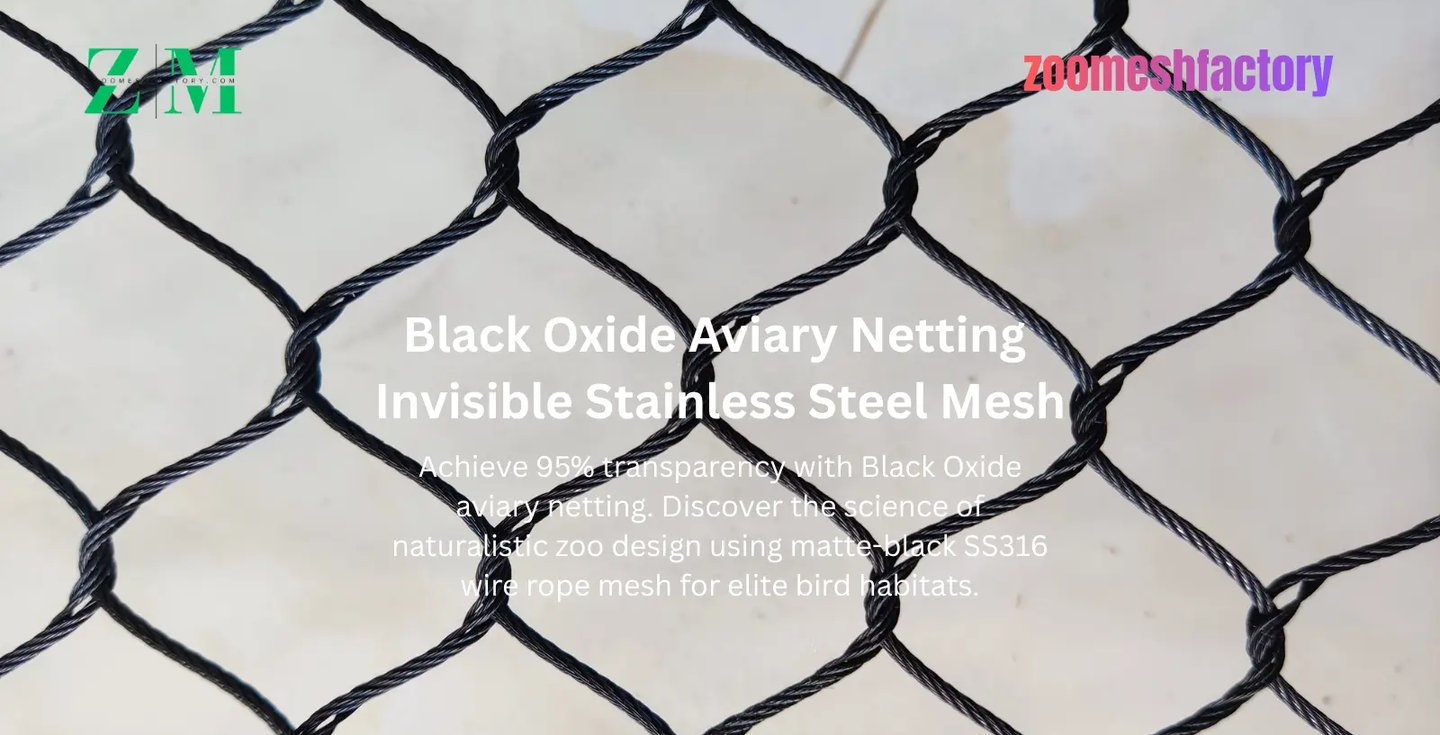
Wire gauge is what survives the beak. Conures do not just perch; they gnaw, and a parrot proof mesh is one where the metal itself discourages the behavior because it never gives. Stainless is the honest choice: it does not rust, it does not flake, and it does not leave a bird chewing on a zinc-coated surface. The finish matters too — a matte or powder coat reads as less "edible" than a bright galvanized shine, and it cuts glare in a planted flight.
Galvanized is the trap most builders fall into
Galvanized after weld looks cheap and tough, and for a garden fence it is. For a parrot it is a slow mistake: the zinc layer can wear, and the risk is a bird ingesting it. When people compare options they often reach for the lowest price, which is exactly why the alexandrine parakeet enclosure mesh guide stresses a non-toxic coating first and a number second. The same logic applies to conures — pick the safe finish, then tune the gauge.
Build the escape-proof flight
An escape-proof conure flight is mostly about edges, not the open field of the mesh. Steps that actually work:
Tension the mesh so it cannot be pushed aside at a corner.
Terminate every border with a continuous cable, not point screws that a bird can work loose.
Overlap doors and service panels so there is no gap a conure can wedge.
Check the latch — conures are clever; a simple hook is an invitation.
This is the kind of detail a black oxide mesh treatment process article covers from the finish side: a clean, scuff-free surface is also a bite-resistant one, because there is nothing rough for the bird to worry at.


Outdoor and juvenile considerations
For outdoor use, drainage and sun matter as much as spacing. A flight that holds moisture grows biofilm on the wire, and a juvenile conure exploring that surface is at higher risk. Wider mesh spacing in a roof panel is fine if the walls are right; do not trade wall safety for roof visibility. And remember that a conure raised indoors will still chew just as hard outside — the gauge does not get thinner because the weather is nice.
A quick buying checklist
Aperture: 25 mm for adults, tighter for known juvenile conure stock.
Gauge: thick enough that the wire does not flex under a bite.
Finish: stainless or certified non-toxic coat; no bare galvanized.
Edges: continuous border cable, inspected, photographed.
Frame: rigid enough that tension actually holds.
If you want the tension side of the build handled properly, the cable net tension calculation guide shows how to keep any net — parrot or raptor — from sagging into a hazard.
Common mistakes
Buying generic "parrot" wire — conures need their own spacing, not a macaw's.
Choosing on price — the cheap finish is the one a bird chews and ingests.
Loose borders — most escapes are at the edge, not the field.
Ignoring juveniles — fledglings need tighter spacing until they grow.
FAQ
Q: Is 25 mm safe for a sun conure? A: Yes for adults; if you house fledglings, drop to a tighter aperture until they grow.
Q: Will a conure chew through stainless? A: Not in any practical sense — stainless is far harder than a beak can wear, which is why it is the standard for parrot proof mesh.
Q: Can I use galvanized and just watch it? A: Not recommended; the zinc risk is real and the saving is small next to a rebuild.
Q: How do I stop escapes at the door? A: Overlap the panel, use a two-step latch, and inspect the gap monthly.
Q: Does roof spacing differ from walls? A: It can be wider on the roof if the walls are correct; never widen the walls.
Q: How often inspect? A: Monthly visual, plus after any storm or noticed looseness.
Key takeaways
Size from the toe, not the catalog: 25 mm aperture is the conure baseline.
Gauge beats shine — a chew-proof finish outlasts a cheap one.
Edges and latches cause more escapes than the open mesh.
For the full standard behind this spec, see the Parrot Enclosure Wire Gauge core page.
Spacing that survives a conure's curiosity
A conure is not a passive tenant of its aviary. These are intelligent, restless birds with strong hooked beaks and a documented talent for testing any gap the mesh leaves open. Conure aviary wire spacing is therefore less a single number than a small system: the aperture that denies a head or foot, the wire gauge that survives the beak, and the layout that stops a bird from ever reaching a weak point. Get the spacing right and the conure fills the flight with activity; get it wrong and you get a bird wedged, escaped, or chewing a strand loose by week two.
The aperture is the first decision. For most conure species the working window sits around 15–25 mm. That range is tight enough that a head cannot follow a foot through, and a toe cannot be captured and held in the cable, while still open enough for light, sightlines and easy cleaning. A smaller aperture is not automatically safer — it just trades one risk for another, because an overly fine mesh shades the flight and traps more waste in the weave. The right spacing is the one matched to the specific conure's dimensions, not a generic "small bird" guess copied from another species.
Wire gauge carries the beak load. Conures chew, and a thin strand is a strand they can work loose over time. The gauge has to be thick enough that a session of gnawing fatigues the bird before it fatigues the wire, which is why the spacing spec and the gauge spec are written together, never separately. A fine aperture on a thin wire is a net that looks right and fails quietly; a balanced aperture on a rated wire is a net that simply holds.
Escape-proofing is the layout, not just the hole. A conure that cannot squeeze through the mesh can still exploit a poorly terminated edge, a loose door frame, or a feeder port cut too wide. The wire spacing is only as good as the point where the mesh meets the structure, so the same attention paid to the aperture has to reach every fixing and every cut-out. A flight with perfect spacing and a sloppy door is a flight with one weak night.
Double mesh is the pragmatic answer when a single layer feels marginal. Running a finer inner net behind a stronger outer one gives the conure a surface it cannot breach while keeping the outer structure coercive, and it also softens the visual wall for the guest side. The spacing of each layer is chosen so the bird meets rated steel at every point, not a gap it can probe.
Inspection is the spacing's quiet partner. Apertures drift when a strand is knocked or a ferrule loosens, and a conure will find the one spot that opened. A monthly check with a gauge, plus a look after any storm or impact, keeps the spacing honest across the life of the flight. The mesh does not hold by being installed once; it holds by being watched, and a conure is exactly the bird that rewards that watching.
The payoff is a calm, busy conure in a flight that reads as open air. The spacing that survives the bird's curiosity is the spacing designed for the bird's actual behaviour, not the catalogue's rounded number — and that is the difference between an aviary that lasts and one that teaches the conure how to leave.
External Reference
World Parrot Trust — authoritative husbandry and conservation guidance for conures and other parrots.
Ready to Start Your Exhibit Design?
Join the hundreds of zoos and sanctuaries worldwide that trust ZooMesh Factory for their containment needs. Our engineers are ready to help you calculate the perfect mesh size for your species.
Contact
Hebei Zoo Mesh Co., Ltd
No. 188 Zhonghua South Street, Shijiazhuang City, Hebei Province, China
info@zoomeshfactory.com
© 2025. All rights reserved.
Quick Link
Product Catalogs
Don't leave without the specs! Save our factory-direct pricing and technical configurations for your next project meeting. Our 2026 Zoo Mesh Factory Direct Catalog is ready for download.