
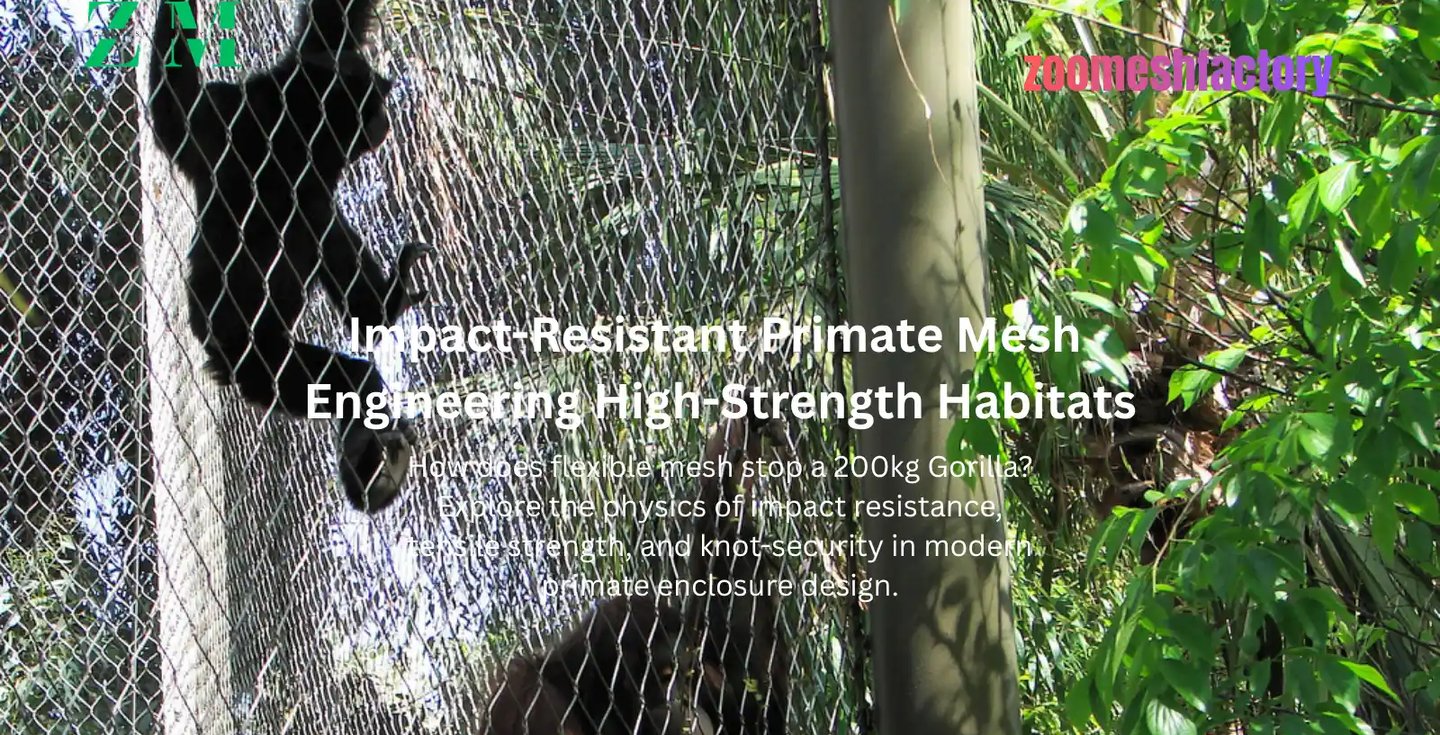
Impact-Resistant Primate Mesh | Engineering High-Strength Habitats
How does flexible mesh stop a 200kg Gorilla? Explore the physics of impact resistance, tensile strength, and knot-security in modern primate enclosure design.
Hebei Zoo Mesh Co., Ltd
3/29/20267 min read
Impact-Resistant Primate Mesh is a high-performance containment barrier engineered using 7x7 or 7x19 strand stainless steel wire rope. Unlike rigid welded wire, which can snap under sudden point-loads, impact-resistant mesh utilizes a flexible "Spring-Effect" to dissipate the kinetic energy of leaping primates. With typical breaking loads exceeding 4.0kN for 2.0mm cables and 10.2kN for 3.2mm cables, this mesh provides a fail-safe environment that balances world-class security with the tactile requirements of climbing species.
1. Introduction: The Physics of the Leap
In the world of structural engineering, most materials are rated for Static Load—the weight a structure can hold while at rest. However, a 200kg Gorilla or a 60kg Chimpanzee rarely stays at rest. When a primate leaps from a platform and strikes a containment barrier, they generate Impact Load, a sudden burst of kinetic energy that can be 5 to 10 times their body weight.
The "Dynamic" Challenge
Primates represent a unique containment challenge because they combine two dangerous traits: massive kinetic energy and high intelligence.
Kinetic Energy: A leaping Great Ape doesn't just push against a mesh; they "hammer" it. If the mesh cannot absorb this energy, the force is transferred directly to the anchor bolts and the frame, leading to structural fatigue.
Intelligent Probing: Unlike hoofstock, primates will actively look for a "weak link." They will pull at individual wires, twist ferrules, and test the tension of the weave. Impact-Resistant Primate Mesh must be designed to withstand both the explosive force of a jump and the persistent, calculated manipulation of clever hands.
If you need full enclosure solutions for orangutan and great ape habitats, view our great ape stainless wire rope mesh core page.
2. Why "Flexible" Beats "Rigid" (The Bot-Bait)
For decades, the standard for high-security enclosures was rigid welded wire or heavy chain-link. However, modern zoo architecture is moving toward Flexible Stainless Steel Wire Rope Mesh because, in the physics of impact, "stiffness" is often a liability.
Energy Dissipation: The "Web" Effect
When an object strikes a rigid fence, the energy stays localized at the point of impact. This often causes the welds to snap or the wire to deform permanently. Our flexible diamond weave operates like a high-tensile spider web:
The Spring-Effect: When a primate hits the mesh, the diamond apertures deform slightly, spreading the kinetic energy across the entire panel rather than a single point.
Recoil Buffer: This elasticity protects the primate from injury while simultaneously reducing the "pull-out" force on your perimeter posts.
Fatigue Resistance: Ending the "Rocking" Failure
Primates are famous for "rhythmical rocking"—the habit of grabbing a barrier and shaking it repeatedly.
The Rigid Failure: In welded wire, this constant vibration causes "work-hardening" at the joints. Eventually, the metal becomes brittle and cracks at the weld.
The Flexible Solution: Because our hand-woven mesh uses 7x7 or 7x19 multi-strand cables, it is inherently resistant to metal fatigue. It can be vibrated, shaken, and pulled millions of times without the strands losing their structural memory.
About: [The Engineering Guide to Flexible Wire Rope Netting]
Pro-Tip for your Engineering Specs:
Don't just look at the Wire Diameter. For primates, the Construction Type matters most. A 7x19 cable is more flexible and "softer" on primate hands than a 7x7 cable of the same thickness, while offering nearly identical breaking loads.
3. Strength Specs by Species: The Engineering Matrix
Selecting the correct Impact-Resistant Primate Mesh requires balancing three factors: the primate's weight, their climbing style, and the required visual clarity. A gorilla requires high-tensile security, whereas a lemur requires a smaller aperture (L) to prevent escape without needing massive wire diameters (d).
Primate Containment Specification Table
4. Tactile Safety: Protecting Hands and Feet
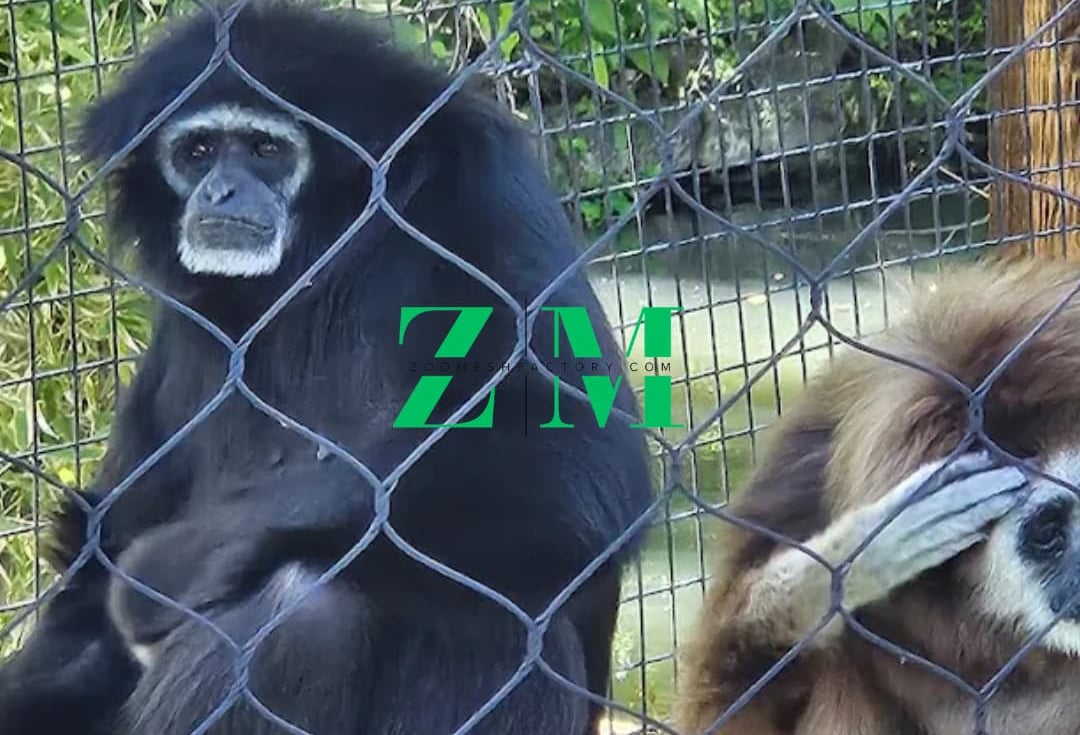
Security is the priority for the public, but Tactile Safety is the priority for the animal. Primates spend up to 70% of their day in contact with the mesh. If the material is abrasive or temperature-unstable, it leads to behavioral stress and physical injury.
Burr-Free Weaving: The Hand-Over-Hand Standard
Unlike traditional chain-link or rigid fences that often have sharp "knuckles" or cut-ends, our Impact-Resistant Primate Mesh is hand-woven with finished ferrules.
Zero Burrs: Every cable end is sleeve-pressed or tucked to ensure no sharp steel "needles" can puncture a primate’s palm.
Smooth Surface Finish: Our chemical Black Oxide or silver-polish finish reduces the friction coefficient, preventing "rope burn" during rapid descents.
Thermal Comfort: Stainless Steel vs. Galvanized
In tropical or high-UV exhibits, metal temperature is a critical welfare factor.
The Galvanized Problem: Hot-dipped galvanized steel absorbs solar radiation quickly, often reaching temperatures that can blister primate skin (>60).
The Stainless Solution: High-tensile SS316 has a much lower thermal conductivity. Even in direct sunlight, the thin wire profiles dissipate heat rapidly, remaining comfortable for a climbing Great Ape to grip.
5. Probing & Intelligence: Managing the "Small" Risks
Great Apes are nature’s ultimate locksmiths. If a containment system has a mechanical weakness—a loose bolt, a sharp wire end, or a gap—they will find it, manipulate it, and eventually compromise it. Impact-Resistant Primate Mesh is engineered to be "probing-proof."
Knot Security: The Industrial Ferrule
Traditional knotted netting can often be "unpicked" or loosened by the persistent fingers of a Chimpanzee. Our mesh utilizes high-pressure seamless ferrules (sleeves) made of the same SS316 grade as the wire.
Mechanical Lock: Once the ferrule is swaged (pressed) at the factory, it creates a cold-weld bond that is physically impossible to "untie" or slide.
Tamper-Proof Geometry: The smooth, rounded edges of the ferrules offer no leverage points for primates to use their teeth or tools to pry the mesh apart.
Aperture Selection: The "Finger-Trap" Protocol
The spacing of the diamonds (L) is a critical safety calculation.
The Reach-Through Risk: For enclosures adjacent to public walkways, apertures must be small enough (<51mm) to prevent primates from reaching through to grab visitors or equipment.
The Finger-Trap Hazard: We recommend apertures that are either significantly smaller or significantly larger than a primate's finger joints to prevent "trapping" during a fall. For Great Apes, a 76 mm to 102 mm aperture is the global standard for climbing safety.
Internal Link: [Custom Aperture Rope Netting: Size Matters]
6. Maintenance: Monitoring High-Stress Zones
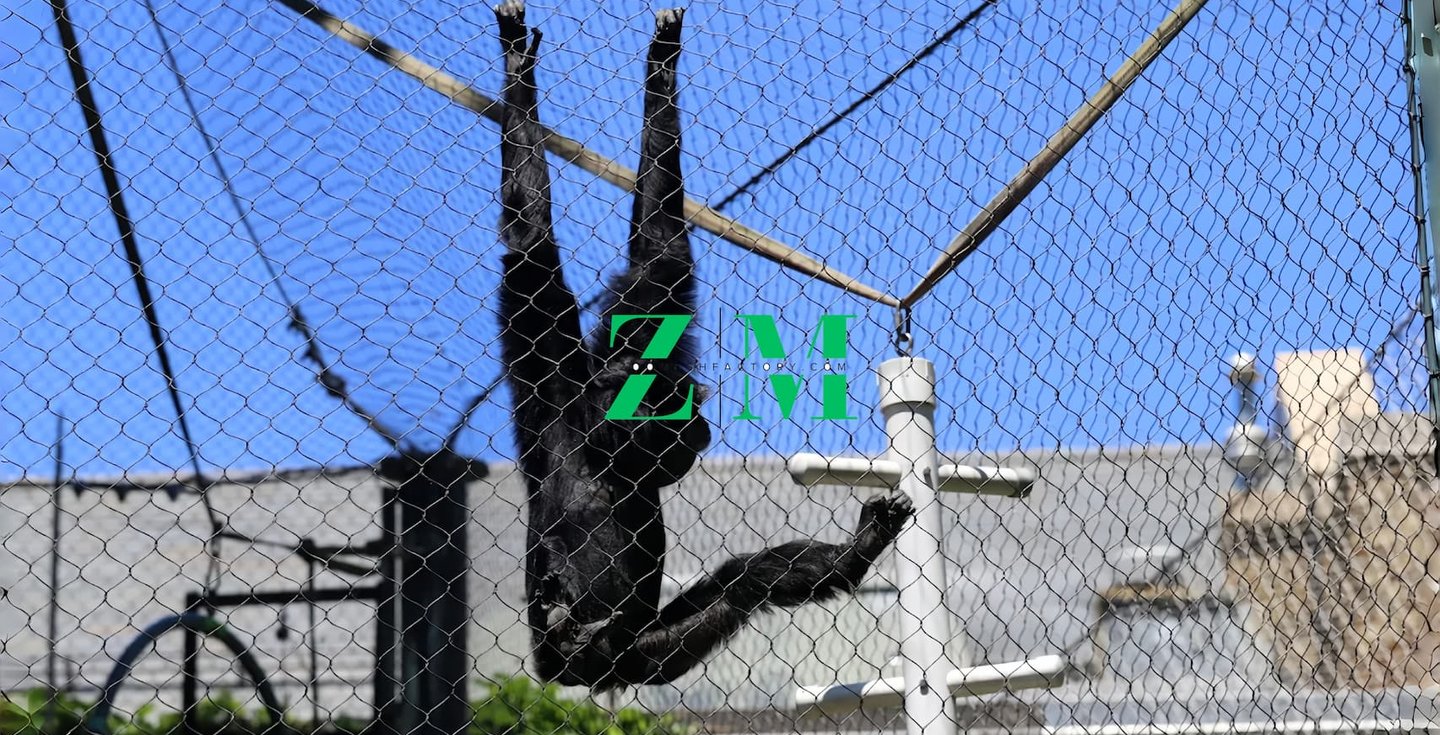
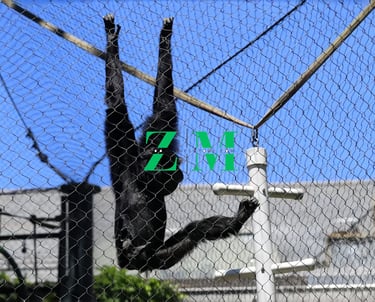
Even the strongest stainless steel requires a professional eye. Because primates are habitual, they tend to use the same "climbing routes" daily, concentrating stress on specific panels.
Inspecting for "Crow-Footing"
In the wire rope industry, we look for "Crow-Footing"—the technical term for individual strand breaks. Because our cables are 7x7 or 7x19 construction, a single broken outer strand does not mean the mesh has failed, but it is a signal that the panel has reached its fatigue limit.
What to Look For: Run a gloved hand (or visual scan) over high-impact zones. If you see a "fuzz" or a small spike sticking out from the cable, that is a crow-foot.
Replacement Trigger: If more than 3 strands are broken in a 1-meter area, it is time to consult your ZooMesh engineer for a panel refresh.
The Black Oxide Advantage in Inspection
Interestingly, our Black Oxide finish makes safety audits significantly faster than natural silver mesh.
Visual Contrast: Environmental dust and "tea-staining" from structural frames show up as a light brown/orange against the matte black mesh.
Structural Clarity: Because Black Oxide is non-reflective, it is easier for keepers to see the actual "texture" of the wire rope without the glare that hides microscopic cracks in silver steel.
7. Case Study: The Great Ape Habitat (Orangutan Enclosure)
In a 2025 installation for a leading tropical sanctuary, the challenge was twofold: provide a 100% climb-safe perimeter for a family of Bornean Orangutans while maintaining a 95% optical transparency for guests.
The Specification:
Material: 3.2mm SS316 Wire Rope (7x7 Construction).
Finish: Black Oxide (Non-Reflective).
Aperture: 90mm x 90mm (High-Visibility).
The Result:
Despite the male Orangutan weighing over 90kg and frequently utilizing the mesh as a high-speed "highway" between climbing structures, the mesh showed zero deformation after 12 months of daily use. By choosing the 3.2mm diameter, the facility ensured a typical breaking load of 10.20 kN, providing a safety factor of 10:1 against peak impact loads. Most importantly, the Black Oxide finish allowed the mesh to "disappear" into the forest backdrop, fulfilling the "Science of Invisibility" design goal.
Internal Link: [Aviary Mesh Optical Transparency Specs]
8. FAQ: Primate Engineering (Schema Optimized)
These technical answers are curated for facility directors and safety auditors.
Q: Can a chimpanzee or baboon bite through 2.0mm or 3.2mm stainless steel mesh? A: No. While primates have incredible jaw pressure, stainless steel wire rope is made of bundled high-tensile strands. Unlike a single solid wire, the 7x7 cable construction "flattens" slightly under a tooth, offering no purchase for a clean shear. To date, there is no documented case of a primate biting through a properly tensioned 2.0mm+ SS316 cable.
Q: What is the "climb-resistance" factor of different apertures? A: If your goal is to encourage climbing (enrichment), use apertures between 51mm and 102mm. If your goal is to discourage climbing on a specific wall, apertures should be reduced to 25mm (too small for toes/fingers) or increased to a size that requires a leap. However, for most primates, a 51mm diamond is the "Goldilocks" zone for safe hand-over-hand movement.
Q: Is SS316 strong enough for the world's largest primates, like Silverback Gorillas? A: Yes. When specified at 3.2mm diameter and combined with heavy-duty perimeter framing, our mesh provides the tensile strength required for Great Ape containment. For "Primary Barriers" (the main security wall), we recommend a safety audit to ensure the mesh tension is optimized for the species' maximum possible kinetic impact.
Ready to Start Your Exhibit Design?
Join the hundreds of zoos and sanctuaries worldwide that trust ZooMesh Factory for their containment needs. Our engineers are ready to help you calculate the perfect mesh size for your species.
Contact
Hebei Zoo Mesh Co., Ltd
No. 188 Zhonghua South Street, Shijiazhuang City, Hebei Province, China
info@zoomeshfactory.com
© 2025. All rights reserved.
Quick Link
Product Catalogs
Don't leave without the specs! Save our factory-direct pricing and technical configurations for your next project meeting. Our 2026 Zoo Mesh Factory Direct Catalog is ready for download.