
Designing for Invisibility: Maximize Transparency in Zoo Exhibits
Design invisible animal containment: wire-to-aperture ratios, the physics of matte black oxide finishes and seamless installation for modern, transparent zoo
Shijiazhuang Zoo Mesh Co., Ltd
2/25/20269 min read
The Era of Immersion – Redefining the Zoo Experience
The Paradigm Shift: From "Cages" to "Habitats"
In the mid-20th century, zoo design was dominated by the "menagerie" philosophy—a collection of animals kept in heavy, barred cages or behind thick concrete walls. The primary goal was containment and ease of cleaning, often at the expense of both animal welfare and the visitor experience.
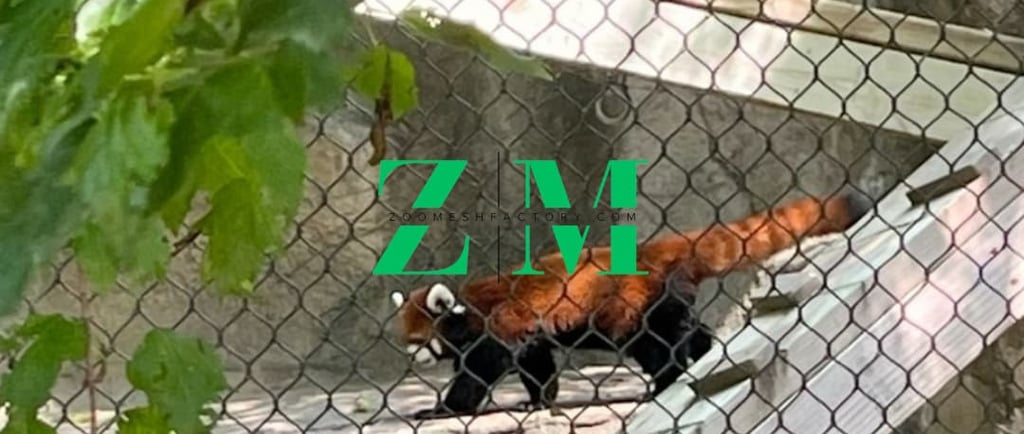
Today, the industry has undergone a radical transformation. Modern zoo architecture is now centered on Immersion Design. The objective is to transport the visitor into a replica of the animal’s natural environment. Whether it is a misty rainforest in Southeast Asia or the arid savannas of sub-Saharan Africa, the physical barriers must "vanish" to create a seamless psychological bridge between the human and the wild.
The Great Architectural Conflict
For the modern architect, this creates a significant engineering paradox. On one hand, safety is non-negotiable. Barriers must withstand the immense force of large primates, the bite pressure of apex predators, and the structural loads of environmental factors like wind and snow. On the other hand, every millimeter of visible barrier creates a "visual noise" that reminds the visitor they are standing in a facility, not a forest.
Historically, glass was seen as the solution to this conflict. However, glass presents its own set of challenges: it is expensive, it creates high-glare reflections that ruin photography, it requires constant cleaning, and it prevents the transmission of natural sounds and scents—essential elements of a truly immersive experience.
The Thesis: Hand-Woven Mesh as the "Invisible" Solution
This is where hand-woven stainless steel wire rope mesh has emerged as the definitive medium for 21st-century exhibit design. Unlike rigid welded wire or heavy chain-link, woven mesh is a "live" textile. It offers the strength of high-tensile steel but possesses the flexibility of a fabric.
When engineered with the correct wire-to-aperture ratio and treated with non-reflective coatings, this mesh achieves a level of transparency that glass cannot provide. It allows for the passage of air, light, and sound, ensuring that the visitor’s senses remain fully engaged with the exhibit. More importantly, it gives architects the freedom to design complex, organic 3D shapes—domes, tunnels, and flowing canopy walks—that were previously impossible to construct.
Why "Invisibility" Matters for Conservation
"Designing for Invisibility" isn't just about aesthetics; it is a tool for education and conservation. When a visitor can see a bird or a primate without the psychological "interference" of a visible cage, their empathy for the species increases. By removing the visual wall, we remove the mental wall between humans and nature.
In the following sections, we will explore the technical physics behind this transparency, the chemical science of non-reflective finishes, and the installation techniques required to make these massive steel structures virtually disappear.
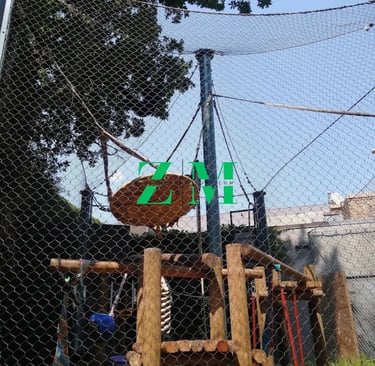
The Physics of Transparency – The Math Behind the "Invisible" Barrier
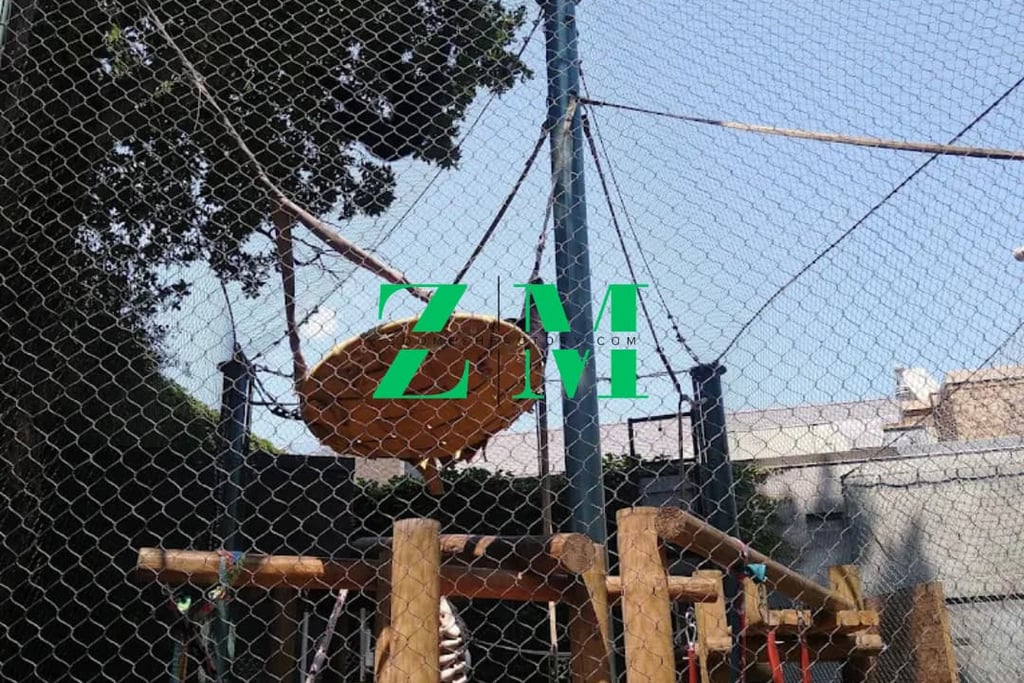
To design a truly immersive exhibit, an architect must understand that "invisibility" is not a subjective feeling—it is a measurable result of geometry and optics. In the world of stainless steel wire rope mesh, we achieve this through a precise balance of the Open Area Ratio and the human eye's focal depth.
The Mathematics of Open Area
The transparency of a mesh panel is determined by the relationship between the wire diameter and the mesh aperture. The "Open Area" represents the percentage of the enclosure that is literally made of air.
For example, consider our popular aviary netting specifications:
Wire Diameter: 1.2mm
Mesh Aperture: 25mm x 25mm
In this configuration, the steel occupies less than 5% of the total surface area. This results in a 95% Open Area Ratio. To the human eye, which naturally seeks to focus on high-contrast objects (like a colorful bird or a moving primate) beyond the mesh, a 95% opening allows the brain to effectively "filter out" the thin lines of the wire.
The "Focal Blur" Effect
Architects can further maximize invisibility by understanding Depth of Field. When a visitor stands 2 to 3 meters away from the mesh and looks at an animal 10 meters away, the mesh falls into the "foreground blur" of the human eye.
Because hand-woven mesh is composed of round wire ropes rather than flat, wide bars, it does not create a solid "wall" of reflection. The light wraps around the thin 7 x 7 cable construction, minimizing the visual footprint of the barrier. This is a primary reason why hand-woven mesh is safer and more aesthetic than traditional chain-link or welded wire.
Aperture Shape: Diamonds vs. Squares
The diamond shape of woven mesh is not just for structural flexibility; it is an optical tool.
Vertical Tension: By stretching the diamonds vertically, we create longer, thinner lines that mimic the verticality of grass and trees.
Horizontal Orientation: For wide, panoramic views, orienting the diamonds horizontally can follow the natural scanning motion of the human eye, making the barrier feel less restrictive.
Breaking Load vs. Visibility
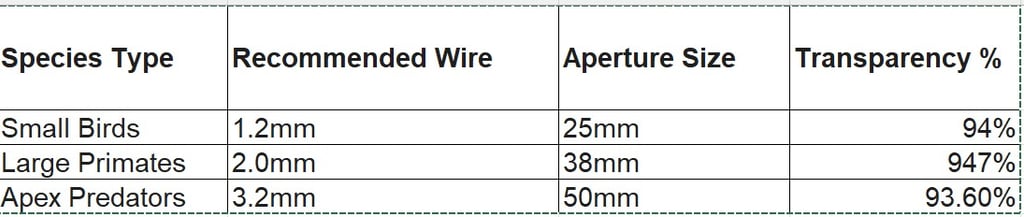
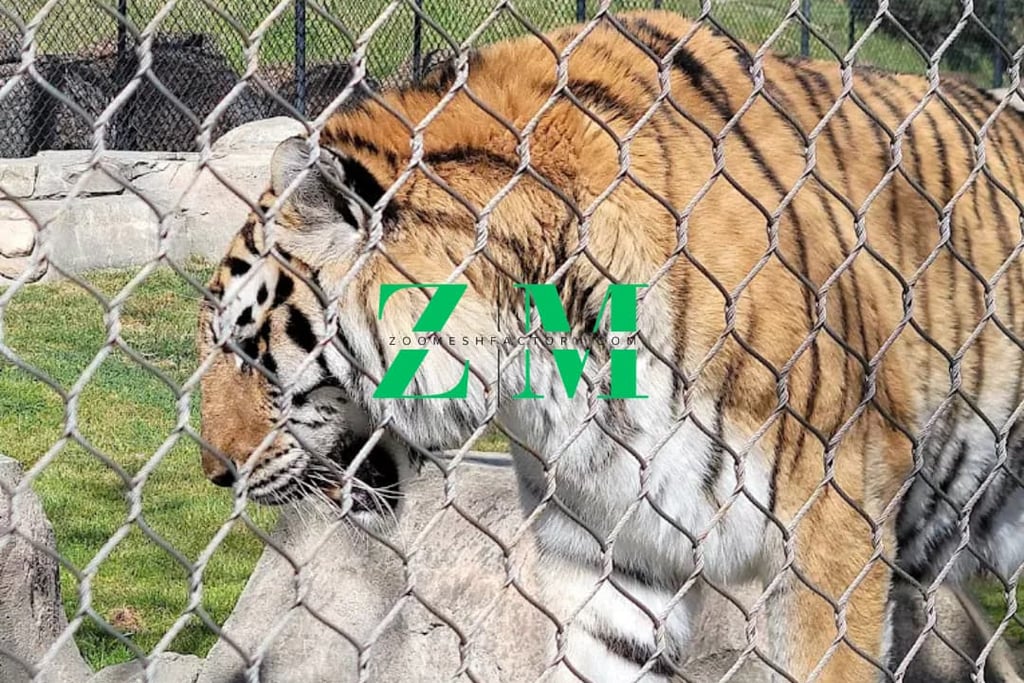
The greatest challenge in modern zoo exhibit design is maintaining this transparency when housing high-strength animals like tigers or orangutans.
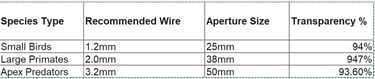
As shown above, even when the wire diameter triples to accommodate the strength of a tiger, we can maintain over 93% transparency by strategically increasing the aperture size. This ensures that even high-security exhibits remain visually stunning.
Optical Interference and Glare
Even a 95% open area can become visible if the steel reflects too much light. This is known as "Specular Reflection." To combat this, architects must consider the finish of the steel. While natural stainless steel is durable, its reflective properties can create a "shimmer" that alerts the eye to the barrier’s presence.
To solve this, we often recommend moving from natural steel to a matte finish. For a deeper dive into how material grades affect both look and longevity, read our guide on SS304 vs. SS316 Mesh Grades.
The Black Oxide Advantage – The Chemical Secret to Invisibility
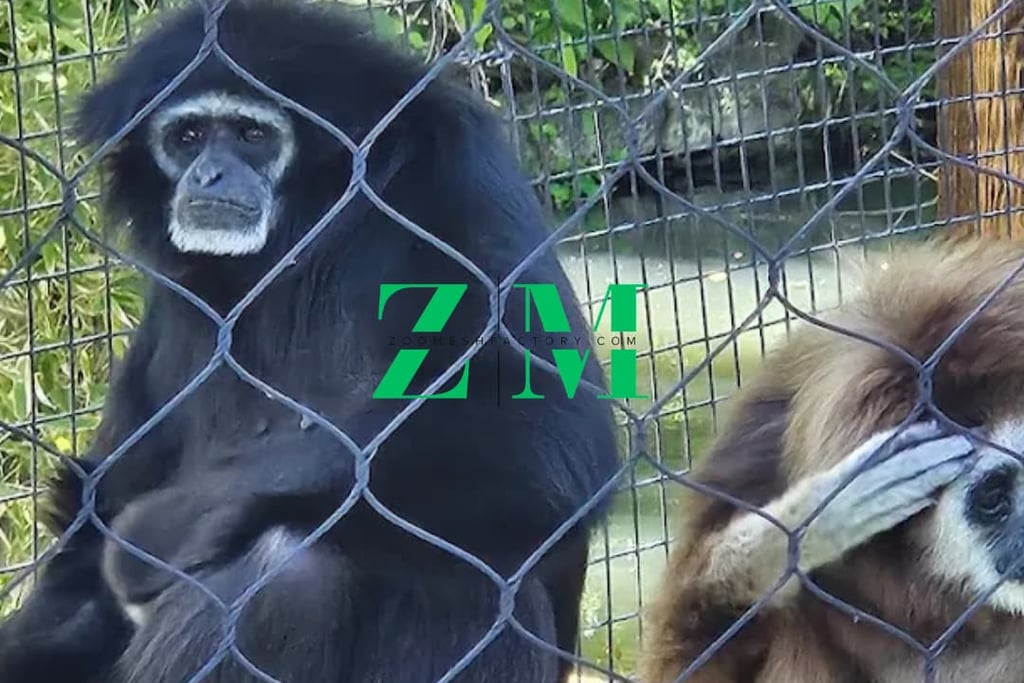
While the Open Area Ratio determines how much light passes through the mesh, the surface finish determines how much light reflects off it. In architectural circles, the ultimate goal is to eliminate specular reflection—the "glint" of sun on metal that immediately alerts the human eye to a barrier's existence.
The Problem with "Natural" Stainless Steel
Standard stainless steel, while beautiful in industrial applications, acts as a series of tiny mirrors. In a zoo environment, these mirrors catch the sunlight and create a "shimmering curtain." This is especially problematic in:
Photography: Lens flare occurs when light bounces off the mesh into the camera.
Bright Climates: In tropical or desert exhibits, the glare can be physically uncomfortable for visitors.
Forest Exhibits: The bright silver lines clash with the dark greens and browns of a naturalistic habitat.
What is Black Oxide?
Unlike paint or powder coating—which can chip, crack, and add thickness to the wire—Black Oxide is a chemical conversion coating. It is a "living" part of the steel's surface. Through a controlled oxidation process, the outer layer of the stainless steel is transformed into a matte, charcoal-black finish.
The Science of Light Absorption
Black oxide works because it has a high Absorption Coefficient. While natural steel reflects light in all directions, the matte black surface absorbs nearly all incoming light waves.
Contrast Reduction: In a shaded or forested exhibit, the mesh becomes darker than the background, causing the human eye to naturally "look past" it.
Enhanced Color Saturation: When the barrier is invisible, the colors of the animals and plants appear more vivid and saturated to the visitor.
Maintenance and Durability of the Finish
For architects, the "life-cycle cost" is just as important as the initial look. One might worry that a black finish would fade or scratch. However, because Black Oxide is a chemical change to the metal itself:
It cannot peel: There is no "layer" to flake off into the animal's environment, making it a key part of safe and humane exhibit design.
Scratch Resistance: Even if a primate's nails scratch the surface, the dark tone remains consistent throughout the treated layer.
UV Stability: Unlike plastic-coated wires, Black Oxide is 100% UV-stable and will not become brittle or gray under intense sun exposure.
Architectural Integration: Choosing the Right "Black"
Not all black finishes are created equal. In modern zoo design, we often aim for a "charcoal" or "gunmetal" tone rather than a jet black. This mimics the natural shadows found in nature.
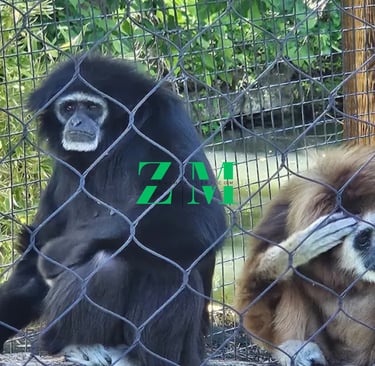
When this finish is combined with the correct tensioning techniques, the result is a panel that stays perfectly flat and matte, allowing for the "near-invisible" effect seen in world-class facilities like the Alpine Wildlife Park expansion.
Technical Integration – Hiding the Perimeter and the "Floating" Mesh Effect
The most common mistake in exhibit design is choosing a high-transparency mesh and then surrounding it with heavy, industrial steel frames. To the visitor, the thick frame acts as a "picture border" that reinforces the sense of confinement. To achieve a seamless transition, architects must use clever integration techniques to hide the perimeter.
1. Boundary Cable Systems (The Frame-less Look)
Instead of attaching mesh directly to a rigid steel tube, modern designs often utilize a high-tension boundary cable.
The Technique: A thick stainless steel structural cable is anchored to primary pillars. The hand-woven mesh is then laced to this flexible cable.
The Result: Because the boundary cable is much thinner than a steel pipe, the edges of the enclosure seem to vanish into the landscape. This is particularly effective for large-scale aviary netting where the mesh needs to span vast distances.
2. The "Pocket" or "Recessed" Mounting
For exhibits with rockwork or themed concrete walls (shotcrete), architects can use the "Pocket" method.
The Technique: A channel or "pocket" is cast directly into the concrete or hidden behind artificial rock. The perimeter of the mesh is secured inside this channel.
The Result: The mesh appears to grow directly out of the stone. There are no visible bolts, ferrules, or lacing wires. This is the gold standard for modern animal enclosures where the goal is a 100% naturalistic look.
3. Strategic Lacing: The Spiral Stitch
The way the mesh is joined to its support determines the "cleanliness" of the design. Using the correct tensioning and lacing techniques is vital.
Spiral Lacing: A single strand of wire rope is spiraled through every mesh diamond and around the support cable.
Visual Symmetry: When done correctly, the lacing wire becomes an extension of the mesh pattern itself, making the joint invisible from more than two meters away.
4. Managing the "Sag" and "Bowing"
A sagging mesh is a visible mesh. To keep the barrier invisible, it must remain perfectly flat and under consistent tension. Architects must calculate the Pre-stress Loads to ensure that:
Wind Loads: The mesh doesn't "flap" or vibrate in high winds (which creates a shimmering effect).
Snow Loads: In colder climates, the mesh can support the weight of snow without permanent deformation. (For more on environmental durability, see our guide on SS304 vs. SS316 grades).
5. The "Angle of Incidence" Strategy
By tilting the mesh panels at a slight 5-degree angle away from the visitor path, architects can ensure that any remaining light reflections are bounced toward the ground or the sky, rather than directly into the visitor’s eyes. This small adjustment can increase perceived transparency by up to 20%.
Sustainability and Life-Cycle Value – The Green Choice
In an era where "Green Building" certifications (such as LEED or BREEAM) are becoming mandatory for public institutions, the choice of containment material carries significant weight. Stainless steel woven mesh is not just a high-performance barrier; it is one of the most sustainable materials available in modern construction.
1. 100% Recyclability
Unlike plastic-coated chain link or chemically treated timber, stainless steel wire rope mesh is 100% recyclable. At the end of its multi-decade lifespan, the material can be melted down and repurposed without any loss of quality. For zoos focused on conservation, using a "circular" material aligns the physical infrastructure with the institution's mission.
2. Longevity vs. Replacement Costs
The "True Cost" of an enclosure is not the purchase price, but the cost per year of its life.
Low Durability Materials: Materials like galvanized steel or nylon netting may be cheaper initially, but they require replacement every 5–10 years due to rust or UV degradation.
The ZooMesh Standard: By selecting the correct grade—such as SS316 for coastal environments—architects specify a product that can last 30+ years with virtually zero structural maintenance.
3. Reducing the Carbon Footprint of Maintenance
Because stainless steel does not require painting, staining, or anti-corrosive coatings, there are no Volatile Organic Compounds (VOCs) leaching into the soil or water over time. Furthermore, the high transparency of the mesh allows for natural airflow and sunlight penetration. This reduces the need for artificial climate control or lighting in indoor-outdoor transition zones, significantly lowering the facility's energy consumption.
4. Passive Safety: The Ultimate ROI
A primary goal of safe and humane exhibit design is the reduction of veterinary costs. When an enclosure is designed to be "impact-absorbing" and "beak-safe," the frequency of animal injuries drops. For a zoo, the avoidance of a single medical procedure for a high-value animal can pay for the price difference of premium mesh in a single day.
5. Conclusion: The "Invisible" Legacy
Designing for invisibility is a masterclass in balance. It requires the strength of an industrial facility, the precision of a laboratory, and the soul of a natural wilderness. By utilizing the principles of open area ratios, matte finishes, and seamless integration, architects can create spaces where the boundaries disappear, leaving only the connection between the visitor and the wild.
At ZooMesh Factory, we don’t just manufacture wire; we provide the raw materials for these immersive experiences. From the first sketch to the final tensioning of the mesh, we are your partners in creating the future of zoo architecture.
Ready to Design Your Next Immersive Habitat?
Our engineering team provides custom weaving for the world's most complex zoo projects. Fill out the form below to receive a technical consultation within 24 hours.
Ready to Start Your Exhibit Design?
Join the hundreds of zoos and sanctuaries worldwide that trust ZooMesh Factory for their containment needs. Our engineers are ready to help you calculate the perfect mesh size for your species.
Contact
Hebei Zoo Mesh Co., Ltd
No. 188 Zhonghua South Street, Shijiazhuang City, Hebei Province, China
info@zoomeshfactory.com
© 2025. All rights reserved.
Quick Link
Product Catalogs
Don't leave without the specs! Save our factory-direct pricing and technical configurations for your next project meeting. Our 2026 Zoo Mesh Factory Direct Catalog is ready for download.