
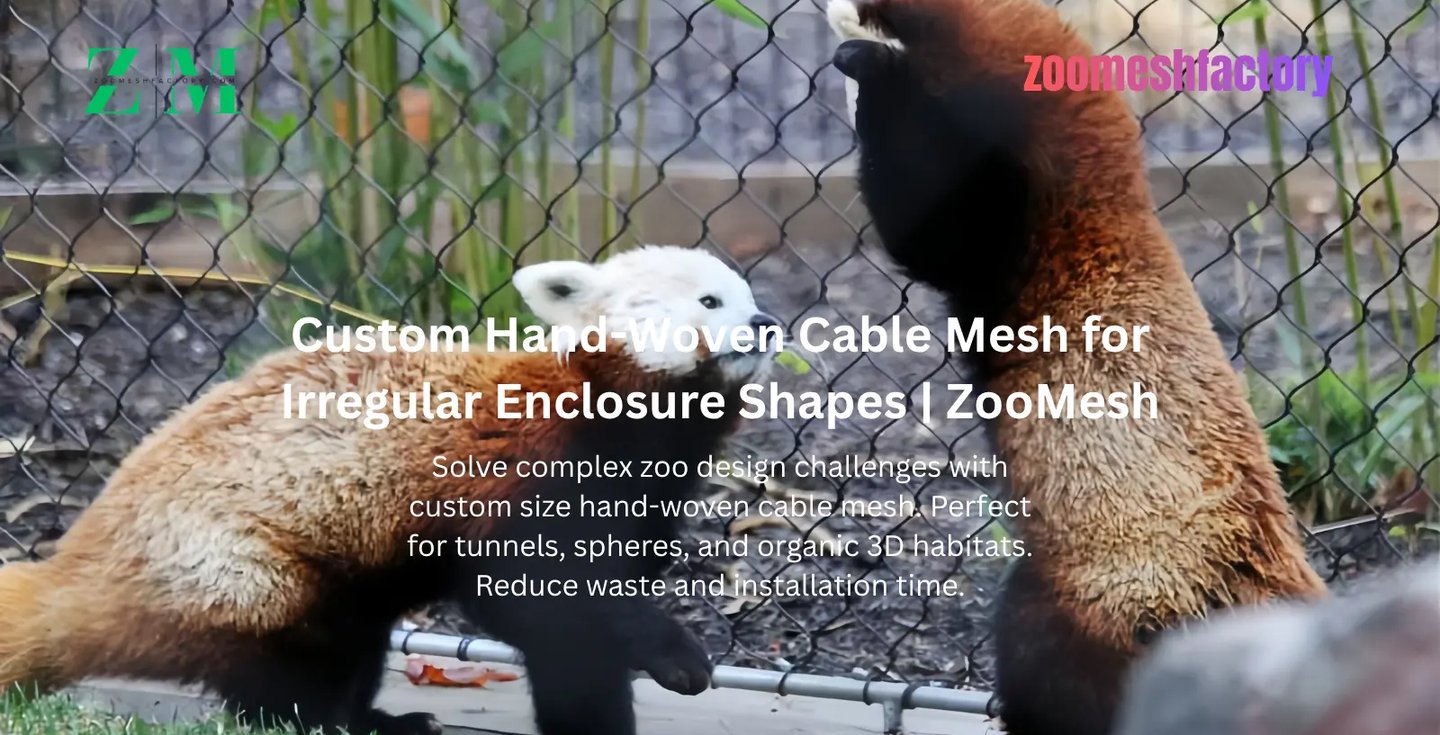
Custom Hand-Woven Cable Mesh for Irregular Enclosure Shapes | ZooMesh
Solve complex zoo design challenges with custom size hand-woven cable mesh. Perfect for tunnels, spheres, and organic 3D habitats. Reduce waste and installation time.
Hebei Zoo Mesh Co., Ltd
4/10/20269 min read
I. Introduction: The Death of the Right Angle
For over a century, zoo design was dictated by the limitations of the materials available: flat concrete walls, square iron cages, and rigid chain-link panels. This created a "boxy" environment that felt artificial to the visitor and restrictive to the animal. However, we are currently witnessing a revolution in zoological master planning: the move toward Organic Architecture.
The Rise of Organic Habitat Design
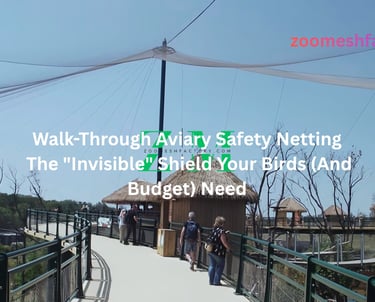
Modern habitats now mimic the fluid, non-linear shapes found in nature. From the soaring, parabolic curves of walkthrough aviaries to the twisting, 3D tunnels of primate "sky-walks," the right angle is disappearing. Architects want enclosures that blend into the topography, wrapping around trees and following the natural contours of the land.
Why "Off-the-Shelf" Fencing is the Enemy
Traditional fencing is the "square peg" in the "round hole" of modern design.
The Framing Nightmare: Rigid panels require heavy, straight-line structural steel frames. To create a curve with rigid panels, you must build a series of small, faceted flat sections, which is expensive and visually cluttered.
The "Cut-and-Waste" Crisis: When contractors try to fit standard 2m x 10m mesh rolls into irregular triangular or trapezoidal openings, they often waste up to 30% of the material and leave behind sharp, dangerous edges that require extensive grinding and finishing.
Refer to the ultimate zoo mesh guide for full specs before ordering custom shaped panels.
II. The Mechanics of Irregular Geometry
To build an organic habitat, you need a material that is "form-active." Custom Size Hand-Woven Cable Mesh for Irregular Enclosure Shapes is not just a barrier; it is a structural fabric that thrives under complex geometry.
The 3D Challenge: Behavior on Curved Surfaces
Unlike welded wire mesh, which snaps or buckles when bent in multiple directions, hand-woven cable mesh is inherently flexible.
Double Curvature: Our mesh can handle synclastic and anticlastic (saddle-shaped) curves. This means it can wrap around a sphere or follow the interior of a twisting tunnel without losing its structural integrity.
Conforming to Nature: If a design requires the mesh to wrap tightly around a living tree or a rock formation, the cable system can be "laced" directly to the anchor points, following the irregular perimeter perfectly.
Understanding Biaxial Tension
The secret to the mesh’s adaptability lies in its Biaxial Tensioning capabilities.
The Diamond Variable: Because the mesh is hand-woven into a diamond pattern, the internal angle of the diamonds can slightly expand or contract. When tension is applied, the mesh "self-adjusts" to the frame.
Adapting to Non-Linear Frames: In an irregular trapezoidal frame, the tension is rarely uniform. Hand-woven mesh allows for the load to be redistributed across the cables, ensuring that even in a shape with five or six different side lengths, the "skin" of the enclosure remains taut, secure, and aesthetically smooth.
III. Manufacturing to CAD: The Factory-to-Site Pipeline
In a high-stakes zoo construction project, "good enough" is never enough. A 10mm discrepancy in a rigid panel can halt an entire installation. Our process replaces guesswork with mathematical precision, aligning our factory looms with your architectural software.
From Blueprints to Loom: Digital Translation
We don't just sell rolls of mesh; we manufacture components. When a design firm submits a CAD or PDF blueprint, our engineers analyze the vertex coordinates of each opening.
The Custom Weave: We calculate the exact number of diamond repetitions required to fill the specific height and width of your frame.
Edge Preparation: Every custom panel is finished with reinforced border edges or open loops, depending on your specified attachment method (e.g., tube-wrapped or eye-bolt tensioned). This ensures that when the panel arrives on-site, it "clicks" into place like a puzzle piece.
Managing Irregular Perimeters: Beyond the Rectangle
Modern exhibits often feature geodesic domes or faceted glass-and-mesh hybrids. These structures are composed of dozens of unique triangular and trapezoidal facets.
Zero-Waste Geometry: Instead of shipping a square sheet for a triangular hole, we weave the triangle. This precision eliminates the "field-cutting" that compromises the protective passive layer of the stainless steel.
Tension Uniformity: By weaving specifically for an irregular shape, we ensure that the tension vectors are aligned with the frame's corners, preventing the "dead spots" or sagging commonly seen in makeshift fencing.
IV. Case Study: Overhead Primate Tunnels and "O-Lines"
One of the most complex applications for irregular mesh is the Overhead Primate Tunnel (often called an O-Line). These systems allow Orangutans or Lemurs to travel above the public, requiring a 360-degree cylindrical or elliptical barrier that must be both secure and aesthetically "light."
Engineering a 360-Degree Containment Tube
Creating a tube with rigid materials requires heavy circular ribs every meter. With Hand-Woven Cable Mesh, the mesh itself provides much of the structural form.
The "Sock" Method: We can manufacture the mesh as a continuous sleeve or a high-precision flat panel designed to wrap perfectly around circular hoops. This creates a seamless, "invisible" tunnel that offers the animal a 360-degree view of the zoo.
Climbing Ergonomics: Because the mesh is hand-woven, it provides a consistent tactile grip for the primates regardless of the tunnel's incline or curve.
Solving the "Sag" Problem in Long-Span Walkways
Long-span walkways are prone to "gravity sag," which can bring the mesh too close to the public or cause the primates to feel unstable.
Pre-Tensioned Integrity: By using custom-sized panels integrated with high-tensile SS316 border cables, we solve the sag problem. The mesh is engineered to be pulled "drum-tight" across long horizontal spans.
Dynamic Load Handling: Our 7x7 or 7x19 cable construction allows the tunnel to flex slightly as the primate moves, absorbing the "bounce" and preventing the structural fatigue that leads to snapping in welded alternatives.
More: [Stainless Steel Wire Rope Mesh for Great Ape Enclosures]
V. Cost Optimization: Eliminating On-Site Waste
In large-scale zoo construction, the "Hidden Costs" of standard materials can easily blow a budget. When you order Custom Size Hand-Woven Cable Mesh for Irregular Enclosure Shapes, you are shifting the labor from the expensive field site to our controlled factory environment.
The Hidden Cost of "Field Cutting"
When a contractor buys standard bulk rolls to fit a non-linear habitat, several things happen:
Material Waste: Cutting a rectangle to fit a trapezoid often results in 15% to 25% of the stainless steel ending up in the scrap bin.
Labor Intensity: Manually trimming SS316 cable is slow and physically demanding. In a 1,000 $m^2$ project, field-trimming can add hundreds of man-hours.
Corrosion Risk: Field-cut ends that aren't properly finished or capped are the first places where "tea-staining" (surface rust) begins. Our factory-finished edges are chemically passivated, ensuring the 30-year lifespan remains intact.
The "Bespoke" ROI
By delivering panels that are pre-sized to your CAD specs, we reduce the on-site installation time by nearly 40%. The contractor simply unrolls, positions, and laces. The higher upfront precision results in a significantly lower "Final Installed Cost."
V. Cost Optimization: Eliminating On-Site Waste
In large-scale zoo construction, the "Hidden Costs" of standard materials can easily blow a budget. When you order Custom Size Hand-Woven Cable Mesh for Irregular Enclosure Shapes, you are shifting the labor from the expensive field site to our controlled factory environment.
The Hidden Cost of "Field Cutting"
When a contractor buys standard bulk rolls to fit a non-linear habitat, several things happen:
Material Waste: Cutting a rectangle to fit a trapezoid often results in 15% to 25% of the stainless steel ending up in the scrap bin.
Labor Intensity: Manually trimming SS316 cable is slow and physically demanding. In a 1,000 m2 project, field-trimming can add hundreds of man-hours.
Corrosion Risk: Field-cut ends that aren't properly finished or capped are the first places where "tea-staining" (surface rust) begins. Our factory-finished edges are chemically passivated, ensuring the 30-year lifespan remains intact.
The "Bespoke" ROI
By delivering panels that are pre-sized to your CAD specs, we reduce the on-site installation time by nearly 40%. The contractor simply unrolls, positions, and laces. The higher upfront precision results in a significantly lower "Final Installed Cost."
VI. Installation Techniques for Complex Shapes
Installing mesh on a 3D organic shape is more like "tailoring a suit" than building a fence. It requires a specific set of techniques to ensure the tension is balanced across every curve.
Using "Border Ropes" for Irregular Edges
For organic shapes, we often recommend a Border Rope (Primary Cable) system.
The Frame-to-Mesh Bridge: Instead of attaching the mesh directly to a rigid steel frame, the mesh is laced to a high-tension perimeter cable. This allows the mesh to "float" and self-adjust its diamond geometry, preventing local stress concentrations that could cause tearing.
Invisible Transitions: Border ropes allow the mesh to follow complex, undulating perimeters (like rock faces) where a straight steel bar simply cannot go.
The "Stitching" Method: Creating Invisible 3D Seams
When wrapping a 360-degree primate tunnel or a spherical aviary, you will inevitably have seams where two panels meet.
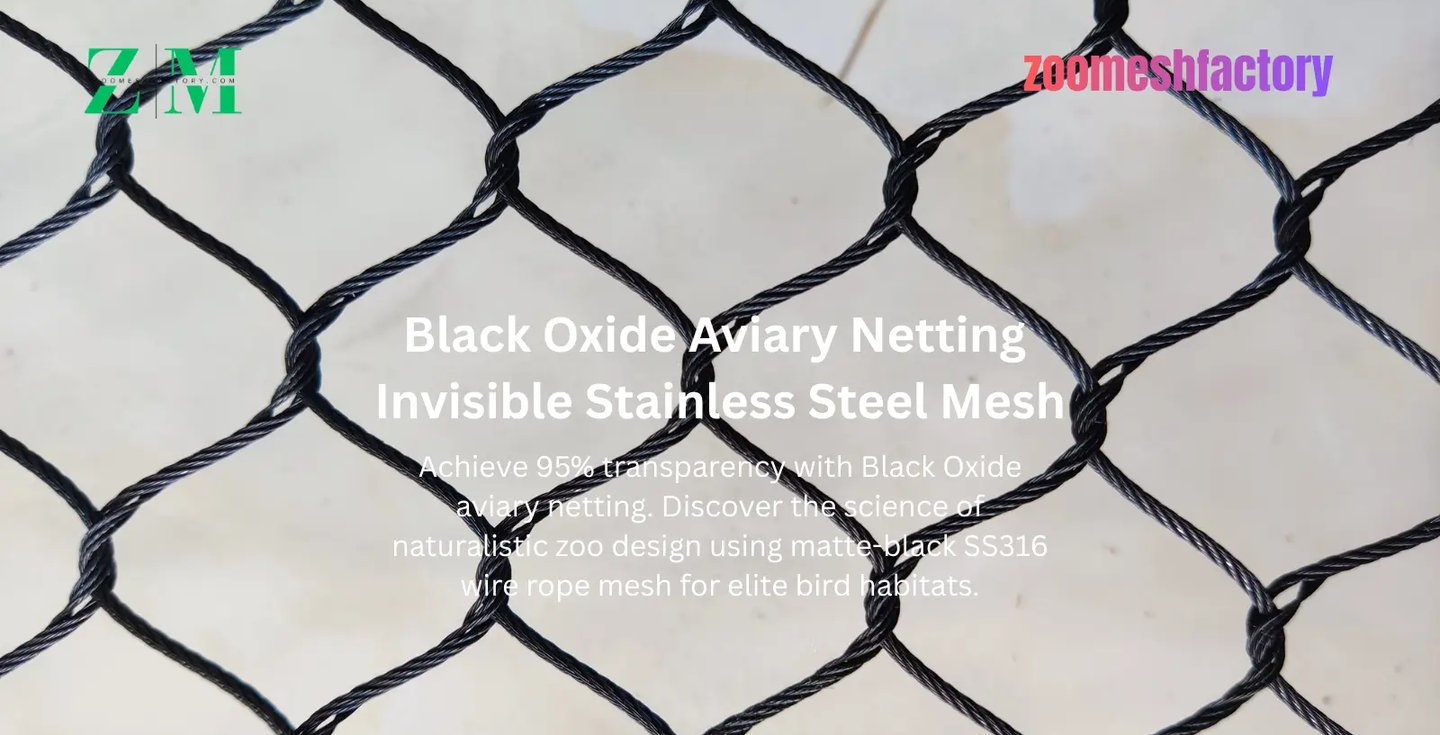
Continuous Lacing: We provide matching SS316 lacing wire that allows installers to "stitch" panels together diamond-by-diamond.
Seamless Continuity: Once the tension is applied, the seam becomes invisible. This is vital for high-end "Naturalistic" exhibits where the presence of a vertical joint would break the guest's immersion.
VII. Maintaining Structural Integrity in Organic Shapes
When you move away from flat planes, the physics of containment changes. In a flat fence, gravity is your main enemy; in an organic 3D shape, you are dealing with Multi-Axial Tension.
Calculating Load Distribution on Curved Surfaces
On a "saddle" curve (anticlastic) or a dome (synclastic), the load isn't concentrated at the bottom—it is distributed across the entire surface.
The "Fabric" Effect: Because our mesh is hand-woven, it behaves like a structural fabric. If a 200kg primate lands on one section of a curved tunnel, the tension is shared by the cables running both longitudinally and latitudinally.
Anchor Point Stress: For irregular shapes, we calculate the Vector Pull at each corner. Irregular shapes often have "High-Stress Anchors" where three or more panels meet. We recommend reinforced SS316 eye-bolts or heavy-duty "Clevis" ends for these critical junctions to ensure the frame doesn't warp under the mesh's tension.
Inspection Protocols for Non-Linear Exhibits
Organic shapes require a "Tactile Inspection."
Tension Checks: Keepers should check for "Soft Spots"—areas where the mesh feels loose compared to the rest of the panel. This is often a sign that the boundary cable has shifted or the frame has settled.
Point-of-Contact Wear: Inspect areas where the mesh wraps around tight radii (corners). Even the highest-quality SS316 can experience localized wear if it is rubbing against a sharp structural edge.
VIII. Conclusion: Designing Without Boundaries
The future of zoological architecture is organic, immersive, and boundary-pushing. By utilizing Custom Size Hand-Woven Cable Mesh for Irregular Enclosure Shapes, architects and engineers are no longer "building cages"—they are "weaving habitats."
The transition from rigid, boxy enclosures to fluid 3D environments is more than an aesthetic choice; it is a commitment to animal welfare and guest engagement. When you partner with a manufacturer capable of translating CAD data into bespoke hand-woven panels, you unlock:
Engineering Precision: A perfect fit for tunnels, spheres, and domes.
Financial Efficiency: Zero-waste manufacturing that lowers the total project cost.
Visual Immersion: A seamless, high-tension barrier that respects the beauty of the natural landscape.
Don't let the "Right Angle" limit your vision. If you can draw it in CAD, we can weave it in steel.
Custom Size Hand-Woven Cable Mesh FAQ
Can hand-woven cable mesh be manufactured to fit CAD-designed irregular shapes?
Yes. We specialize in translating complex CAD blueprints into bespoke mesh panels. Whether your design features trapezoids, triangles, or parabolic curves for 3D tunnels, our hand-weaving process allows us to create panels that match your vertex coordinates exactly, ensuring a perfect fit for organic enclosure shapes."
How does custom-sized mesh reduce zoo construction costs?
Ordering custom-sized panels reduces total project costs by eliminating 'field-cutting' labor and material waste. Traditional bulk rolls often result in 20% waste when fitting irregular frames; bespoke panels are woven to size, reducing on-site installation time by up to 40% and ensuring zero wasted stainless steel.
What is the best way to attach mesh to a non-linear or organic frame?
For irregular perimeters, we recommend a 'Border Rope' or 'Primary Cable' system. Instead of rigid fasteners, the mesh is laced to a high-tensile SS316 cable that follows the organic contour of the frame. This allows the mesh to self-adjust its tension across complex 3D surfaces like tunnels and domes.
Is flexible wire rope mesh strong enough for irregular high-impact zones?
Yes. Hand-woven cable mesh thrives in irregular shapes because of its biaxial tension capabilities. On curved surfaces, the mesh acts as a structural fabric, distributing dynamic loads (like an animal's leap) across the entire panel rather than concentrating stress on a single weld point, making it safer for high-impact species.
Can you create seamless joints in 360-degree primate tunnels?
Absolutely. By using our specialized 'Stitching' method with matching SS316 lacing wire, installers can join custom panels diamond-by-diamond. Once tensioned, the seam becomes structurally integrated and visually invisible, providing a continuous, secure containment 'sock' for overhead primate walks.
Ready to Start Your Exhibit Design?
Join the hundreds of zoos and sanctuaries worldwide that trust ZooMesh Factory for their containment needs. Our engineers are ready to help you calculate the perfect mesh size for your species.
Contact
Hebei Zoo Mesh Co., Ltd
No. 188 Zhonghua South Street, Shijiazhuang City, Hebei Province, China
info@zoomeshfactory.com
© 2025. All rights reserved.
Quick Link
Product Catalogs
Don't leave without the specs! Save our factory-direct pricing and technical configurations for your next project meeting. Our 2026 Zoo Mesh Factory Direct Catalog is ready for download.