
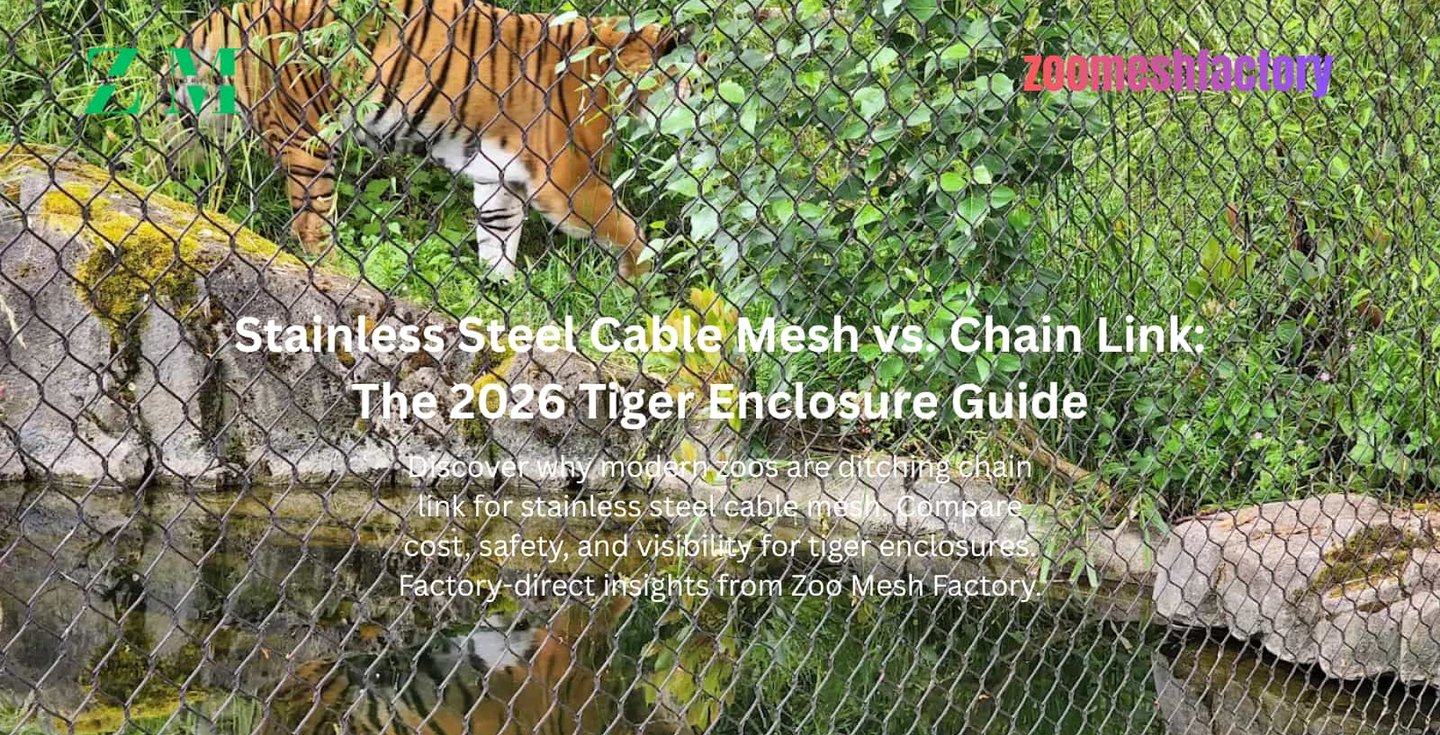
Stainless Steel Cable Mesh vs. Chain Link: Tiger Enclosure Guide
Why modern zoos are ditching chain link for stainless steel cable mesh in tiger enclosures: compare cost, safety and visibility. Factory-direct insights from
Hebei Zoo Mesh Co., Ltd
5/12/20269 min read
Is stainless steel cable mesh better than chain link for tiger enclosures? Yes. While chain link has a lower upfront cost, stainless steel cable mesh (SS316) offers a 30-year lifespan, 90% visibility for visitors, and superior impact absorption. Unlike rigid chain link, handwoven mesh distributes the force of a 500lb tiger's strike across the entire panel, preventing deformation and ensuring maximum safety.
Key Takeaways
Impact Resistance: Handwoven mesh acts like a high-tension spring; chain link bends and stays bent.
Visitor Experience: 90% transparency vs. the "prison-cell" look of thick chain link.
Maintenance: SS316 is rust-proof even in humid zoo climates; no painting or coating required.
Direct Savings: Buying factory-direct from zoomeshfactory.com eliminates middleman markups.
I. The Evolution of the "Zoo Fence": From Cages to Landscapes
The "zoo fence" is no longer just a barrier; it is a critical design element in the modern movement toward habitat immersion. If you look back thirty years, tiger enclosures were essentially concrete boxes with heavy iron bars. They screamed "prison," both to the animal and the guest. But in 2026, the global standard has shifted. We are now in the era of the "invisible barrier."
From "Containment" to "Immersion"
Modern zoo architecture aims to make the visitor feel as though they are stepping into the tiger’s world—the jungles of Sumatra or the snowy forests of Amur—not standing outside looking at a captive specimen. To achieve this, the fencing must disappear.
Traditional materials like heavy-gauge chain link or vertical steel pickets create a visual "stutter." The human eye constantly hits the thick wire, reminding the brain of the barrier. By evolving toward stainless steel cable mesh, zoos can now create massive, open-span habitats. This mesh allows for natural light, airflow, and, most importantly, an unobstructed line of sight. When you reduce the wire diameter while increasing the strength, you transition from a "cage" to a "landscape."
The Psychological Impact of the Barrier
The evolution of fencing isn't just for the humans; it’s for the cats. Tigers are apex predators with a roaming range of hundreds of miles in the wild. High-visibility, rigid fencing—like thick chain link—can increase stereotypic behaviors in large felids. They feel confined.
Furthermore, from a visitor’s psychological perspective, seeing a magnificent tiger behind a "prison-style" fence creates a sense of guilt rather than awe. By utilizing a sleek, handwoven mesh that blends into the shadows (especially when treated with a black oxide finish), zoos foster a deeper emotional connection between the guest and the animal. This connection is what drives conservation donations and repeat visits. Traffic is king, but experience is the kingdom.
While big cats require sheer strength, primates and leopards demand more specialized agility-based engineering.
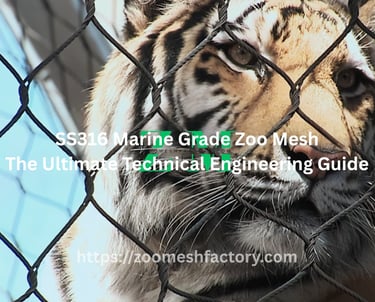
II. Strength Comparison: The Physics of a Tiger Strike
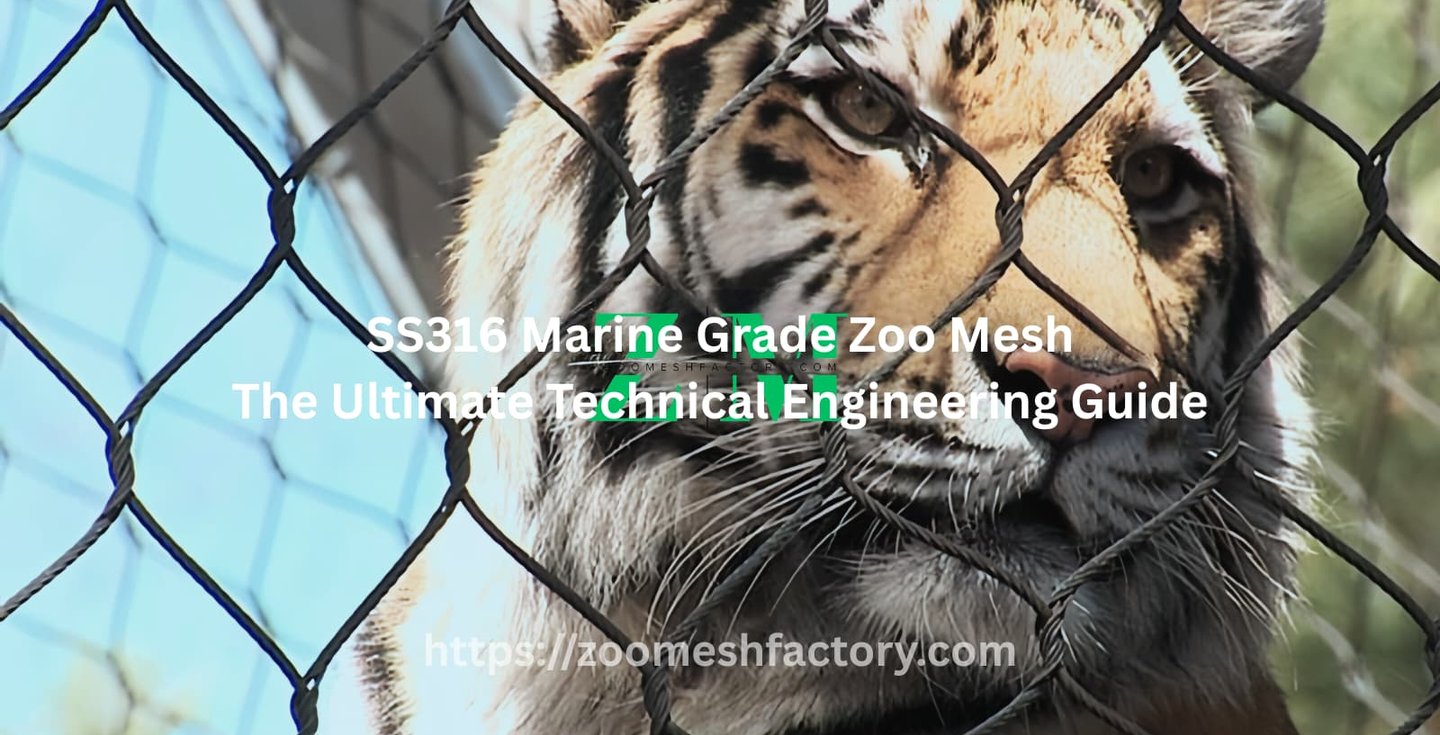
When a 500lb (225kg) Siberian tiger decides to lunge, it isn't just "pushing" on a fence; it is delivering a massive burst of kinetic energy. Understanding the physics of this impact is where many zoo contractors make a fatal, or at least expensive, mistake.
How Chain Link Fails: The "Point of No Return"
Chain link is often the "default" because it’s cheap and available. However, in a high-security tiger enclosure, it has two major physical flaws:
Mechanical Links: Chain link is made of individual wires hooked together. Under the localized pressure of a tiger’s paws or a full-body strike, these links can stretch and "unravel." Once the wire deforms, it stays deformed.
Weld and Tension Points: Because chain link is rigid, the energy of an impact is concentrated on the fence posts and the ties. This often leads to the wire snapping at the weld points or pulling away from the frame entirely. You aren't just looking at a safety risk; you're looking at a constant cycle of "patch-and-repair" maintenance.
How Cable Mesh Wins: The Interwoven Diamond Structure
Our handwoven stainless steel cable mesh operates on a completely different physical principle. Instead of resisting force with rigidity, it manages force through distribution.
The Spring Effect: Because the mesh is handwoven in a diamond pattern, an impact at one point is distributed across the entire panel. The mesh "gives" slightly, absorbing the kinetic energy like a high-tensile spring, and then snaps back to its original shape.
No Mechanical Joins: There are no "hooks" to unravel. Each cable is interwoven, meaning the only way for the fence to fail is for the actual stainless steel rope to snap—which, given our breaking loads, is nearly impossible for even the largest male tiger.
Expert Insight: When safety is the priority, don't look at the weight of the fence—look at the Breaking Load. Our 3.2mm cable mesh is designed to withstand the raw power of apex predators without the permanent deformation seen in traditional fencing.
Technical Resource: To ensure your habitat meets 2026 safety regulations, you can review our full technical specs for animal enclosure mesh, including wire diameters and certified breaking strengths.
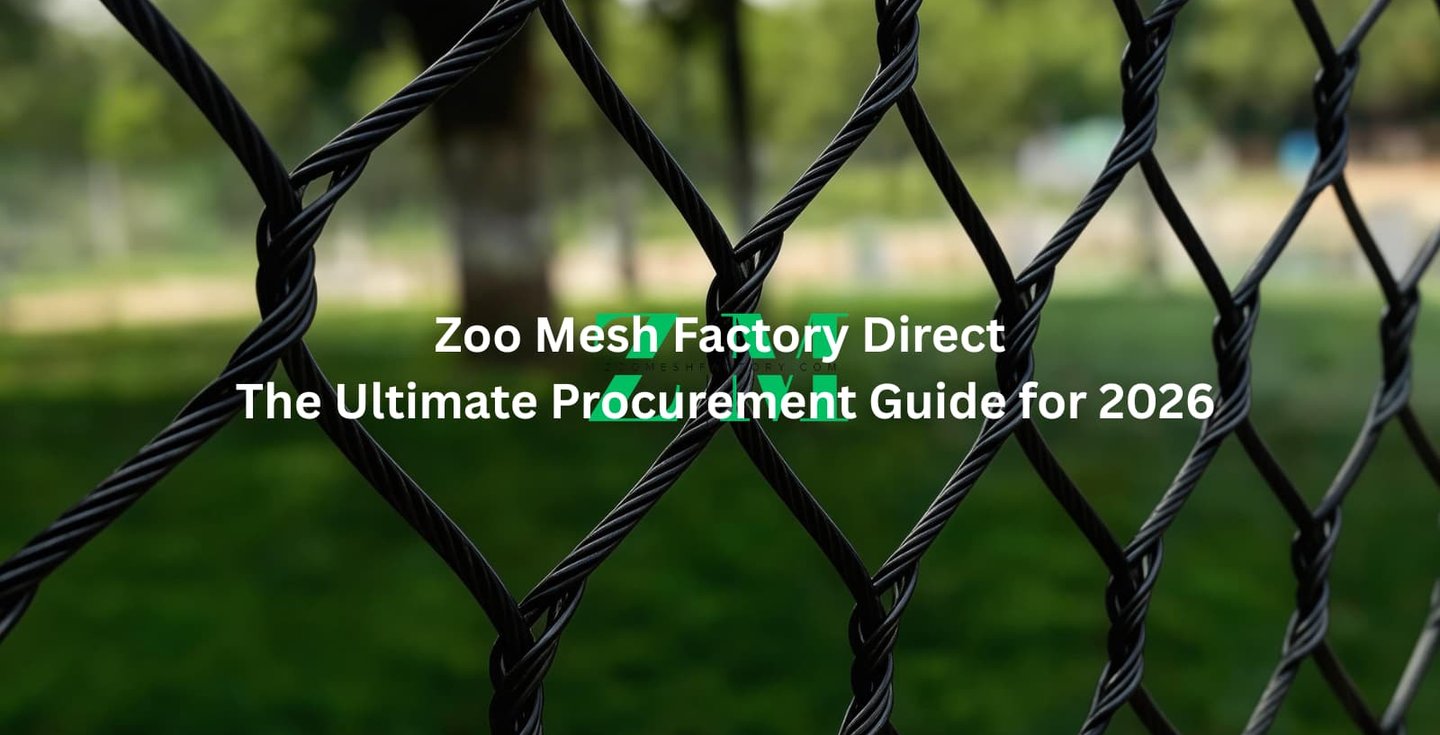
III. Visibility & Aesthetics: The "Invisible" Barrier
In the world of zoo design, the best fence is the one you can’t see. We call this "optical transparency," and it’s the secret sauce that separates a world-class exhibit from a backyard cage.
Why the Human Eye "Focuses Through" the Mesh
There is a fascinating piece of human biology at play here. When the human eye looks at an object in the distance, it naturally ignores thin, dark foreground obstructions. By using a wire diameter of 2.0mm to 3.2mm, our mesh occupies less than 10% of the total surface area of the barrier.
Because the handwoven diamonds are so precise and the cables so thin, the eye literally "focuses through" the mesh to the tiger or the foliage behind it. Unlike thick, silver-colored chain link that reflects light and creates a visual "wall," our stainless steel rope mesh allows the brain to process the habitat as an open space. This is the "Aha!" moment for visitors—when they feel like they are sharing the same air as the animal.
Black Oxide Finish: The Disappearing Act
While natural stainless steel looks sleek, the Black Oxide finish is the true game-changer for aesthetics. A silver fence reflects the sun, creating "glare" that draws attention back to the barrier.
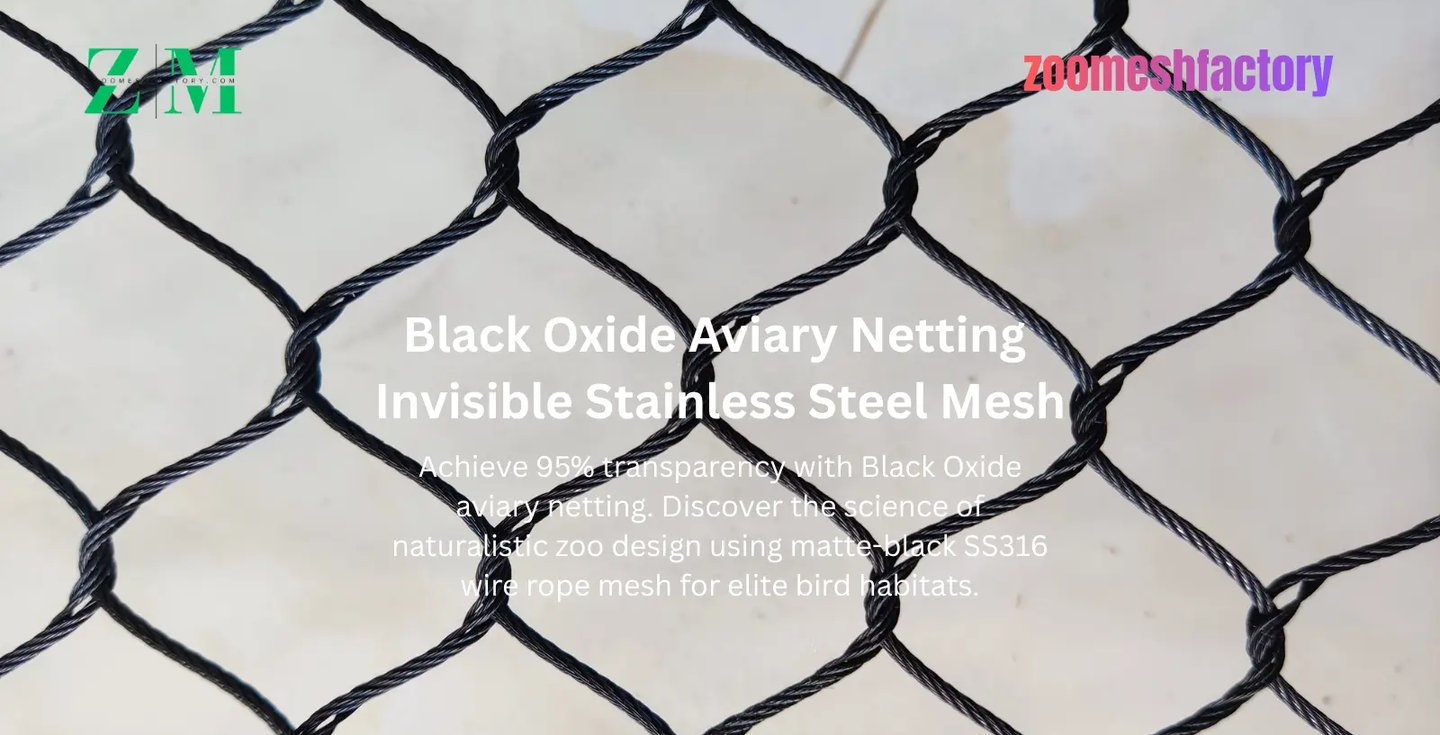
Absorbing Light: The black oxide treatment is a chemical conversion process that turns the surface of the steel a deep, matte black.
Shadow Integration: In a lush, green habitat, shadows are naturally black. A black mesh blends perfectly into these shadows, becoming virtually invisible against a background of trees, rocks, or soil.
If you want your enclosure to look like a National Geographic film set rather than a construction site, the black oxide cable mesh is the only way to go.
For ultra high-tensile mesh sized specifically for climbing leopards and jaguars, view our leopard enclosure spec guide.
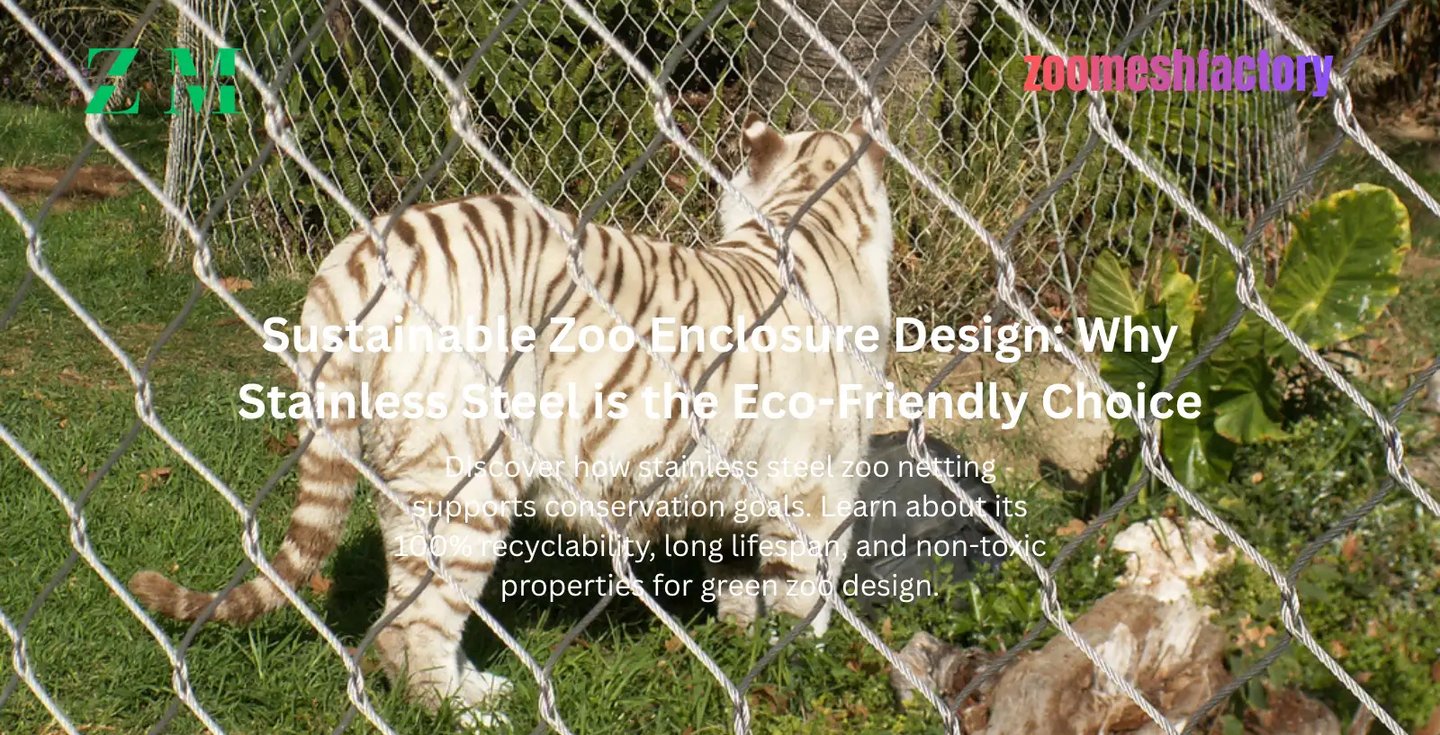
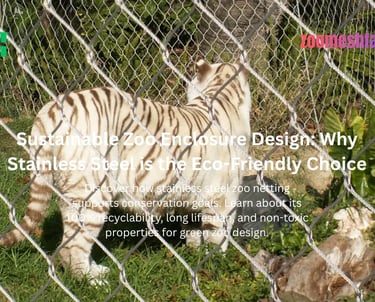
IV. Longevity & The "Real" Cost
Let's talk about money. Too often, zoo directors choose chain link because the "initial quote" is lower. But as anyone in the industry knows, the purchase price is only 20% of the total cost of ownership.
10-Year Cost Analysis: The Truth About "Cheap" Fencing
When you factor in labor for repairs, material replacement, and the "safety tax" of potential escapes, the numbers tell a different story.
Weather & Biological Resistance: The Corrosion Factor
Tigers are impressive, but their biology is surprisingly destructive to infrastructure. Tiger urine is highly acidic and concentrated. In a standard galvanized chain link fence, this leads to rapid "white rust" and structural pitting at the base of the enclosure—the very place where security is most critical.
Our stainless steel cable mesh—specifically in SS316 grade—is chemically inert to animal waste. It doesn't matter if you are in a high-humidity tropical zone or a coastal zoo with salt-heavy air; stainless steel won't lose its tensile strength. It doesn't peel, it doesn't flake, and it doesn't need to be repainted with toxic anti-rust coatings.
Expert Tip: If you are building in a humid region, don't just buy "stainless steel"—insist on SS316. It's the difference between a fence that lasts a decade and a fence that lasts a lifetime.
Explore More: For large-scale projects where visibility is even more critical, check out our aviary netting applications which use the same high-durability technology.
V. Installation and Customization: Eliminating the "Weak Link"
In the world of high-security containment, a fence is only as strong as its weakest seam. Traditional fencing often arrives in standard roll sizes, forcing installers to create multiple joins and overlaps on-site. Every time you join two panels of mesh, you create a potential point of failure.
Why Custom Factory Roll Sizes Matter
At Zoo Mesh Factory, we don’t believe in "one size fits all." Because we manufacture our handwoven mesh to order, we can produce massive, seamless panels tailored specifically to your enclosure’s dimensions.
Seamless Security: By reducing the number of joins, you minimize the "snag points" that tigers can exploit with their claws.
Labor Savings: Custom-sized rolls mean your installation team spends less time trimming and "patching" and more time securing the perimeter. Our mesh is flexible and lightweight, making it significantly easier to drape over complex, organic habitat shapes compared to rigid welded wire.
Structural Integrity: When a panel is a single, continuous weave from top to bottom, the tension is distributed perfectly across the entire surface, ensuring no sagging over time.
Expert Insight: For massive projects like walk-through bird sanctuaries or mixed-species habitats, the ability to customize roll height and length isn't just a luxury—it’s a safety requirement. You can see examples of this in our specialized large-scale aviary netting and our heavy-duty predator-proof options.
VI. 2026 Safety Standards: Why Spec Matters
As we move through 2026, international zoo associations (like AZA and EAZA) have become increasingly stringent regarding the physical properties of primary barriers. It’s no longer enough to have "a strong fence"; you must have a "documented safe barrier."
Meeting International Guidelines for Large Felids
Modern guidelines focus on dynamic containment. This means the fence must not only stop an animal from escaping but must also protect the animal from injuring itself during an attempted breach.
The "Soft" Catch: Handwoven cable mesh is now the preferred material because of its "elastic" properties. If a tiger lunges at the barrier, the mesh deflects slightly, absorbing the shock. This prevents the bone fractures or dental injuries often caused by rigid steel bars or heavy welded mesh.
Non-Toxic Materials: Our SS316 stainless steel is 100% lead-free and requires no chemical coatings, meeting the highest 2026 "Green Zoo" health standards.
Why 3.2mm (1/8") is the Tiger Industry Standard
If you ask any zoo safety engineer about tiger containment, one number keeps coming up: 3.2mm.
Tensile Strength: A 3.2mm stainless steel cable (7x19 construction) has a breaking strength that far exceeds the maximum impact force a male Siberian tiger can generate.
Paw Safety: When paired with a 2" to 3" mesh aperture, the 3.2mm wire is thick enough that it won't "cut" into the tiger’s pads if they lean or climb on it, yet thin enough to maintain that "invisible" look we discussed earlier.
Bite Resistance: Tigers have incredible jaw strength. 3.2mm wire is the threshold where the cable becomes too thick and structurally sound for a tiger to sever or significantly damage with a single bite.
Technical Selection: Choosing the right diameter is a balance of safety, cost, and visibility. To find the perfect fit for your specific species, feel free to browse all factory products for specific diameter options ranging from 1.2mm to 3.2mm.
For species-specific wire diameter and aperture specs built for elite climbing leopards, visit our leopard enclosure expert specification page.
Want to see how we apply these safety standards to large-scale flight habitats? Read our Guide to Professional Aviary Design
Understanding the metallurgical differences between stainless steel grades is essential for long-term durability; you can learn more about choosing the best solution for your facility in our expert zoo fencing article.
VII. Frequently Asked Questions (FAQ)
1. Is stainless steel cable mesh strong enough to contain an adult male Siberian tiger?
Absolutely. For adult tigers, we recommend our 3.2mm (1/8") diameter cable. This mesh is engineered with a 7x19 strand structure, providing a breaking load that exceeds 1,600 lbs. Because the handwoven diamond pattern distributes impact energy across the entire panel rather than a single point, it can easily withstand the full-force lunge of a 500lb apex predator.
2. How does the cost of zoo mesh from a factory compare to local suppliers?
By sourcing directly from Zoo Mesh Factory, you typically save 30% to 50% on material costs. Local suppliers often act as middlemen, adding significant markups for warehousing and branding. Buying factory-direct also allows for custom-sized rolls, which reduces expensive on-site material waste and labor time.
3. Will the mesh rust if the zoo is located in a coastal or humid tropical area?
For high-humidity or coastal environments, we strictly recommend Grade 316 Stainless Steel (SS316). This grade contains molybdenum, which protects the steel from chloride-induced pitting and "tea staining" caused by salt air. When you choose SS316, your animal enclosure will remain structurally sound and rust-free for over 30 years.
4. Can tigers climb the stainless steel cable mesh?
While tigers are capable climbers, the flexibility of the cable mesh makes it much more difficult for them to gain a solid foothold compared to rigid bars or chain link. To ensure 100% security, most modern products are installed with an inward-leaning "anti-climb" overhang at the top of the enclosure, which utilizes the same high-tensile mesh to prevent escapes.
5. Is the black oxide finish safe for the animals?
Yes. Our black oxide finish is a chemical conversion process, not a painted coating. This means it won't flake, peel, or chip off—even if an animal bites or scratches at the mesh. It is non-toxic and environmentally friendly, making it the safest choice for sensitive species in both predator habitats and large aviary netting installations.
Ready to Start Your Exhibit Design?
Join the hundreds of zoos and sanctuaries worldwide that trust ZooMesh Factory for their containment needs. Our engineers are ready to help you calculate the perfect mesh size for your species.
Contact
Hebei Zoo Mesh Co., Ltd
No. 188 Zhonghua South Street, Shijiazhuang City, Hebei Province, China
info@zoomeshfactory.com
© 2025. All rights reserved.
Quick Link
Product Catalogs
Don't leave without the specs! Save our factory-direct pricing and technical configurations for your next project meeting. Our 2026 Zoo Mesh Factory Direct Catalog is ready for download.